
The pattern has a rhythm by now. Something happens — a political event, a cultural flashpoint, a moment the community has decided requires response. The social media apparatus activates. Lists circulate of who said something, who stayed silent, who said the wrong thing, who said the right thing but not loudly enough. The artist is evaluated, adjudicated, and assigned a verdict. The cycle completes and begins again with the next event, the next silence, the next insufficient statement.
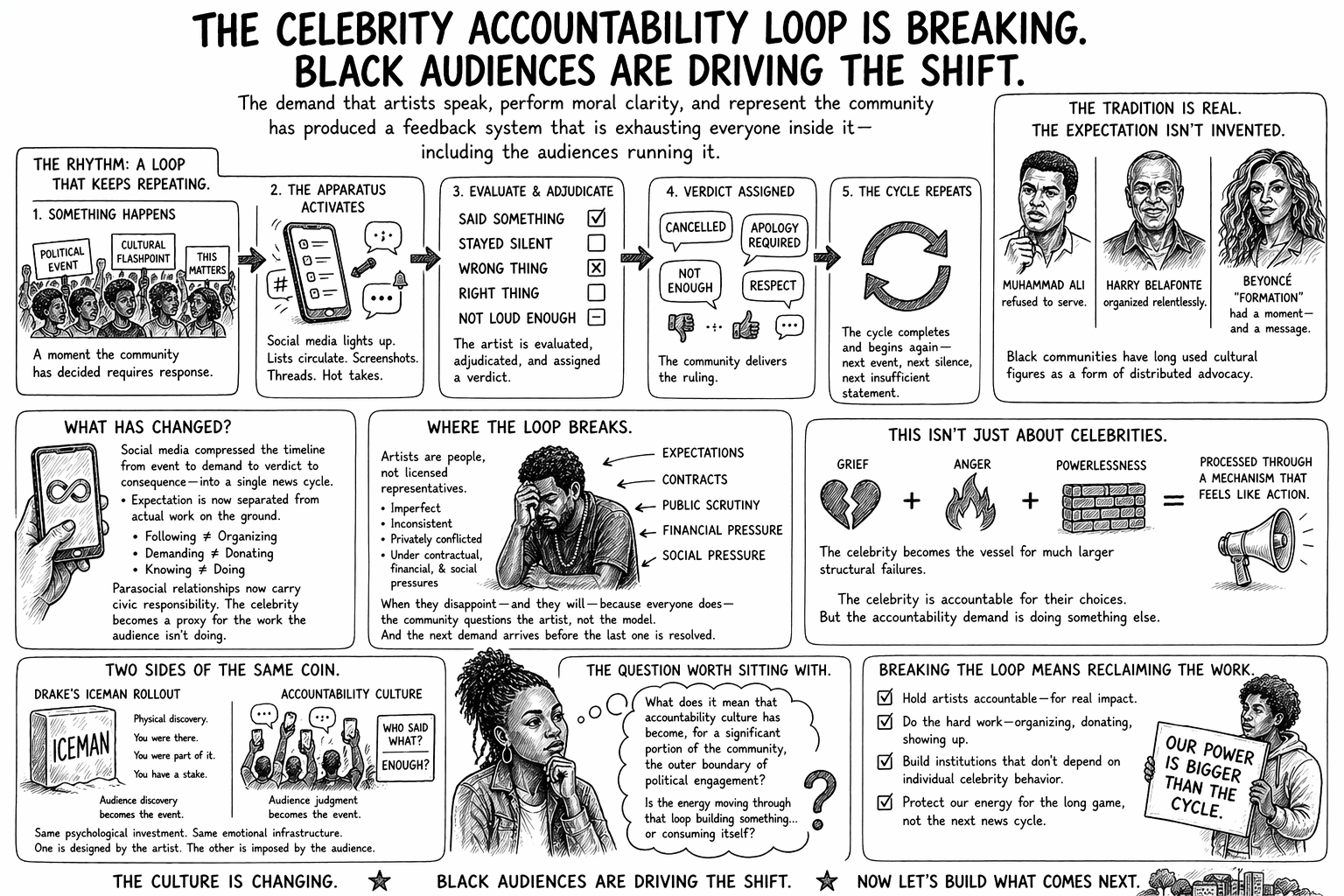
The demand underneath this rhythm is not irrational. Black communities have historically used cultural figures as a form of distributed advocacy — artists, athletes, and entertainers who carry visibility into spaces that institutional voices cannot reach. The tradition is real and has produced real outcomes. Muhammad Ali’s refusal to serve. Harry Belafonte’s sustained civil rights organizing. Beyoncé’s “Formation” arriving at a specific cultural moment with a specific political charge. The expectation that public figures with platforms use them is not invented.
What has changed is the infrastructure through which that expectation moves. Social media has compressed the timeline from event to demand to verdict to consequence into a single news cycle. It has also separated the expectation from any relationship to the actual work of organizing, donating, or showing up. Following the right accounts feels like political engagement. Demanding the right statement feels like holding power accountable. Knowing which celebrities have been correctly positioned on the current issue feels like being informed. The parasocial relationship has expanded to include civic responsibility — and when that substitution becomes the primary mode of political engagement, the celebrity is not just an artist anymore. They are a proxy for the work the audience is not doing.
This is where the loop breaks down. The demand that artists be moral spokespeople is structurally set up for failure because the artists are people, not licensed representatives. They are imperfect, inconsistent, privately conflicted, and operating under contractual, financial, and social pressures the audience rarely has full visibility into. When they disappoint — and they will, because everyone does — the community does not question the model. It questions the artist. And the next demand arrives before the previous one has been resolved.
SSC’s coverage of the Tamera Mowry-Housley Threads moment traced one version of this. A public figure appears in a space the community occupies, fails to meet an implicit expectation, and becomes the vessel for accumulated frustration that is really about much larger structural failures. The celebrity is accountable for their choices. The accountability demand is also doing something else — processing grief, anger, and political powerlessness through a mechanism that feels like action because it produces visible response.
The Drake ICEMAN rollout is relevant here from a different angle. The participatory structure of that rollout — audiences discovering the release date through physical engagement with an installation, turning discovery into event — generates the same psychological investment as accountability culture. You were there. You were part of it. You have a stake in what happens next. That feeling of stake is the emotional infrastructure underneath both phenomena. The difference is that one is designed by the artist and the other is imposed by the audience.
The question worth sitting with is not whether celebrities should be held accountable. They should, for their actual choices and actual impact. The question is what it means that accountability culture has become, for a significant portion of the community, the outer boundary of political engagement — and whether the energy moving through that loop is building something or consuming itself.
Culture in Motion | The Inner Work