
The story begins with a medical outcome that sounds extreme but is increasingly difficult to dismiss as isolated. A man preparing for a bodybuilding competition takes a high dose of Retatrutide, a next-generation GLP-1 compound, without clinical supervision and without a prescription. He purchased it through a growing network of online suppliers connected to overseas manufacturers. The result, according to reporting, was acute necrotizing pancreatitis — in plain terms, parts of his pancreas began to die. That outcome is not just about individual misuse. It is about the conditions that made the misuse possible, and those conditions are structural, not incidental.
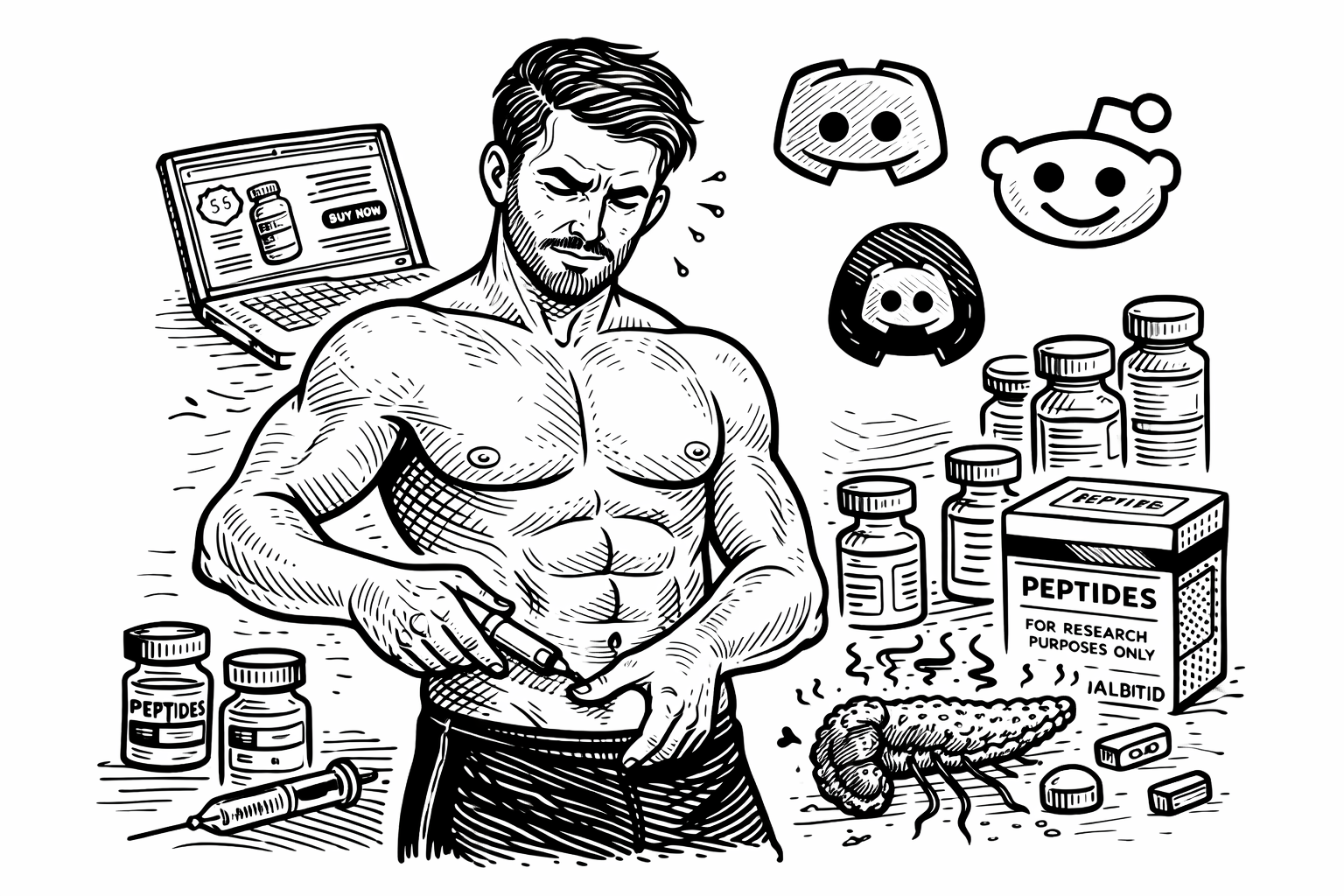
Peptides now exist in multiple parallel systems simultaneously. In one, they are tightly controlled, studied, and prescribed within formal healthcare environments. In another, they move through compounding pharmacies operating in regulatory gray zones. And in a third, increasingly visible system, they are purchased directly from overseas factories through Discord groups, Reddit forums, and storefront websites that label products “for research purposes only” while marketing them explicitly for human use. The same compound name can move across all three systems while meaning something fundamentally different in each — and the difference between those meanings is where risk concentrates most acutely.
Without regulatory oversight, there is no guarantee of dosage accuracy, purity, or consistency. A vial labeled as five milligrams may contain significantly more. With compounds that alter metabolic pathways, insulin signaling, and appetite regulation, that margin of error is not theoretical — it is physiological. The pancreas does not interpret intent. It responds to exposure. At the same time, demand is accelerating in ways that are outpacing any regulatory response. GLP-1 medications have reshaped public expectations around weight loss, longevity, and body optimization, and social media has amplified those outcomes consistently without context around dosing, supervision, or risk. What was once a clinical intervention has been reframed as a lifestyle tool, and the market has responded accordingly — expanding access faster than the infrastructure designed to make that access safe can adapt.
The geography of this problem matters less than its structure. The issue is not simply that peptides are being sourced from China. It is that global manufacturing capacity, digital distribution channels, and decentralized payment systems have combined to create a parallel pharmaceutical supply chain that operates entirely outside traditional safeguards. In that system, the distance between factory and consumer has effectively collapsed. A teenager in Houston and a competitive bodybuilder in Los Angeles and a 50-year-old biohacker in Miami are all one Reddit thread away from the same unverified compound at the same unverified dose. As SSC has reported in its broader peptide coverage recently, the populations least likely to have clinical guidance are also most likely to be sourcing from this system — meaning the risk is not distributed evenly across the market. It flows downward, toward the people with the least access to the oversight that would protect them.
Policy is now trying to respond to a market that already exists and is growing faster than regulatory frameworks can track. The FDA has moved to restrict certain peptides, citing safety risks, while political pressure — including from within the current administration — is pushing to loosen those restrictions in the name of access and innovation. The specific regulatory mechanism at the center of that debate — Kennedy’s push to allow compounding pharmacies to legally produce peptides the FDA restricted in 2023 — is examined in SSC’s reporting on the RFK Jr. peptide proposal, which tracks how the policy is being framed as a harm-reduction measure even as the evidence base for many of the compounds under discussion remains thin. What is being debated is not just regulation. It is the definition of what counts as medicine, who controls it, and how it reaches the body. The pancreatitis case is not the center of that debate. It is the signal — showing what happens when medical infrastructure is bypassed, when dosage becomes uncertain, and when biological systems are treated as endpoints of a supply chain rather than subjects of care. The body, in this emerging market, is no longer just being treated. It is being supplied. And supply, once established at scale, is very difficult to reverse.