
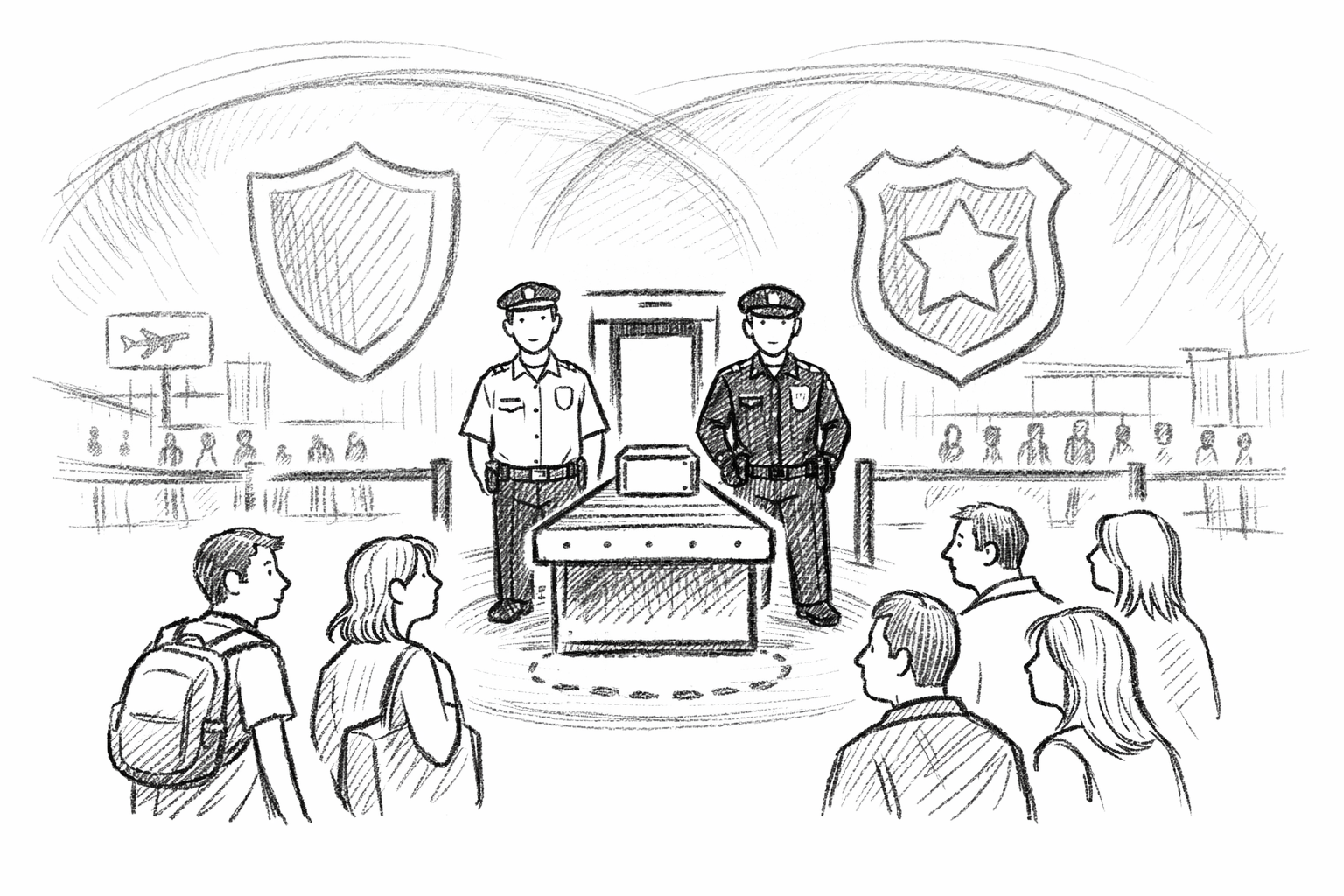
At most airports, security has long been understood as routine. Shoes off. Bags scanned. A process designed to feel standardized, even predictable. That assumption is now shifting in real time.
President Trump announced this weekend that Immigration and Customs Enforcement agents will begin assisting TSA at airports starting Monday—a response to a staffing crisis that has been building for months. Around 50,000 TSA officers have been working without pay since mid-February following a funding impasse within the Department of Homeland Security. Hundreds have quit. Absentee rates at major airports have reached between 30 and 39 percent in cities including New York, Houston, Atlanta, and New Orleans. In some cases, travelers have been advised to arrive as much as five hours before departure.
The decision to deploy ICE is being framed as operational—a stopgap to manage lines while the funding standoff continues. Border czar Tom Homan confirmed that ICE agents will assist at entrances and exits, freeing TSA officers to focus on screening, the specialized work ICE agents are not trained to perform. On paper, the roles remain distinct.
But the significance isn’t just operational—it’s structural.
The use of immigration enforcement agents in a transportation security environment reflects a broader convergence happening within federal systems. Agencies that once operated with clearer mandates are increasingly being deployed interchangeably—not by design, but by default. Homan also confirmed that ICE agents will continue conducting immigration enforcement operations while simultaneously aiding TSA, meaning they are not stepping out of one role and into another. They are doing both at once, in the same space.
Airports are one of the most routine, civilian-facing environments in the country. Introducing enforcement personnel into that space—even in a limited capacity—changes how that environment is experienced. What was once understood as a checkpoint becomes something more layered, where security and enforcement occupy the same physical and psychological space.
The economic dimension is impossible to separate from the decision. TSA officials have warned that attrition will continue to worsen unless normal operations resume, noting that a 25 percent spike in departures followed the previous shutdown. This is the third funding lapse in six months. TSA roles require four to six weeks of training, including time at a TSA Academy—which means the workforce gap does not close the moment a deal is reached. Recovery takes time.
That context raises a deeper question.
When a system designed for one function begins absorbing the responsibilities of another—not as policy, but as a response to constraint—does the arrangement remain temporary? Or does it establish a new baseline that becomes harder to reverse?
For travelers, the short-term impact may be neutral or even positive: more personnel, faster lines. But structurally, what is happening at airports this week is a pressure test. It reveals how quickly distinct institutional roles can blur when funding fails—and how easily a temporary fix can begin to feel permanent.
The boundaries between security, enforcement, and everyday public life are not shifting because someone decided they should. They are shifting because the system ran out of options.