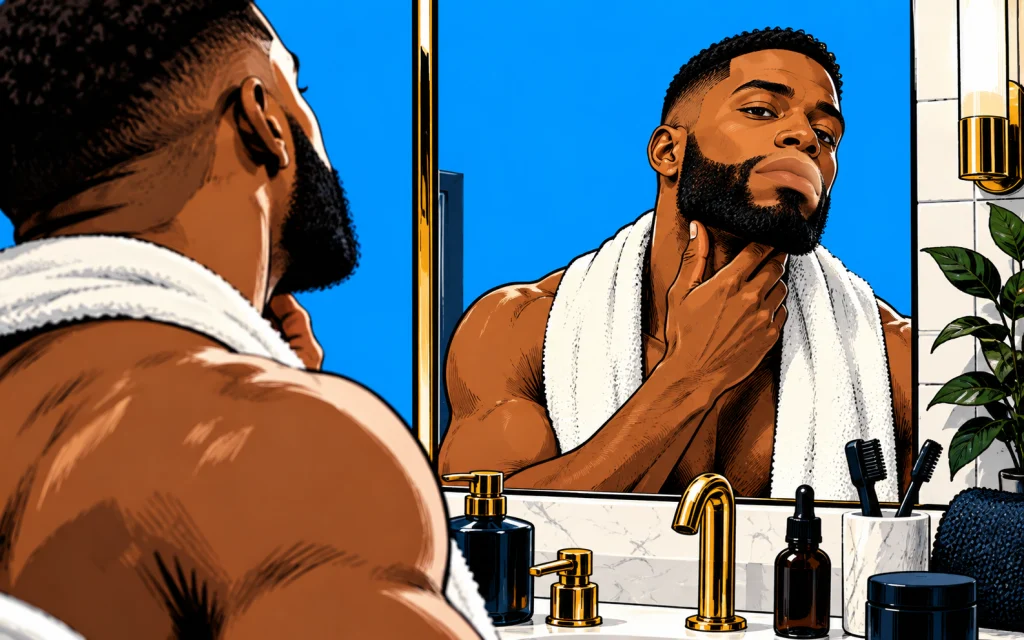
I wear a full beard, and I’ve always wondered why some men leave the mustache behind. The answer involves faith, history and a style choice I still haven’t learned to love.
I rock a full beard, so I pay attention to what other men do with theirs. I notice the shape, the fullness, the line along the cheek and whether the barber understood the assignment. But one choice has always stopped me: a full beard with no mustache. The cheeks are covered and the chin is committed, but the upper lip has apparently declined to participate. To my eye, it looks like an incomplete thought, something that started with a clear direction and stopped before finishing the sentence.
Personal style belongs to the individual. Nobody needs my permission to arrange the hair on his own face, and I’m sure someone has opinions about mine. I can respect that freedom and still admit that I have yet to see anyone in real life pull this particular look off. That’s my taste, not an objective ruling on attractiveness. Still, my curiosity is sincere. When a man has enough beard to frame his entire face, why deliberately remove the part that, to me, brings it all together?
The first thing to understand is that similar-looking beards can come from very different choices. One recognizable version is the chin curtain, which follows the jaw and covers the chin while leaving the upper lip bare. Abraham Lincoln helped make it famous, and the National Archives has written about the whiskers he grew on his way to the White House. So this is hardly a new experiment, since one of the most recognizable faces in American history wore it. Lincoln complicates my argument, although appearing on the five-dollar bill doesn’t automatically settle a grooming debate. Historical significance and personal preference can coexist without agreeing.
For some men, the choice begins with faith. Islamic tradition includes guidance to grow the beard and trim the mustache, and different interpretations shape how men follow it. Egypt’s Dar al-Ifta discusses those teachings and acknowledges scholarly disagreement over whether keeping a beard is obligatory or recommended. Trimming a mustache closely is also different from shaving it off entirely, and Muslim men don’t all wear one uniform style. But the religious context matters. While I’m looking at the relationship between a beard and an upper lip, the man wearing it may be following a practice whose meaning has nothing to do with my visual preferences.
Among Amish men, the combination carries another set of meanings. Elizabethtown College’s Amish Studies resource explains that married men are expected to grow beards without mustaches, a practice rooted in community rules that express shared identity. Amish Heritage author Anna, who grew up Amish, connects the avoidance of mustaches to their historical military associations and the Amish commitment to nonresistance, and notes that communities differ on when men begin growing their beards. A style that looks incomplete to me can communicate marriage, faith and belonging to someone who understands its context. That meaning was there long before I arrived with an opinion about the missing mustache.
Of course, not every beard comes with a religious explanation. A man may prefer the look, dislike the feel of hair above his mouth or decide his mustache adds little to the beard he wants. You can’t identify someone’s beliefs from a bare upper lip, and nobody owes strangers a detailed defense of a grooming decision. My own reaction probably comes partly from what I expect a full beard to look like. I see the mustache as the piece that connects the frame, so when it’s gone, my eye goes straight to the space it left behind. Someone else might see that same space as clean, deliberate and exactly right.
Learning the history gives me a better answer to why the look exists, but it hasn’t persuaded me to try it. I still prefer a full beard with the mustache included, and I still haven’t met the man who makes me reconsider. Understanding a choice doesn’t require adopting it or finding it attractive. Sometimes it simply means recognizing that what looks unfinished to you is exactly what someone else intended. He’s entitled to his bare upper lip, and I’m entitled to remain unconvinced.