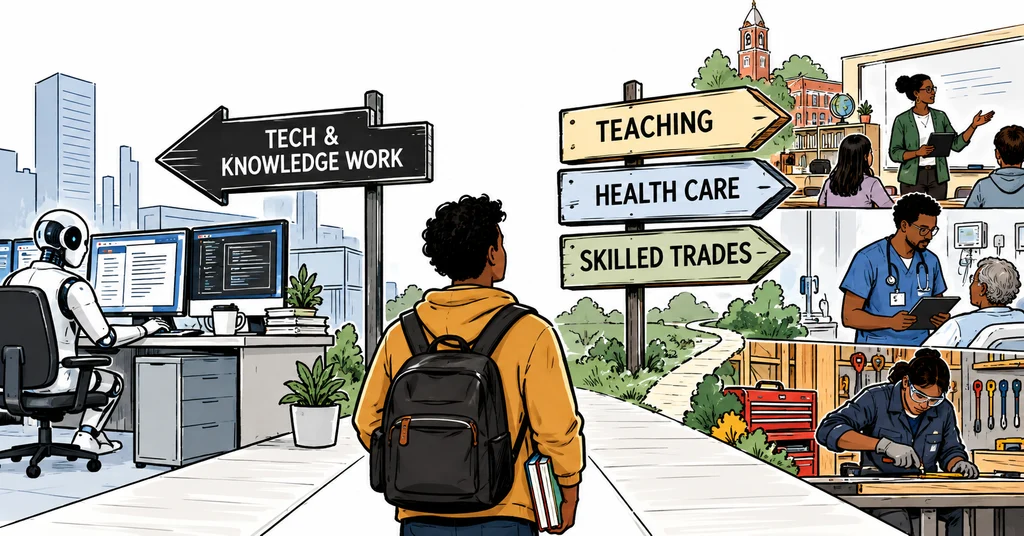
After years of steering students toward coding and other knowledge work, anxiety about automation is pushing some workers toward teaching, health care and skilled trades. The career calculation is changing from what pays well to what still requires a person.
For years, the safest career advice seemed to point in one direction: learn technical skills, earn a degree and move into the knowledge economy. Artificial intelligence is beginning to complicate that calculation. The Washington Post reports that some younger workers and recent graduates are returning to school or retraining for careers in teaching, health care and skilled trades because they believe those jobs will be harder to automate. At the same time, computer-science enrollment is showing signs of weakening while interest in teacher preparation and apprenticeships is increasing.
The shift does not mean AI has already eliminated white-collar work on a massive scale. In fact, the evidence is more complicated. A recent UCLA study found no statistically significant increase in unemployment specifically among recent graduates pursuing AI-exposed occupations, even as the overall unemployment rate for 22- to 25-year-old college graduates reached 7.3% during June through August. What appears to be changing first may be expectations: workers are making career decisions based not only on the jobs available today, but on which jobs they believe will still need them five or ten years from now.
The Entry-Level Problem Is Showing Up First
There is evidence behind that concern. Researchers at the Stanford Digital Economy Lab analyzed payroll data covering millions of U.S. workers and found no widespread, economy-wide employment displacement associated with AI. But among workers ages 22 to 25 in highly AI-exposed occupations, employment stood about 19% below where it would have been if it had kept pace with employment among similarly aged workers in less-exposed occupations as of June. The researchers found that the divergence appears to be driven primarily by reduced hiring rather than companies suddenly firing large numbers of younger workers.
That distinction changes the career problem. A worker does not have to lose a job to be affected by automation. The position that once provided an entry point may simply stop being created. Junior coding, administrative, customer-service and analytical work are precisely the kinds of tasks generative AI can increasingly perform or accelerate. Experienced employees may retain an advantage because their jobs include judgment, institutional knowledge and responsibility that extend beyond producing the initial work.
The response is beginning to reshape what counts as a technologically resilient career. The Washington Post profiles workers moving from marketing toward teaching and from software development toward automotive technology. Trade schools are marketing programs around work that still requires someone to enter a building, diagnose a physical problem, operate equipment or interact directly with another person. Schools are also changing curricula so students learn how to work with AI rather than compete against it.
The Safe Job Is Being Redefined
There is an irony in where that leaves the labor market. For decades, many young people were encouraged to leave manual and service work behind for careers built around computers. Now some of the characteristics that once made those occupations appear less desirable—their physicality, location dependence and reliance on direct human interaction—can also make them harder to automate.
None of that makes teaching, nursing, electrical work or automotive repair “AI-proof.” Technology can change how those jobs are performed, and workers in them face their own problems involving pay, working conditions and labor shortages. But the calculation around career security is becoming more complicated than white collar versus blue collar or college degree versus trade school.
AI does not have to eliminate millions of jobs at once to reshape the workforce. It can change which entry-level positions companies create, which degrees students pursue and which skills workers decide are worth learning. The first major labor-market effect of AI may not be a wave of people losing their jobs. It may be a generation choosing different ones before the old jobs disappear.