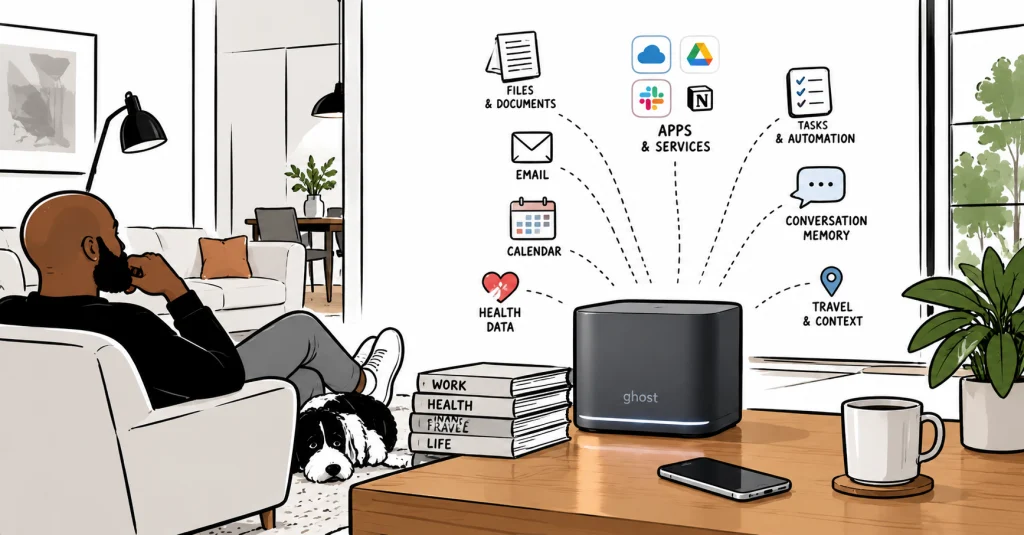
The $3,499 Core computer is designed to remember your life, connect to your apps and let AI agents act continuously on your behalf. Its bigger bet is that the next fight in personal AI will be over where your intelligence—and your data—actually lives.
For most people, using artificial intelligence still means opening an app, typing a request and waiting for a response from computers somewhere else. Ghost wants to put that relationship inside your house. The startup emerged from stealth Monday with $11 million in seed funding led by Andreessen Horowitz and introduced Core, a $3,499 screenless computer built specifically to run personal AI agents. Instead of waiting for individual prompts, Core is designed to connect information from a user’s files, apps and devices, build memory over time and continuously perform tasks on the owner’s behalf. Preorders opened October 5, with the first units expected to ship during the final week of October.
The Computer Is Becoming the Assistant
Core is not being pitched as another desktop computer with an AI feature attached. Ghost is effectively arguing that personal AI needs its own computing architecture. The device includes an Nvidia RTX Pro 4000 SFF Blackwell GPU, its own software layer, browser and file system, and several AI models installed locally. Users can also install compatible models from repositories such as Hugging Face. There is no monitor attached to the box; people interact with Core through an app or phone.
The difference becomes clearer when considering what Ghost wants the machine to know. Founder and CEO Zain Javaid described a system capable of combining information that normally lives in separate places. In one example, Core could notice an elevated resting heart rate, recognize from computer activity that someone had been working late and use seasonal context to suggest that the person might be getting sick. The ambition is therefore larger than answering questions. The machine is supposed to develop enough context about a person’s life to decide when it should act or speak up.
That idea is spreading across the technology industry. Google introduced Gemini Spark this year as a continuously operating personal assistant with access to services including Gmail, while Meta’s Muse can interact with files, messages, calendars, notes and mail on a Mac. The industry is steadily moving from AI that responds when summoned toward agents that remain available in the background and act across multiple parts of someone’s digital life.
Where the AI Lives Is Becoming Part of the Product
Ghost’s differentiator is its answer to an increasingly important question: Where should all of that personal context live?
The company says Core’s conversational AI and memory run on the hardware itself. Its privacy policy says conversations, files, connected-app content and memories can be processed and stored on-device, while Ghost says the machine is designed so its core functionality can continue even if the company disappears. That is a materially different proposition from making a cloud service the permanent repository for an assistant’s understanding of someone’s life.
There is a reason that distinction is arriving now. Just three days before Ghost’s announcement, Apple said it would introduce additional macOS controls around Full Disk Access because increasingly autonomous AI agents can potentially reach files, email, messages and browsing history. Apple warned that the risks associated with granting agents that level of access will increase as the technology becomes more capable.
Local processing does not eliminate every privacy problem. An AI agent may still communicate with external applications, websites and services when completing tasks, potentially sending information beyond the machine. Security researchers have specifically warned that even locally running agents can expose sensitive context through the external tools they call.
$3,499 Is Also a Test of What Personal AI Is Worth
Core’s price makes this an early-adopter product rather than an obvious mass-market computer. A consumer has to believe that an always-available personal agent provides enough value to justify spending $3,499 on dedicated hardware when general-purpose computers can already run some AI models locally and cloud assistants require no separate machine. Ghost is betting that convenience, persistent memory, autonomy and ownership will eventually make the dedicated device worthwhile.
The more interesting question may not be whether Core itself becomes the computer sitting in millions of homes. Ghost is testing a broader proposition about what happens after AI stops being something people visit and becomes something that continuously accompanies them.
For years, the technology industry’s personal-computing competition centered on the operating system, the browser and eventually the smartphone. Personal AI introduces another layer: the machine that knows enough about you to act for you. If that becomes normal, consumers may start asking a different question before choosing an assistant—not simply what it can do, but where everything it learns about them goes.