
Culture in Motion — examining how culture is created, distributed, and who ultimately benefits from it
Seven years after the death of Nipsey Hussle, I didn’t go looking for his music. That’s the point. I didn’t have to. There was a time when it would find me—through playlists, recommendations, the quiet rotation of songs that stayed close to the surface of the culture. But that doesn’t happen the same way anymore. Not because the music changed. Because the system did.
I still remember when I first heard Victory Lap. It was February 2018, and I know that because I had that album on rotation during a breakup that forced me to slow down and sit with everything I was feeling. What started as listening turned into something deeper. I went back through Nipsey’s catalog, his interviews, his thinking. It wasn’t just music—it was ideology. Discipline. Ownership. Vision. And then, just over a year later, the news broke that he was gone. Taken in a way that didn’t match the trajectory he was on. It felt abrupt, unfinished. What he left behind was a gift. What we didn’t get to see still lingers as a question.
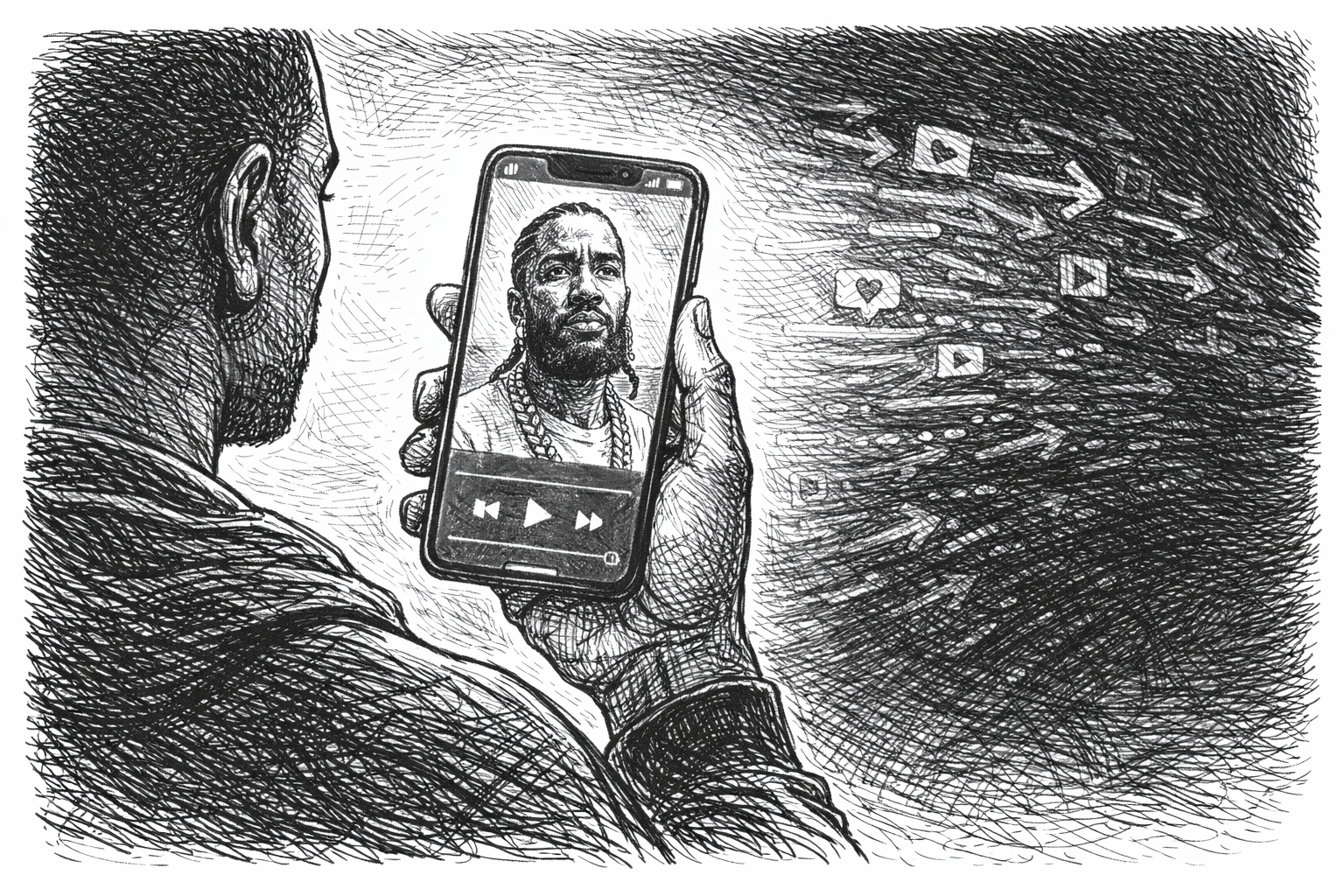
Streaming platforms are often described as libraries, but they don’t behave like them. Libraries preserve. Platforms prioritize. What gets surfaced is not what matters most, but what performs best in the moment. That distinction is easy to miss until you notice the absence—not disappearance, but distance. The catalog is still there. It just isn’t being brought forward.
That’s where infrastructure becomes personal. The way we experience music now is shaped less by what exists and more by what is placed in front of us. Recommendation systems decide the entry point. They decide what feels current, what feels relevant, what feels close. And when an artist is no longer producing new work, that system has less reason to keep them in rotation. Not out of neglect. Out of design.
For artists like Nipsey, whose work carried both cultural weight and community context, that shift matters. His life was short, but it was intentional. Focused. Lived with a clarity that made his message resonate beyond music. He was a man operating with a level of awareness that felt ahead of his time. His legacy reflects that. Not just in what he created, but in how he moved. I don’t mean to “glaze,” as the younger generation might say, but giving him his flowers is about recognizing what was built—and what was lost.
This is what happens when the platform becomes the primary gatekeeper of memory. The system doesn’t erase. It deprioritizes. And over time, deprioritization functions the same way. The artist becomes something you have to search for, rather than something you encounter. That shift changes how legacy is experienced, especially for listeners who weren’t there when it was being formed.
I’ve been thinking about this in the same way we think about infrastructure everywhere else. Roads don’t decide where you go, but they shape what’s accessible. Platforms work the same way. They don’t remove the catalog. They change the path to it. And when that path becomes less visible, fewer people take it.
Why This Matters
Legacy used to be sustained by presence. Now it’s mediated by systems. And when those systems are optimized for what’s next, what’s current, what’s constantly updating, the past requires intention to reach. Nipsey Hussle’s music didn’t lose its relevance. The system just stopped bringing it forward. And in a culture increasingly shaped by algorithms, that difference determines what gets remembered—and what simply remains available.