
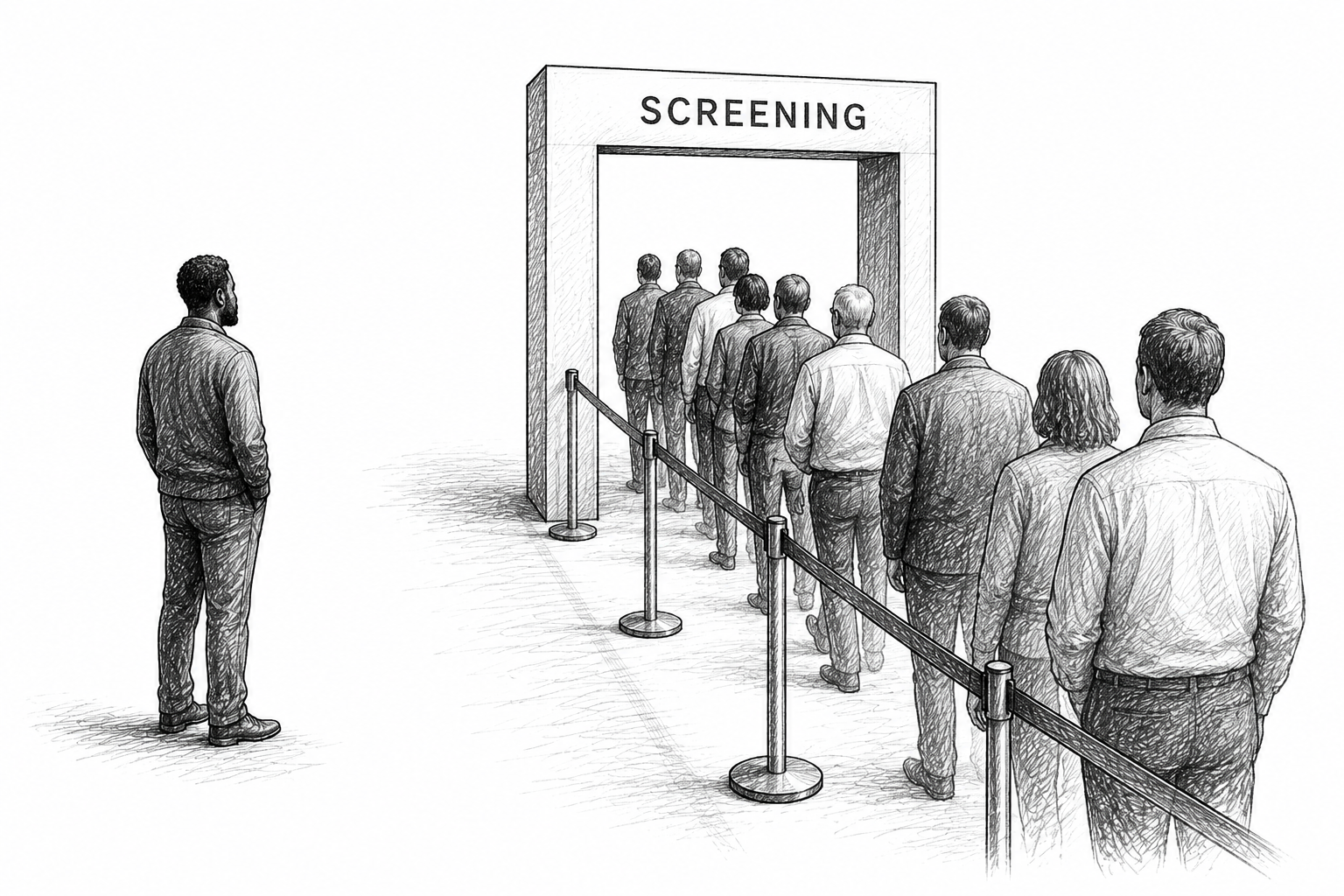
The United Kingdom’s National Screening Committee made a decision last week that drew immediate criticism: it recommended against population-wide prostate cancer screening using the PSA blood test, concluding the test was “likely to cause more harm than good.” The Health Secretary accepted the recommendation — and simultaneously announced £20 million in additional funding to expand the Transform trial, a screening initiative that will now specifically include more Black men between the ages of 45 and 74.
The expansion is being called a historic moment. It is also an acknowledgment of a failure that has been documented for years. Black men are twice as likely to develop prostate cancer and twice as likely to die from it. That disparity is not new information. It has not been new information for a long time. The screening system that the UK — and the United States — built around prostate cancer was not designed with that reality at its center. The decision to now specifically fund research into what works best for the population most at risk is not a breakthrough. It is a correction.
The numbers make the stakes concrete. Of 100 men with a BRCA2 genetic variant, between 21 and 35 will develop prostate cancer before the age of 80. The new UK guidance targets men with that specific mutation for testing every two years between the ages of 45 and 61, provided they have a family history of breast, ovarian, pancreatic, or prostate cancers. Black men living in the UK aged 45 to 74 will be eligible for the expanded Transform trial regardless of genetic mutation status, as long as they have not had a PSA test or MRI scan in the last five years. The programme is expected to roll out in 2027.
Critics were not satisfied. Nick Jones, founder of Soho House and a prostate cancer survivor, said the government accepted a recommendation that “entrenches” existing injustices rather than addressing them. “Campaigners and community representatives have been trying to engage with the UKNSC for months and have been dismissed,” he said. “To rubber-stamp this recommendation into Government policy is not caution — it is a dereliction of duty that will cost lives.” The UK’s Deputy Prime Minister David Lammy, who has two brothers living with prostate cancer, framed the funding announcement in personal terms — describing the disease’s toll firsthand and calling the expanded trial a step toward closing what he called deadly inequalities.
The access gap is only part of the story. There is a second layer — one SSC has been tracking — that sits underneath the screening question and shapes whether Black men engage with the healthcare system at all. SSC reported in April on Stanford psychiatry research that named racialized masculinity as a structural health condition: the compounding cultural expectation that positions Black men as inherently resilient, unbreakable, and beyond the need for care. That expectation does not simply discourage therapy. It discourages the recognition that something is wrong in the first place. It codes help-seeking as incompatible with being a Black man — and it shapes the calculus of whether a man schedules a screening, mentions a symptom, or tells anyone he is worried. Performing strength is killing Black men — and a prostate cancer screening trial, however well-funded, cannot fully reach a population that has been culturally conditioned to manage their health in silence.
The silence problem is not unique to prostate cancer. SSC covered it in May when the Testicular Cancer Foundationreached 71 million people with a campaign called If These Balls Could Talk — a title engineered to cut through the exact discomfort that keeps young men from checking, from asking, and from catching something early enough to make catching it matter. Testicular cancer is 99 percent beatable when caught at stage one. Prostate cancer, when caught early, carries similarly strong survival odds. The medical case for early detection is not complicated. The cultural and structural barriers to it are. What connects the testicular cancer awareness gap, the racialized masculinity research, and the UK prostate cancer screening debate is the same thing: the men most at risk are the ones the system was least designed to reach — and the ones most conditioned to manage what they find in silence rather than in a doctor’s office.
The US context is not separate from this story. American medical guidelines on prostate cancer screening have undergone their own contested history — the US Preventive Services Task Force previously recommended against routine PSA screening for all men, a position that drew criticism from urologists and patient advocates who argued the blanket guidance failed to account for the elevated risk profile of Black men. The task force has since updated its guidance to acknowledge that Black men and men with a family history of prostate cancer may benefit from earlier and more frequent screening — but implementation remains inconsistent, and the awareness gap in Black communities about both the elevated risk and the screening options available remains significant.
Prostate Cancer UK chief executive Laura Kerby called the funding announcement a “truly historic moment” — and noted that the progress is only possible because of the commitment and leadership of Black communities across the country who refused to let the evidence gap become an excuse for inaction. That framing matters. The research being funded now exists because communities pushed for it. The disparity being studied now has been documented for decades. The question the expanded trial is trying to answer — what screening approach works best for the men most at risk — should have been the organizing question from the beginning.
It was not. That is the structural argument. And the men who developed and died from prostate cancer in the interval between when that question should have been asked and when it finally got funded are the cost of building a screening system around an assumed patient who did not reflect the population carrying the highest risk.