
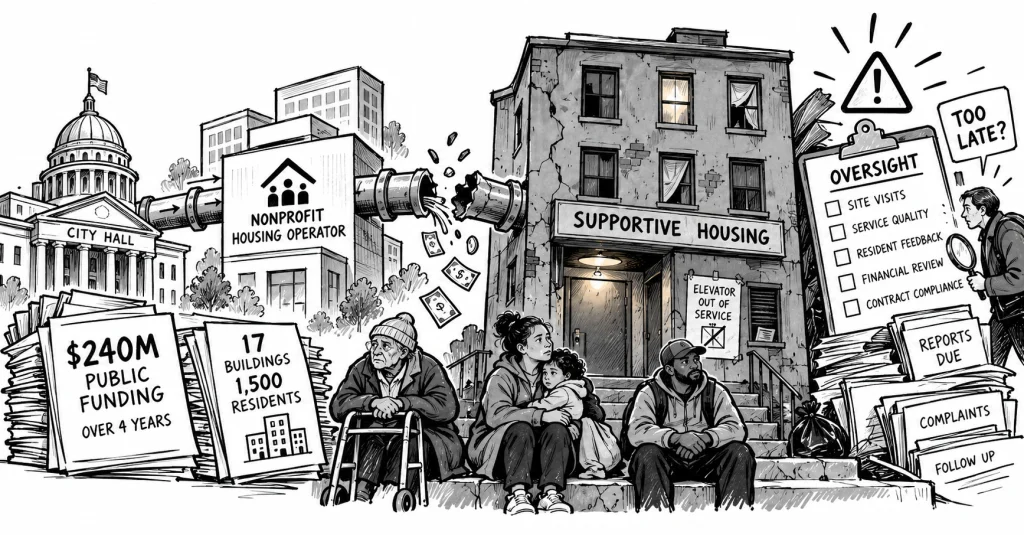
HomeRise once stood as a model of supportive housing. After receiving about $240 million in public money over four years, the nonprofit is shutting down amid investigations into financial dysfunction, neglect and resident deaths.
One of San Francisco’s largest supportive-housing nonprofits is winding down after years of problems that raise a broader question about how cities govern services they pay outside organizations to provide. HomeRise operates 17 housing complexes serving more than 1,500 residents, many of them formerly homeless. Over four years, the organization received roughly $240 million in public funding.
Now it is shutting down over a period expected to take one to two years. Investigations by the San Francisco Chronicle and UC Berkeley uncovered financial dysfunction, allegations of employee misconduct and failures in buildings housing some of the city’s most vulnerable residents. The city subsequently moved to terminate important contracts, further destabilizing the nonprofit’s finances.
Government Paid for the Service. Residents Experienced the Result.
Supportive housing operates on a model that combines affordable housing with services intended to help residents remain stably housed. For cities confronting chronic homelessness, nonprofits often perform the work because they have specialized staff, community relationships and experience serving populations with complex needs.
But outsourcing service delivery does not eliminate government’s responsibility for the outcome. It creates another layer between public money and the person receiving the service.
When that system functions, the arrangement can combine public funding with nonprofit expertise. When it fails, accountability becomes less straightforward. The organization may own or operate buildings. The city may hold multiple contracts with it. Different departments may oversee separate pieces of the relationship. Residents do not experience those administrative divisions. They experience whether the elevator works, whether staff respond, whether the building is safe and whether someone notices when a person is in crisis.
The Contract Is Not the Outcome
San Francisco is now moving toward more performance-based approaches to homelessness contracts, an effort to connect public spending more directly to measurable results. HomeRise demonstrates why that shift is attracting attention. The important number is not simply how many dollars entered a nonprofit. It is what those dollars produced for the people living inside the system.
The closure creates another problem: the city cannot simply walk away. HomeRise owns most of its properties, and roughly 1,500 residents still need housing and services regardless of what happens to the organization managing them. The city must now help transfer operations without destabilizing the people the contracts were supposed to protect.
That is the hidden cost when outsourced public systems break down. Government may delegate operations, staffing and property management. It cannot delegate the final obligation.
For residents, the distinction between a municipal agency and a city-funded nonprofit is mostly bureaucratic. The public paid for housing services either way. When those services failed, the consequences remained public too.