
Princeton’s faculty voted Monday to require proctoring for all in-person examinations beginning July 1, ending an honor system that has been in place since 1893. The vote passed with a single dissenting vote out of the full faculty. The policy preserves the student-run Honor Committee and does not change the Honor Code itself — but it fundamentally alters the condition under which that code has always operated. For 133 years, Princeton’s academic integrity system ran on peer accountability. Students pledged not only to refrain from dishonesty but to report those they witnessed in violation. That compact is now over.
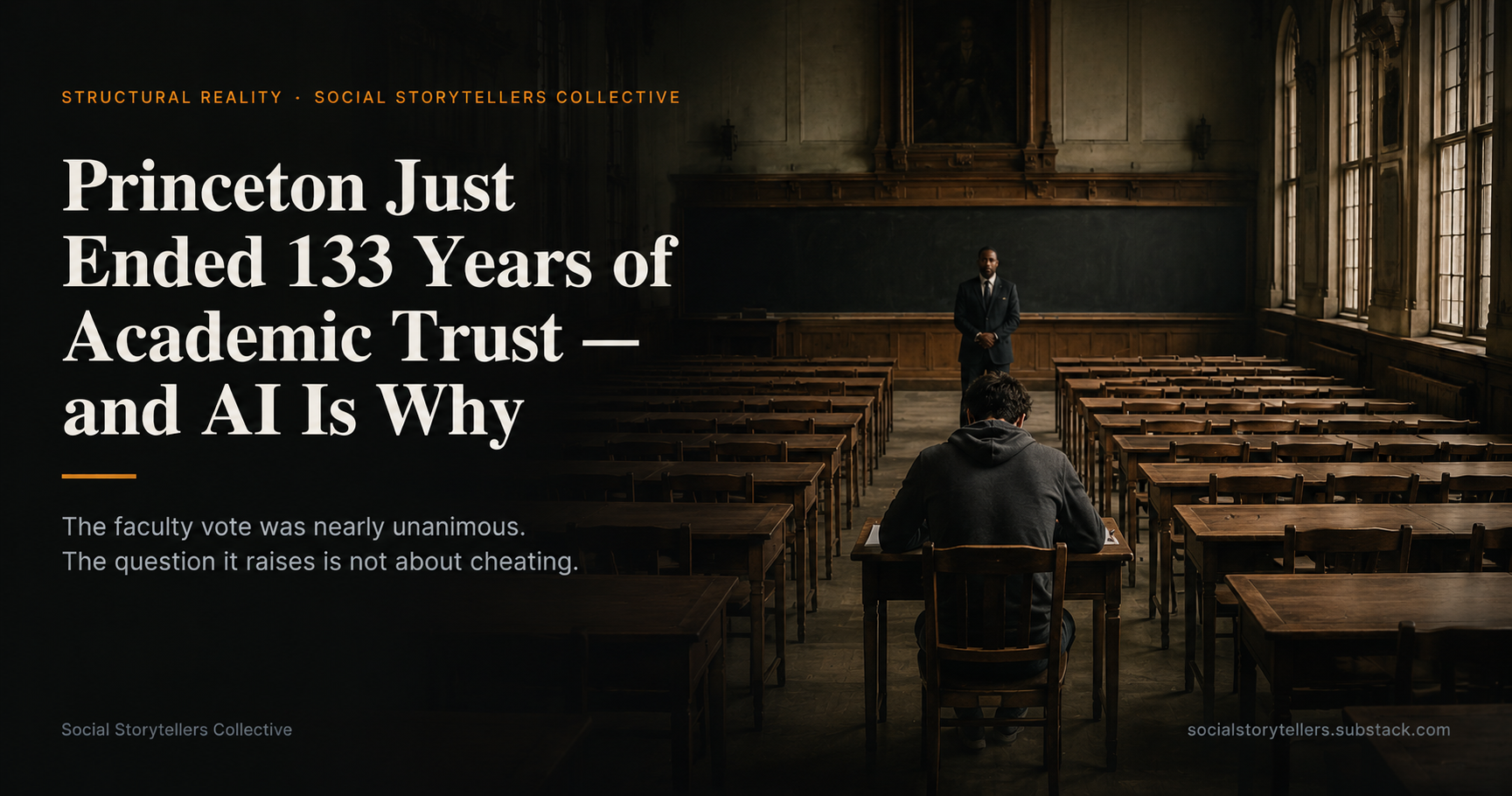
The administration’s own policy proposal names the reason directly: AI. Personal devices have made misconduct during examinations harder for other students to observe, and therefore harder to report. A student using an AI tool on a phone looks, from the outside, like a student checking the time. The behavioral signal that peer reporting depended on has been effectively erased. The Honor Committee has seen an uptick in cases over the past year. Anonymous reporting has increased as students cite fears of online shaming and retaliation for reporting peers. A 2025 senior survey found that nearly 30% of seniors reported cheating on an assignment or exam during their time at Princeton, while 44.6% knew of violations they did not report. Only 0.4% had ever reported a peer.
The new policy requires instructors to serve as witnesses in exam rooms — present, observing, but instructed not to interfere. If a suspected violation occurs, the proctor documents their observations and submits a report to the Honor Committee, where they may later testify. The student-run adjudication process remains intact. What changes is the evidentiary foundation it operates on.
The structural argument here is not about individual dishonesty or whether Princeton students are cheating more than they used to. It is about what happens when a system designed around a specific set of behavioral assumptions meets a technology that quietly invalidates those assumptions. Princeton did not abandon its values on Monday. It acknowledged that the conditions required to uphold them had already changed — and that the institution had been operating on a compact that no longer reflected the reality of its own classrooms.
Professor of English Jill Dolan, who served as dean of the college from 2015 to 2024, said it plainly after the vote: “I think it’s a shame, but it’s necessary.”
That sentence is worth sitting with. The shame is real — 133 years of student-faculty trust reduced to a policy adjustment in a single meeting. So is the necessity. The question SSC keeps returning to is not whether the decision was right. It is what it reveals about the broader pattern: that institutions built on behavioral norms are discovering, one by one, that AI does not break the rules. It makes the rules unenforceable. And when that happens, the institution has to choose between the form of the system and its function. Princeton chose function. The cost of that choice is the trust the form was built on.