
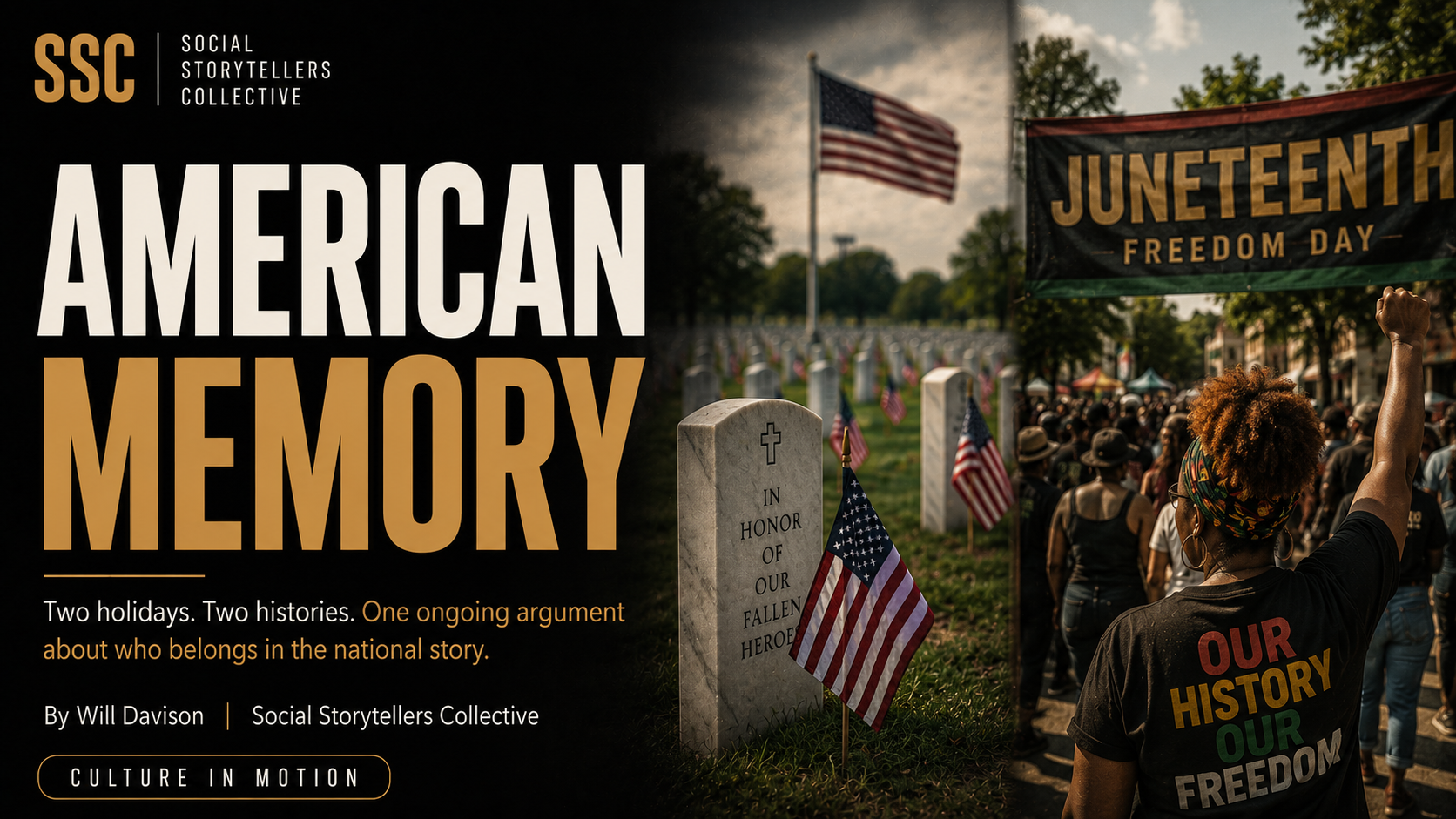
Each year, Memorial Day arrives with a familiar rhythm. Flags appear in cemeteries, elected officials deliver speeches, and communities gather to honor the service members who died in uniform. A few weeks later, Juneteenth invites Americans to sit with a different history — the delayed enforcement of emancipation in Texas on June 19, 1865, more than two years after the Emancipation Proclamation, and the long unfinished work of freedom that followed. Both holidays are rooted in remembrance. They do not occupy the same country.
The contrast is not accidental. Memorial Day has had more than a century of institutional reinforcement behind it — schools, government ceremonies, veterans’ organizations, commercial culture, and civic tradition all pulling in the same direction. Juneteenth remained largely regional for most of its history, celebrated primarily by Black communities who understood its significance without being told to, before becoming a federal holiday in 2021. The gap between them is not simply a matter of age. It reflects which stories receive sustained investment, which ones get built into the architecture of public life, and which ones must keep making the case for their own existence.
National memory is not a neutral record. It is a set of choices — about which events get commemorated, which figures get monuments, which narratives get written into school curricula and repeated on the floor of Congress. Those choices compound over time. The infrastructure of memory — holidays, textbooks, museums, public art, government ceremonies — shapes how future generations understand who belongs in the story of the country and who is standing at its edges. Once that infrastructure is built, it does not stay in the past. It operates in the present every time a child learns what is worth knowing.
This is why debates over history education, public monuments, and cultural representation are never really about the past. They are arguments about the present — about whose experiences are treated as central to the national narrative and whose are framed as supplementary, specialized, or divisive. The discomfort those arguments produce is not evidence that they are the wrong arguments. It is evidence of how much the existing infrastructure has already shaped what people consider normal.
Juneteenth’s elevation to federal holiday status did not create new history. It moved existing history — history that Black communities had preserved and transmitted for generations without institutional support — into institutional visibility. That shift reflects real demographic, cultural, and political changes in who is demanding to be included in the national story. The resistance to that shift, which has intensified rather than faded, reflects how much is at stake in that negotiation. Memory that becomes official becomes curriculum. Curriculum becomes identity. Identity becomes political.
Memorial Day and Juneteenth are not competing claims on American loyalty. They are two dimensions of the same country — one that asked people to die for it, and one that had to be reminded, twice and then again, that the people it asked to die for it were supposed to be free. Holding both of those truths at once is not comfortable. It is, however, accurate. And accuracy is the thing that a genuine memory project cannot afford to leave out.