
As Converse revisits the era of Larry Bird and Magic Johnson, the strategy reflects a broader shift — where legacy is repackaged through partnerships to stay culturally relevant. The question nobody’s asking is who gets priced out in the process.
The modern sneaker market doesn’t have a product problem. It has an attention problem. New silhouettes release constantly, performance technology keeps evolving, and distribution has never been more accessible. But consumer attention hasn’t scaled alongside supply — it’s fragmented, selective, and increasingly governed by emotional logic rather than functional differentiation. In that environment, heritage has become one of the few assets that still cuts through without explanation. Not because it’s new, but because it arrives pre-loaded with meaning.
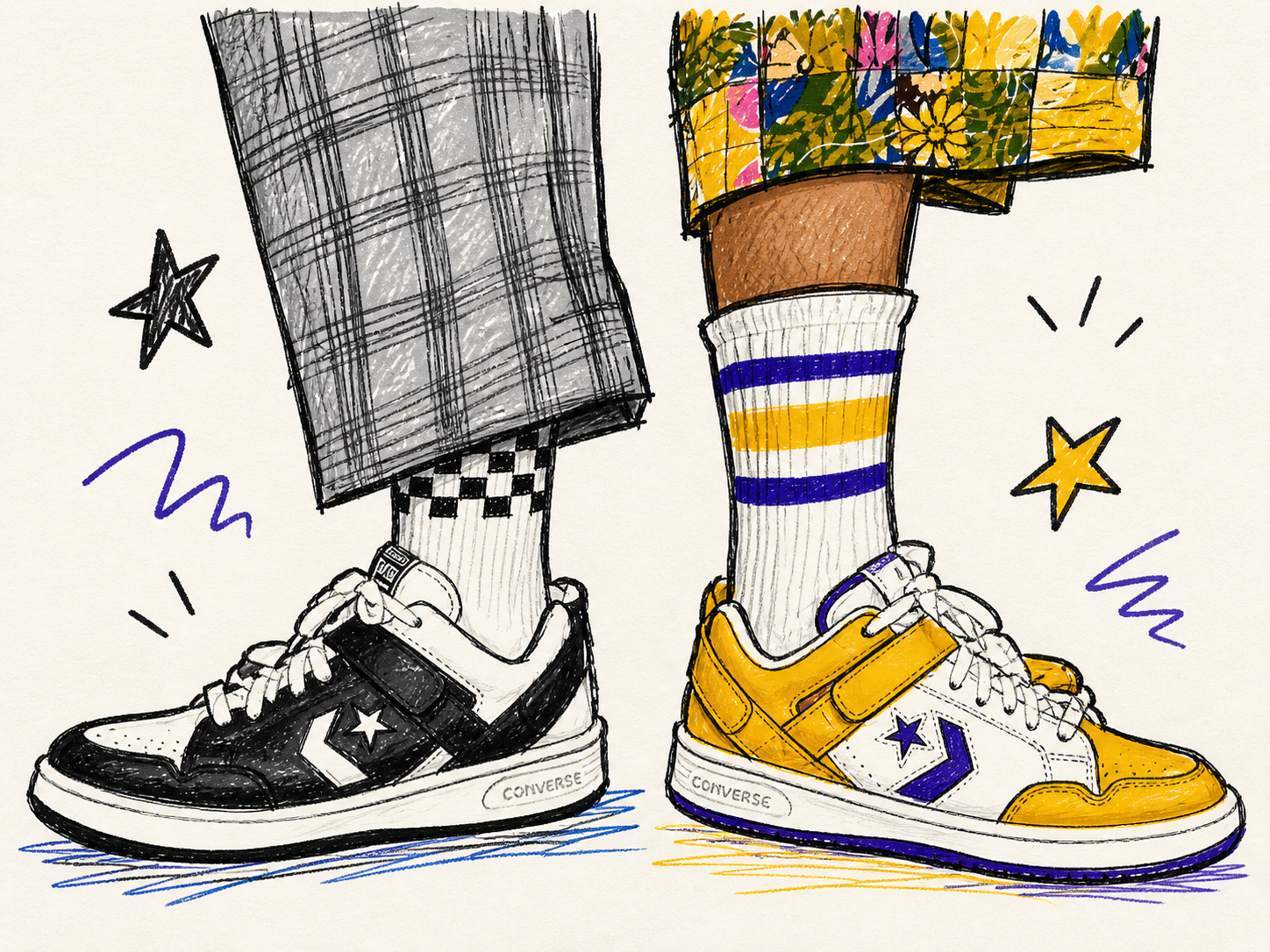
I grew up adjacent to that era without fully inhabiting it. The Bird-Johnson rivalry was already mythology by the time I was paying attention — something I understood through highlight reels, older relatives, and the particular reverence Black communities gave Magic specifically. Not just as a basketball player, but as a figure who carried cultural weight that extended well past the court. That context matters, because it’s exactly the kind of weight brands are now packaging and reselling — and the people whose culture created that weight are rarely the ones the repackaged product is aimed at.
That’s the operating condition that makes Converse’s return to the Bird-Johnson era legible as strategy rather than sentiment. The original moment already did the cultural work: a rivalry that nationalized the NBA’s audience, a period when basketball was transitioning from regional sport to global product, and two figures whose contrast — in style, geography, and persona — gave the league a narrative architecture it could sell. Reintroducing that era doesn’t require Converse to build a story. It requires them to redistribute one that already exists, at a fraction of the storytelling cost.
But nostalgia has a distribution problem of its own. The audience that holds the original memory is aging. Younger consumers engage with the past differently — through curated aesthetics, secondhand cultural transmission, and the visual grammar of vintage rather than lived experience. They can recognize the era without having inhabited it. That recognition is real, but it’s thinner. It doesn’t carry the same emotional weight, and it doesn’t automatically translate into purchase behavior. What it needs is a frame — something that makes the archival legible as contemporary without erasing what made it worth revisiting.
That’s the function Engineered Garments is serving, and it’s more precise than “collaboration” as a general category suggests. Engineered Garments brings a specific cultural position: workwear influence, Japanese-American craft sensibility, a design language that operates at the intersection of utility and deliberate anachronism. That’s not an arbitrary pairing with a retro basketball shoe — it’s a translation that recontextualizes the product for a consumer who cares about provenance, construction, and the kind of intentionality that mass releases can’t signal. The collaborator isn’t just adding credibility. They’re doing interpretive labor that Converse’s internal design team couldn’t do from the inside, because insiders are always somewhat constrained by the equity they’re protecting.
Here’s where the access question enters — and where the brand strategy framing starts to reveal what it’s leaving out.
The collaboration model is efficient for brands. It compresses risk, expands reach, and converts archival awareness into renewed demand across a different consumer segment. What it also does, structurably and predictably, is shift the price point. Collaborative releases don’t move toward accessibility — they move away from it. The Engineered Garments consumer isn’t the person who bought Chucks at Foot Locker in 1987. They’re not the kid in a Black neighborhood who saved up for a pair because the shoe meant something culturally specific to his community. The collaboration takes a product whose original cultural resonance was built substantially by Black consumers — through the game, through the players, through the street-level adoption that made basketball footwear a cultural category in the first place — and reissues it at a price point and through a retail channel that systematically excludes that same community.
That’s not an accident. It’s the model.
The brand holds the archive. The collaborator holds the taste-making credibility. Together they produce a product that moves upmarket, attracts a different buyer, and generates the kind of cultural conversation that justifies premium pricing. The original audience — the one whose lived relationship with the era gives the nostalgia its actual weight — becomes the backstory rather than the customer. Their culture is the foundation. The product built on top of it isn’t for them.
This points to something the industry rarely says plainly: the collaboration model is also a displacement model. Not in the housing sense, but in the cultural economy sense. The value that gets extracted from a legacy moment — the recognition, the emotional resonance, the story — was largely produced by communities that won’t be the primary beneficiaries when that value gets converted into a limited release with a three-figure price tag.
As a brand strategist, I understand the logic. As a culture critic, I’m naming what that logic obscures. And as someone who grew up adjacent to this era and the communities that gave it meaning, I find it hard to look at a Converse x Engineered Garments collab as purely an exercise in creative translation without asking who gets to walk away with what.
Converse’s latest move fits squarely within the broader structure. But every archival reissue is an argument about what the past means — and that argument is always being made by someone, toward someone, for reasons that aren’t always as sentimental as the campaign imagery suggests. The nostalgia is real. The audience being addressed is selective. And the community whose culture made the original moment worth revisiting is, once again, watching from outside the transaction.