
Most conversations about gentrification focus on cities where it has already happened — where the displacement is visible in the demographics, the rents, and the cultural character of neighborhoods that no longer resemble what they were a decade ago. Newark offers a different kind of case study. Academic research examining Newark’s gentrification trajectory found something unusual: in a city that should, by all market indicators, have experienced rapid gentrification given its proximity to New York City, its transit infrastructure, and its dramatically undervalued housing stock, the process has stalled in ways that cannot be fully explained by market dynamics alone. The explanation that the research points toward is political — specifically, the role of a majority-Black political infrastructure that has consistently, if imperfectly, created friction against the displacement mechanisms that have reshaped comparable cities.
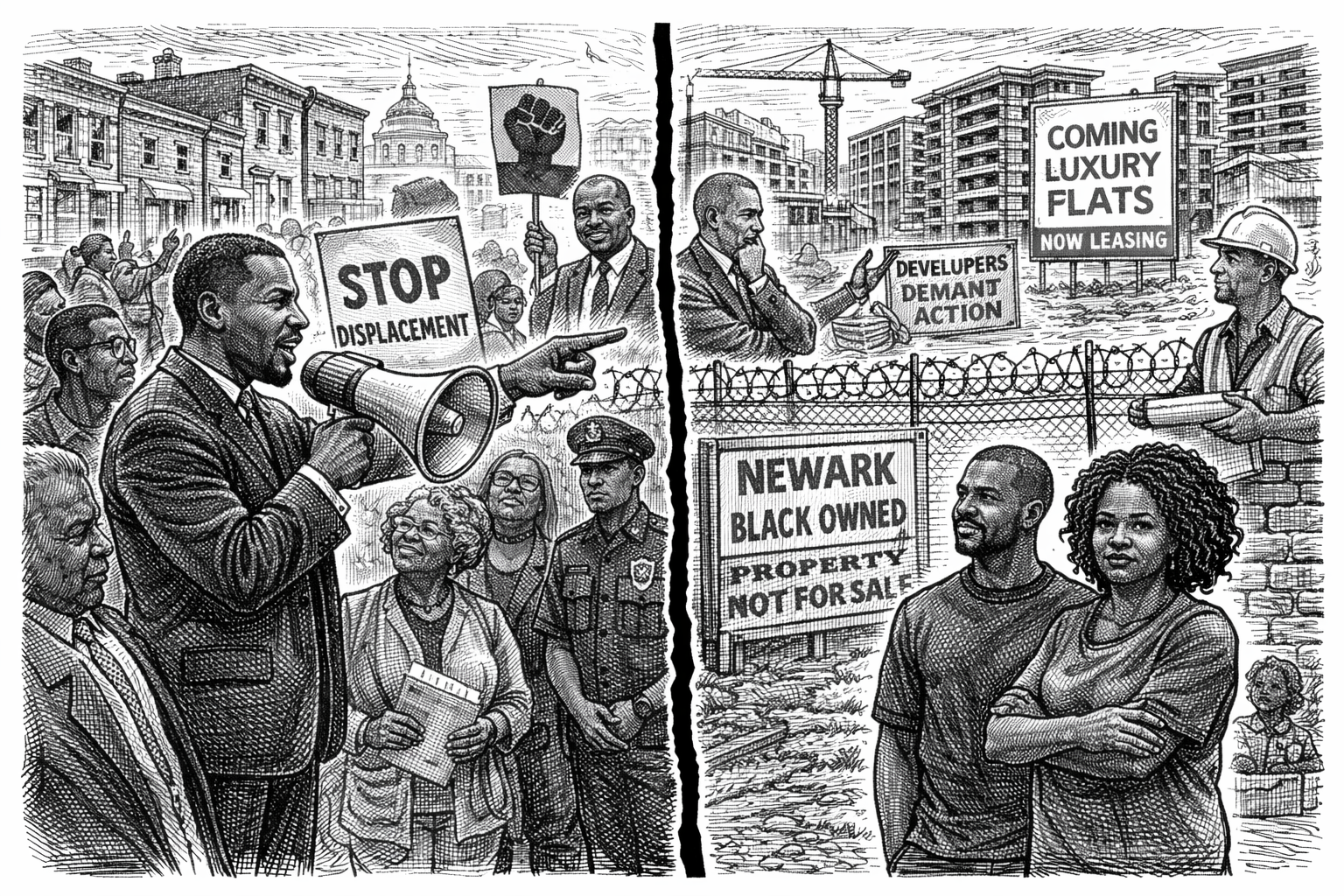
Newark’s resistance is not the product of a single policy or a single leader. It is the accumulated effect of political representation that reflects the city’s demographics, of community organizations with deep roots and credible relationships with residents, and of a governing orientation that has treated displacement prevention as a legitimate policy concern rather than an inevitable consequence of development. That does not mean Newark has solved gentrification. It means Newark has slowed it — has created conditions in which developers face more organized resistance, in which affordable housing requirements are more seriously enforced, and in which the political cost of visibly displacing Black and Brown residents is higher than it is in cities where those residents do not hold political power. The lesson is not that Black political representation guarantees equitable development. It is that it changes the terrain on which development negotiations happen.
The limits of that model are equally instructive. Political representation can create friction, but it cannot fully counter market forces that are operating at a scale beyond municipal authority. As federal housing investment has declined and as the pressure of New York City’s housing crisis has pushed higher-income households to look across the Hudson, Newark’s position has become increasingly difficult to defend through local politics alone. State-level policy, access to capital for community land trusts and limited-equity housing cooperatives, and federal investment in affordable housing preservation would be necessary to fully stabilize the gains that local political resistance has produced. Without those tools, the friction Newark’s political infrastructure creates is meaningful but insufficient — it delays displacement without preventing it, buys time without permanently securing community.
For cities across SSC’s coverage map — Houston, Baltimore, Miami, Los Angeles — the Newark model offers a specific kind of hope that is worth naming precisely. It is not the hope that a community can fully stop gentrification once the market has decided to move. It is the hope that political power, when it actually reflects a community’s demographics and interests, can shape the terms on which development happens — can extract community benefit agreements, preserve affordable housing, and make displacement expensive enough that developers must negotiate rather than simply proceed. That is not the same as justice. But it is a foothold, and in cities where Black communities are watching their geography reshape around them with limited tools to respond, even a foothold is worth studying carefully.