
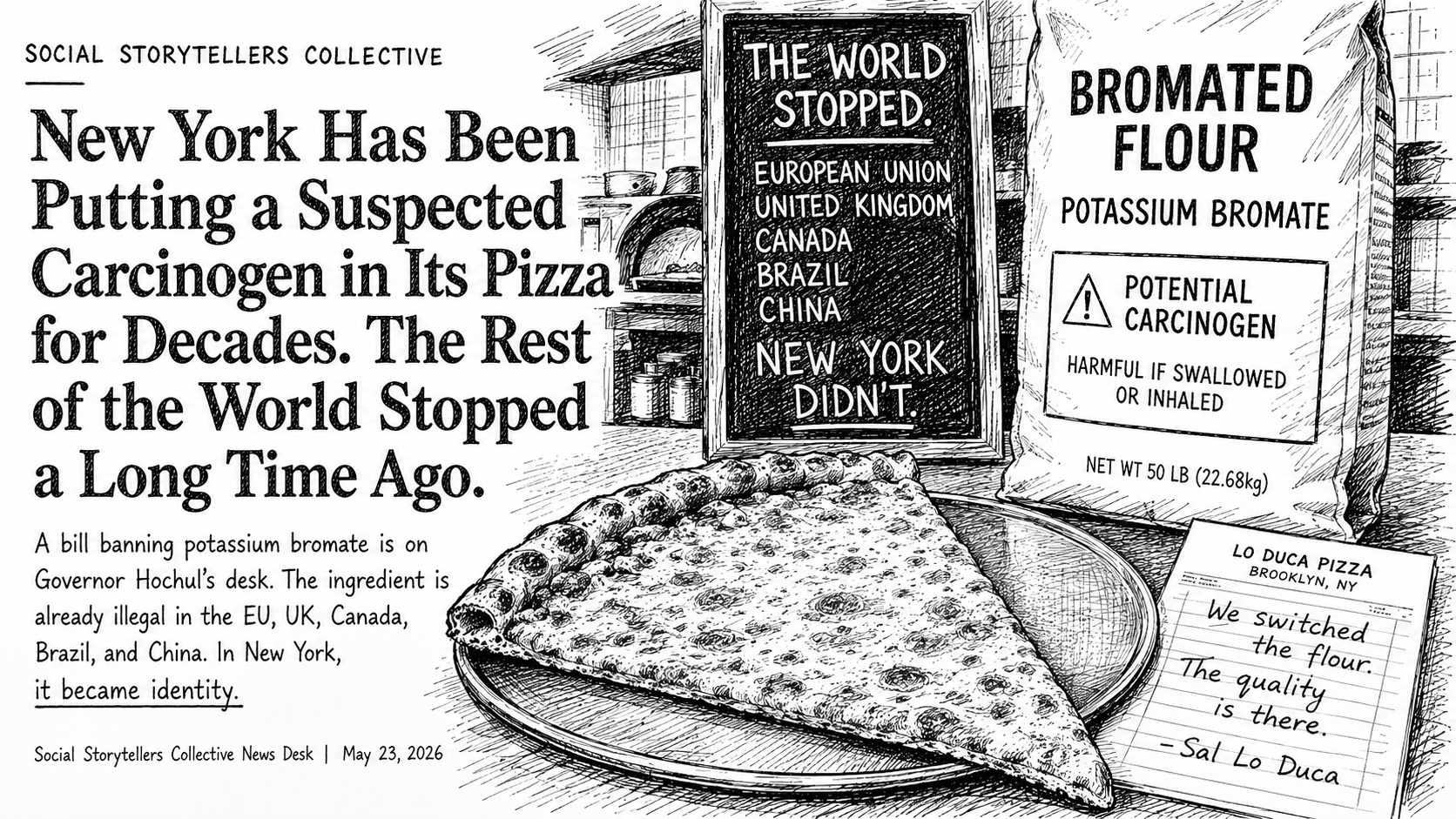
Salvatore Lo Duca runs Lo Duca Pizza in Brooklyn with his five brothers. A few months ago, he switched away from bromated flour — the additive that has defined the texture of the New York slice for generations. He expected to lose something. He didn’t. “When we started playing around with a different flour, I actually took a liking to it,” he said. “It’s a little more expensive, but the quality is there.”
That sentence is doing more work than it appears to. Because the argument for keeping potassium bromate in New York pizza and bagels has never really been about quality. It has been about identity — and the fear that changing the recipe changes what the food means.
A bill banning potassium bromate has passed the New York state legislature and is now awaiting Governor Kathy Hochul’s signature. If signed, it would become law — and thousands of pizzerias and bagel shops across the state would be required to reformulate recipes built around an ingredient the rest of the developed world banned decades ago. The European Union outlawed it. So did the United Kingdom, Canada, Brazil, China, and most of the international community. The FDA has classified potassium bromate as a potential carcinogen. It has not moved to ban it federally, citing a standard of “generally recognized as safe” for quantities used in baking — an assessment that puts the United States in a distinct minority position globally.
Pizza historian Scott Wiener estimates that roughly 80% of New York pizza and bagel shops use bromated flour. The ingredient is an oxidizing agent that reduces the time dough needs to rest and produces the specific chewy, pliable texture that generations of New Yorkers have eaten and called authentic. The commercial baking industry has long argued that the bromate breaks down during baking and poses minimal risk in the finished product. The countries that banned it looked at the same data and reached a different conclusion.
What the New York debate keeps circling without landing on is a simple fact: Italy never used potassium bromate. The country that invented pizza built its entire food culture around the ingredient not being there. The New York slice is not Neapolitan pizza. It developed its own identity over decades — and somewhere in that development, an industrial additive became load-bearing mythology.
The mythology is real. The ingredient does not have to be. Lo Duca switched the flour. He said the quality is there. The slice survived. The question Governor Hochul is being asked to answer is whether New York’s food identity is fragile enough that it cannot survive being made without a substance the rest of the world decided wasn’t worth the risk. The answer to that question says more about the city than the pizza does.