Netflix is facing slower engagement growth and fierce competition from YouTube. Behind the streaming industry’s financial math is another measure of success: whether the people who write, film, build and produce entertainment can still make a living doing it.
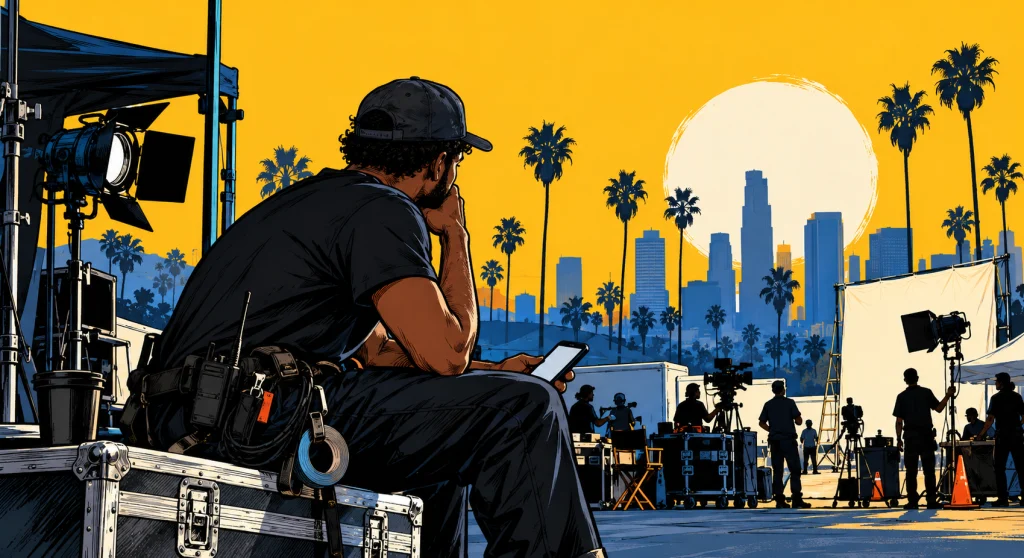
Somewhere in Los Angeles, a television production worker is waiting for the phone to ring with the next job. It might be a camera operator, a costume designer, a production assistant or someone who has spent decades building a career behind the scenes. Their livelihood depends on projects getting green-lit, production schedules getting approved and studios deciding another series is worth making. Meanwhile, Wall Street is watching a different set of numbers: how many hours people spend on Netflix, whether subscribers stay engaged and how efficiently the company turns viewing into revenue. Those two conversations are connected, but they rarely get equal weight.
On Oct. 19, Reuters reported that Netflix faces growing questions about engagement as YouTube and other creator-driven platforms compete for viewing time. Citing Nielsen, Reuters said Americans now spend nearly twice as much time watching YouTube as Netflix. Jefferies analysts estimate that average monthly viewing per Netflix member fell from 66 hours in the first half of 2023 to 49 hours in the same period this year. Netflix, which reports third-quarter results today, also confirmed last week that it is cutting roughly 1,000 jobs, about 6% of its workforce, mostly in product, technology, legal and human resources.
For investors, those numbers raise questions about growth, profitability and the future of subscription entertainment. Netflix is a business, and businesses have to generate returns. But I’m increasingly concerned about an entertainment economy that measures success mostly through engagement and efficiency while paying comparatively little attention to the stability of the people whose work makes the product possible.
Streaming Changed More Than How We Watch
Netflix helped transform television by putting viewers in control. Entire seasons dropped at once, libraries expanded and audiences got programming traditional networks might never have commissioned. For consumers, the convenience was extraordinary. For the people who make television, the change was more complicated. Streaming created new opportunities for actors, writers, directors, crews and independent studios, but it also disrupted the financial arrangements that once sustained television careers, including residuals, syndication revenue and the steadier production schedules of long-running broadcast series.
The industry went through a spending boom as companies raced to build libraries, followed by consolidation and pressure to cut costs. The 2023 Hollywood strikes brought those tensions into public view, from pay and streaming transparency to artificial intelligence and whether creative work can still support a career. That pressure hasn’t eased. Disney laid off hundreds of workers and then agreed to pay $60 million a year for 66 AI specialists, and the newly combined Paramount and Warner Bros. is pursuing $6 billion in savings. I don’t believe the answer is to romanticize traditional television, which had its own barriers to entry and unequal access. But streaming has shown that an industry can become more convenient for consumers while becoming less predictable for the people who work in it.
YouTube Changed the Economics of Entertainment
Part of Netflix’s challenge is that the definition of television has changed. On any given night, a viewer might choose a professionally produced Netflix drama or a string of independently made YouTube videos. Both compete for the same attention, but their economics are worlds apart. A scripted series can require months of development, a writers room, crews, actors, permits, sets, costumes and postproduction specialists. A successful creator can make compelling entertainment with a small team and a fraction of the budget. For a growing share of younger viewers, as SSC reported today, the front page is now a For You Page, and Hollywood has noticed, with influencers now entering its casting pipeline.
Neither form is inherently better. Creator-driven media has opened doors for independent storytellers and built careers outside traditional Hollywood. But when platforms compete on viewing hours with very different production costs, the pressure can push investment toward whatever draws audiences most cheaply. That worries me, because the most efficient content isn’t necessarily the content that supports the widest range of creative jobs. A highly successful creator might run an excellent business with five employees. A scripted series can employ hundreds of people across dozens of trades. Both contribute to the economy, but their employment footprints are very different, and that difference matters when we look at where entertainment money is going and who benefits.
Hollywood’s Jobs Problem Is Bigger Than Netflix
The concern about production jobs isn’t theoretical. On Oct. 5, the Directors Guild of America, SAG-AFTRA, IATSE, the Teamsters, LIUNA and both Writers Guilds released a study by EY tracking where film and television production has gone over 25 years. It found that the share of production spending on films with significant U.S.-based production fell 32 percentage points between 1999 and 2024, to 42%. For television episodes, the share fell 30 points, to 64%. The human toll shows up most clearly in one figure: the share of cast and crew on major studio films working in the U.S. fell from 72% to 43%.
The study doesn’t prove that streaming caused that shift, and it was released to support the unions’ push for stronger federal production incentives. But the consequences are real. When productions leave, the losses reach well beyond actors and directors, to caterers, drivers, construction crews, equipment suppliers and hotel workers in the communities that once hosted them. Studios have legitimate reasons to choose where they film, including tax incentives, infrastructure, exchange rates and available talent. But lower costs for a studio don’t automatically mean better outcomes for the workers in the places losing that work. That’s why conversations about the financial health of entertainment companies should look beyond revenue and shareholder returns to where production is happening, how many people it employs and whether skilled professionals can survive the gaps between jobs.
We’ve Seen This Pattern Before
The gap between business growth and job security reaches far beyond entertainment. SSC has reported on how labor’s share of income keeps falling even as the economy grows, and how Houston added 24,000 jobs while workers in the wrong part of the economy lost theirs. Entertainment fits the same pattern. Platforms can grow revenue through advertising, subscriptions, licensing and live events without growing production employment at the same pace, and a streamer can post strong results while crews go months between jobs.
That isn’t automatically exploitation. Productivity gains, new technology and shifting consumer tastes are normal features of a changing economy, and the two trends can exist side by side without one causing the other. But who shares in the gains is a legitimate question, and both realities belong in the picture of how the industry is doing.
Success Should Include the People Who Make the Work
Netflix has good reasons to respond to changing audience behavior. Viewers have more options than ever, and the company has to decide how to divide its money among scripted shows, films, live events, advertising and new formats. There’s no guarantee that spending more on scripted production would lift engagement, just as there’s no guarantee that cutting costs will strengthen its position over time.
But I’d like to see entertainment companies be more transparent about the link between content spending and employment. How much production spending supports workers in the United States? How many projects are being commissioned compared with past years? How long are crews employed, and how much of the budget actually reaches working professionals? Those measures wouldn’t replace subscriber counts, viewing hours or profit. They would give a fuller picture of what success looks like. I’m not arguing that Netflix should finance shows just to preserve jobs, since a sustainable industry still needs audiences who want to watch what’s being made. But the people creating that entertainment shouldn’t drop out of the conversation just because their circumstances are harder to measure than engagement.
The streaming revolution promised more access, more choice and new opportunities for storytelling, and much of that promise has been kept for audiences and some creators. The open question is whether the industry’s next phase can sustain the writers, technicians, performers, craftspeople and production professionals whose livelihoods depend on steady investment. Netflix still commands an enormous audience, and YouTube has proved the power of a different model. While the industry measures how long viewers stay on a platform, we should also be asking how long the people making the entertainment can afford to stay in the business.
Reporting sources: Reuters, Nielsen, Jefferies, Directors Guild of America/EY study