
Let me be direct: Made of Honour is not a good album. It is a functional one. There is a difference.
Three songs earn their place — Shabang, BBW, and New Bestie. The rest sounds like an artist who has already made his decision and is finishing the paperwork. And honestly? That might be exactly what this is.
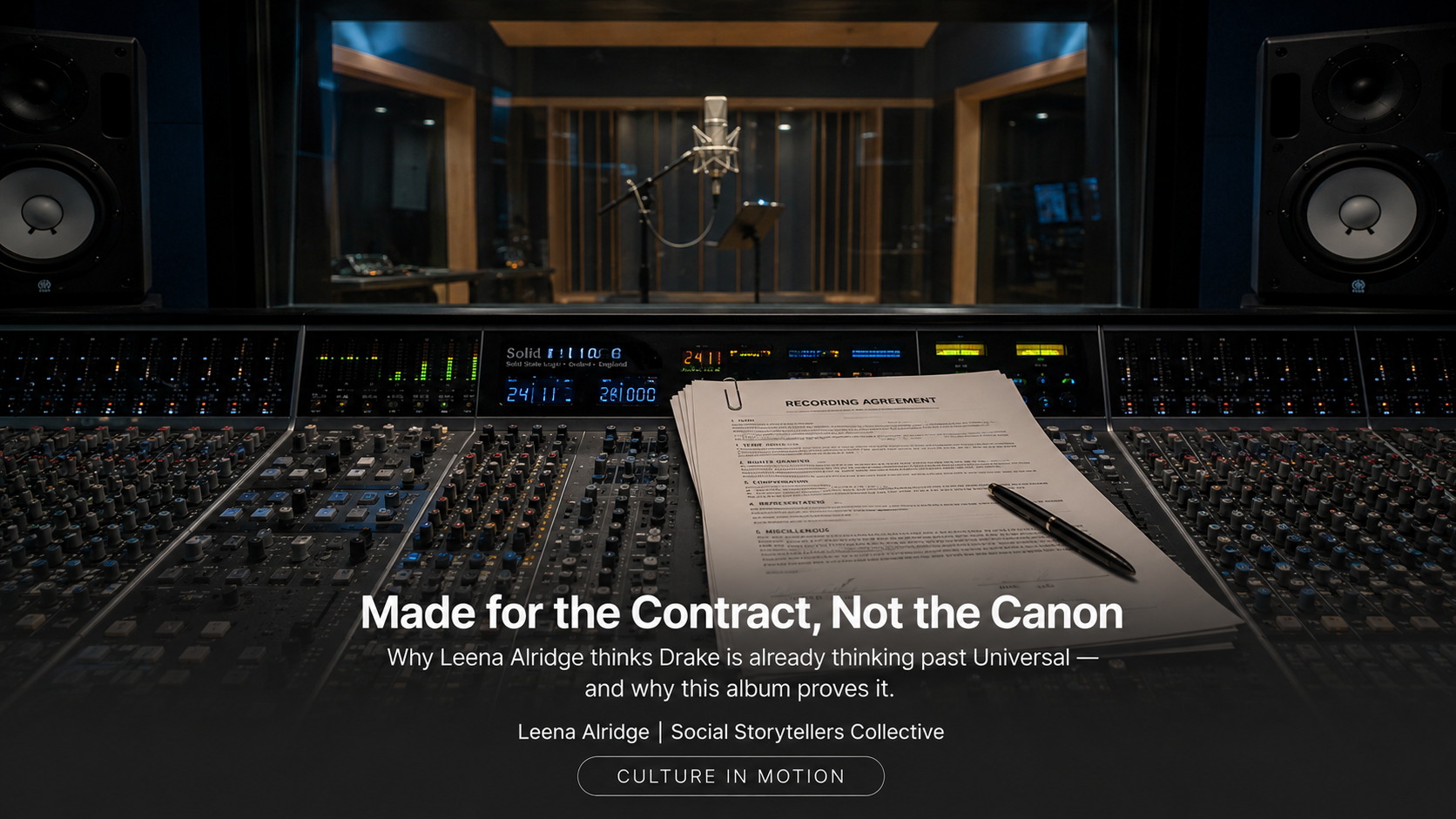
There is a growing theory floating through music circles, fan communities, and industry conversations that Drake‘s recent output does not sound like an artist building legacy. It sounds like an artist exiting a deal. Not collapsing. Not spiraling. Exiting. And after sitting with this project, I think the theory is right — and the music is the evidence.
For more than a decade, Drake mastered the modern streaming era better than almost anyone alive. He understood volume before the industry admitted volume mattered. He understood playlist culture before critics took playlists seriously. He understood mood music, algorithmic repeatability, passive listening, and platform omnipresence before labels fully optimized around them. Drake was not simply making albums. He was designing occupancy. He made music that lived everywhere all at once.
Made of Honour does not sound like that artist.
Shabang does. It has the kind of effortless melodic pull that made Drake unavoidable at his peak — the hook lands before you realize you’re already inside it. BBW works because it commits to a lane without hedging. New Bestie is the album’s most emotionally present moment, the one track where the performance doesn’t feel like a delivery. Those three songs remind you what this artist sounds like when he’s actually in the room.
The rest of the album sounds like he sent a representative.
The conversation around the project has been strangely detached from the kind of event energy that once surrounded his releases. Instead of cultural urgency, there is analysis about obligation. Instead of mythology, there are spreadsheets. Fans are counting projects, discussing rumored deal structures, debating ownership leverage, and trying to calculate whether the music feels emotionally invested or strategically sufficient.
That distinction matters — because when audiences begin discussing contracts more than songs, they are usually sensing a shift in artistic posture. The audience may not know the exact paperwork. But listeners are remarkably good at detecting intent. People can hear when an artist sounds hungry. They can also hear when an artist sounds procedural.
Procedural is the word quietly haunting Made of Honour. Outside of those three tracks, the album functions less like a defining statement and more like maintenance. Enough music to dominate conversation. Enough records to feed streaming ecosystems. Enough ambiguity to keep speculation alive. But not the emotionally exposed, era-defining work people associate with artistic reinvention. It is music designed to occupy space, not earn it.
That interpretation becomes more convincing because Drake has already achieved nearly everything the traditional label system was designed to offer. Scale. Global reach. Brand recognition. Catalog dominance. The leverage equation changes when an artist becomes larger than the infrastructure distributing them. At that stage, the relationship between superstar and label shifts from partnership to negotiation over control.
What may actually sit underneath the Made of Honour discourse is not whether the album is good or bad. It is whether we are watching an artist emotionally disengage from one institutional phase before entering another. The streaming era changed how albums are consumed. It also changed how fans interpret behavior. Listeners now read release timing, rollout intensity, social media energy, and feature selection as forms of corporate signaling. Music fandom increasingly resembles market analysis. Fans no longer just consume projects. They audit strategy.
Drake‘s career helped create that environment. He may now be operating inside it with full awareness — releasing enough to satisfy the contract while reserving his actual creative investment for whatever comes next.
The strangest part of all this is that even the theory that Made of Honour is a contract obligation still reinforces his stature. Very few artists are successful enough for audiences to believe they can casually release music at scale while saving their real creative energy for later. That assumption itself reflects how large his catalog, influence, and commercial dominance have become.
But stature is not the same as stakes. And right now, Made of Honour has plenty of the first and not enough of the second.
Shabang, BBW, New Bestie. Save those. Skip the rest.
The audience is no longer asking whether Drake can make hits. They are asking whether he still wants to make statements. Based on this album, the answer is: not yet. Not here. Not for Universal.
Whatever he’s saving it for better be worth the wait.