Los Angeles County has announced it will withdraw most of its funding from the Los Angeles Homeless Services Authority beginning July 1, leaving the city as the primary funder and triggering proposals to restructure oversight, contracting processes, and performance accountability across the agency. The decision reflects growing frustration not with how much has been spent — billions of dollars have flowed into homelessness programs across the region — but with how that spending has been administered and what it has visibly produced. Shelter access, housing placement, and street conditions have not improved at the pace public officials or residents expected, and the institutional structure responsible for delivering those outcomes is now being redesigned rather than simply refunded.
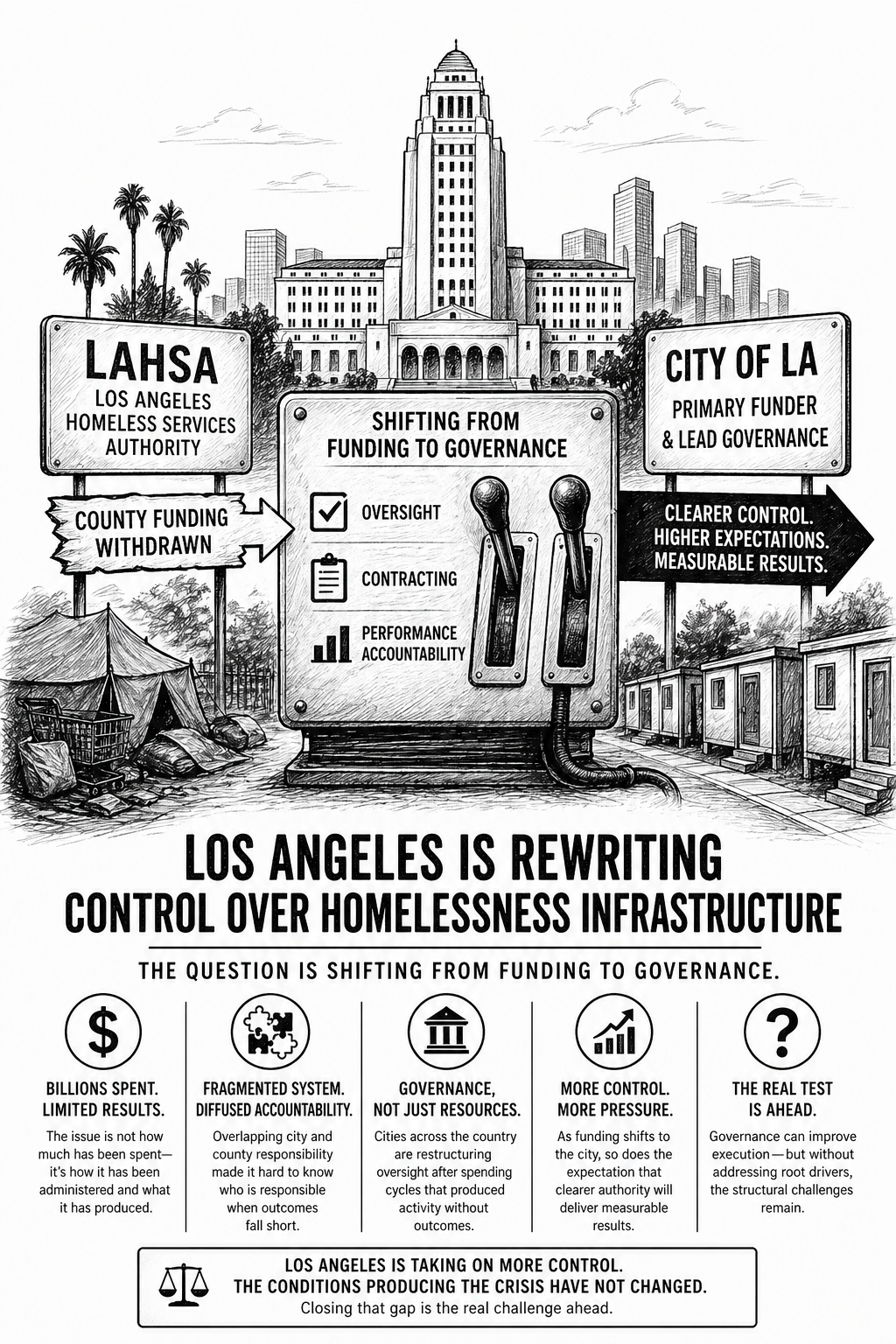
The fragmentation built into the existing system is central to why this moment is arriving now. City and county governments have historically shared responsibility for homelessness services, creating overlapping authority and diffused accountability that made it difficult to identify who was responsible when outcomes fell short. That diffusion has compounded the pressure on a city already navigating simultaneous crises across tourism, population loss, and enforcement disruption— conditions that have reshaped how Los Angeles functions at the neighborhood level in ways that homelessness policy alone cannot address. As funding shifts toward the city, so does the expectation that clearer lines of control will produce more measurable results. Whether consolidated authority actually delivers that is a different question than whether it was necessary.
The broader implication is that homelessness is increasingly being treated as a governance problem rather than solely a resource problem. Los Angeles is not alone in arriving at this conclusion — New York, San Francisco, and Seattle have all moved in similar directions, restructuring oversight mechanisms after spending cycles that produced limited visible progress. The pattern across these cities is consistent: resource investment without clear accountability structures tends to produce activity without outcomes, and the political pressure to demonstrate results eventually forces a restructuring of the system rather than simply an increase in its budget.
What the LAHSA restructuring will test is whether clearer authority actually translates into better outcomes — or whether the underlying drivers of homelessness, housing costs, wage gaps, mental health infrastructure, and displacement pressure, are simply too structural for any governance redesign to meaningfully address without confronting them directly. The city is taking on more control. The conditions producing the crisis have not changed. That gap between what governance can deliver and what the problem actually requires is where the next phase of this story will unfold.