
When Leena dropped on April 24th, the critical apparatus moved fast and moved favorably. An 80/100 on Metacritic. Pitchfork praising its buoyancy. Tracks like “Unlearn” and “I Need You” getting singled out as standouts. A projected No. 4 debut on the Billboard 200. On paper, this is a successful album release — the kind of reception that validates a creative direction and sets up the next chapter. By every institutional metric, Kehlani delivered.

The fan response tells a different story, and it doesn’t resolve cleanly into the same narrative.
Across X and streaming comment sections, the reaction split in a way that’s analytically more interesting than either side taken alone. One camp landed on “bland and repetitive,” arriving at the conclusion that the album’s 17 tracks blur into each other without enough friction to create distinction. The other camp pushed back with something that sounds like defense but is actually its own form of diagnosis — celebrating the project’s homage to classic R&B elements: stacked vocals, deliberate key changes, a sonic palette that’s intentionally referencing a tradition rather than chasing a trend. Both reactions are real. Neither is wrong. And the fact that they’re describing the same album is the thing worth examining.
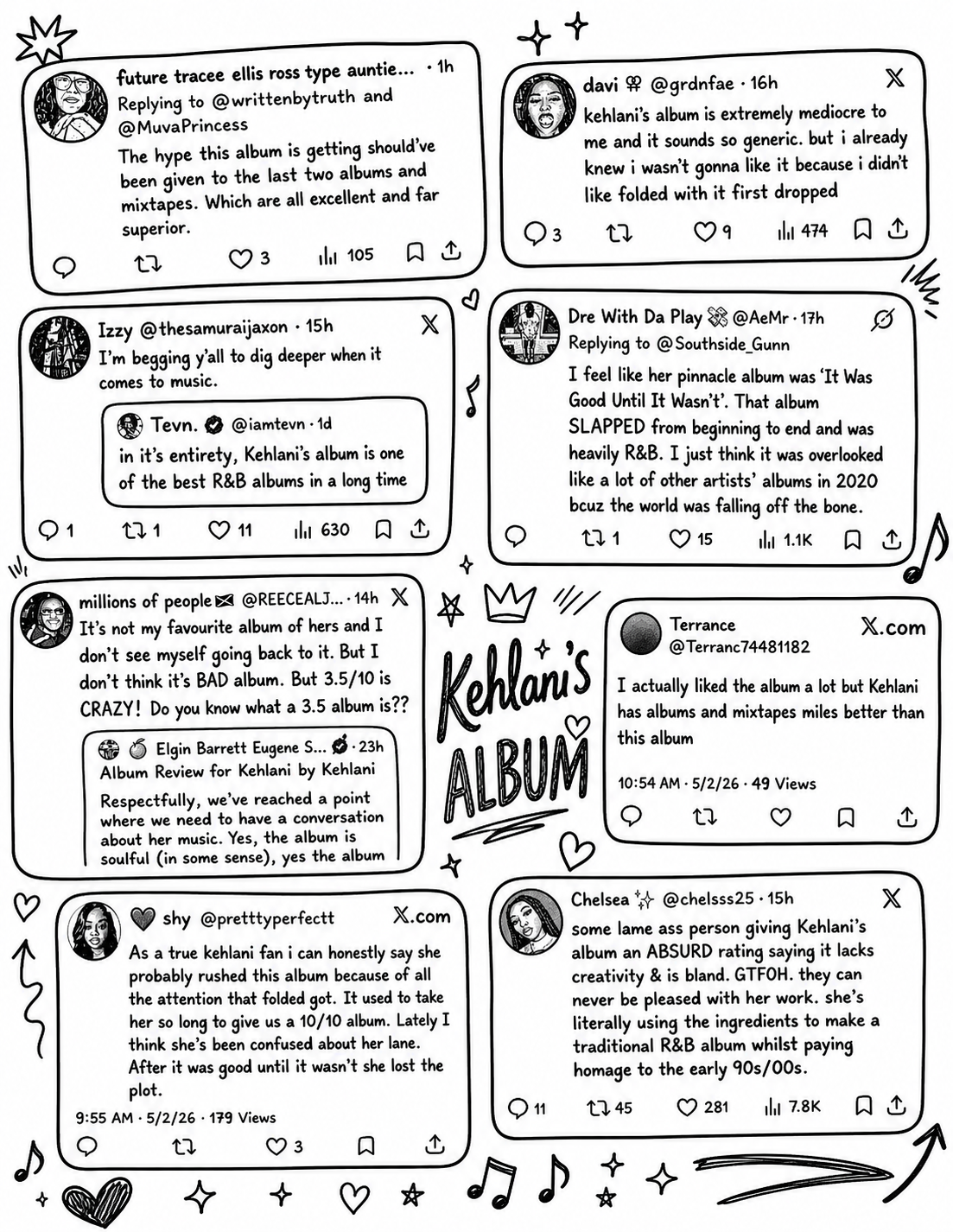
Because what looks like a fan split on the surface is actually a disagreement about what the album is for — and that kind of disagreement doesn’t happen by accident. It usually means the project hasn’t made its own intentions legible enough to adjudicate the debate.
The critics who praised Leena were largely evaluating it on craft. Buoyancy is a production quality. Standout tracks are discrete units. An 80 on Metacritic is an aggregate of people assessing individual elements — songwriting, vocal performance, sonic texture — and finding them above average. That’s a legitimate form of evaluation. It’s also, notably, not the same as evaluating whether the album coheres into something larger than its parts. Critics tend to reward execution. Fans tend to reward experience. And those two things can diverge sharply on a 17-track project where the question of sequencing and accumulation matters as much as the quality of any single record.
That’s where the “bland and repetitive” contingent is actually doing structural criticism, even if they’re not framing it that way. When listeners say an album sounds the same across too many tracks, they’re not necessarily saying the tracks are bad — they’re saying the album doesn’t know how to use them. Seventeen songs is a curatorial argument. It’s a statement that the project has enough range, enough movement, enough internal contrast to justify the runtime. When that argument doesn’t land, the response isn’t “these songs are bad” — it’s “this could have been less, and been more.”
The classic R&B defense, meanwhile, is making a different kind of case — one that’s about lineage and intentionality. Stacked vocals and key changes aren’t accidents; they’re choices that locate the album within a specific tradition. If that’s the frame, then “bland” misreads what the project is doing. It’s not building toward a contemporary pop moment — it’s excavating something older, slower, more deliberate. That’s a valid artistic position. But it requires the album to signal that intention clearly enough that listeners can find their way into it, and it requires the sequencing to reward the patience that kind of listening demands.
The question is whether Leena does either of those things consistently enough to close the gap.
The Usher, Cardi B, and Lil Wayne features are worth pausing on here, because they’re a useful test case for what the album is and isn’t doing. Features at that level don’t just add star power — they create contrast. They introduce different cadences, different registers, different relationships to the material. On a 17-track project that’s drawing criticism for sonic uniformity, those moments should be functioning as structural interruptions, points where the album shifts weight and changes its argument. If the fan response is still landing on “repetitive” despite that lineup, it suggests the features are getting absorbed into the album’s texture rather than disrupting it — which is itself an A&R and sequencing decision that tells you something about where the creative priorities were.
What makes the critical/fan divide on Leena significant beyond this one release is what it reveals about how we’re evaluating music right now. Critics and fans are increasingly operating with different frameworks, and those frameworks are producing different verdicts from the same material. Institutional criticism — even when it’s good criticism — tends to assess albums as collections of moments. Fan response, shaped by streaming culture and the expectation that an album should function as an experience with arc and resolution, tends to assess albums as arguments. An album can score well on the first framework and fail on the second simultaneously. That’s not a contradiction. It’s a structural gap in how we talk about music, and Leena is sitting directly in that gap.
The No. 4 Billboard debut will give Kehlani the commercial story she needs. The Metacritic score will follow her into the next press cycle. But the fan discourse — split, unresolved, still arguing about what the album was actually trying to do — is the more honest accounting of where the project landed. Not because fans are always right, but because the argument they’re having is the one that actually matters for longevity. Albums that generate that kind of sustained, unresolved debate either get reappraised upward as people find the frame, or they settle into the catalog as the one where the intention didn’t quite come through.
Leena hasn’t resolved yet. And that unresolved quality — not the Metacritic score, not the Billboard position — is the most accurate description of where it actually stands.