
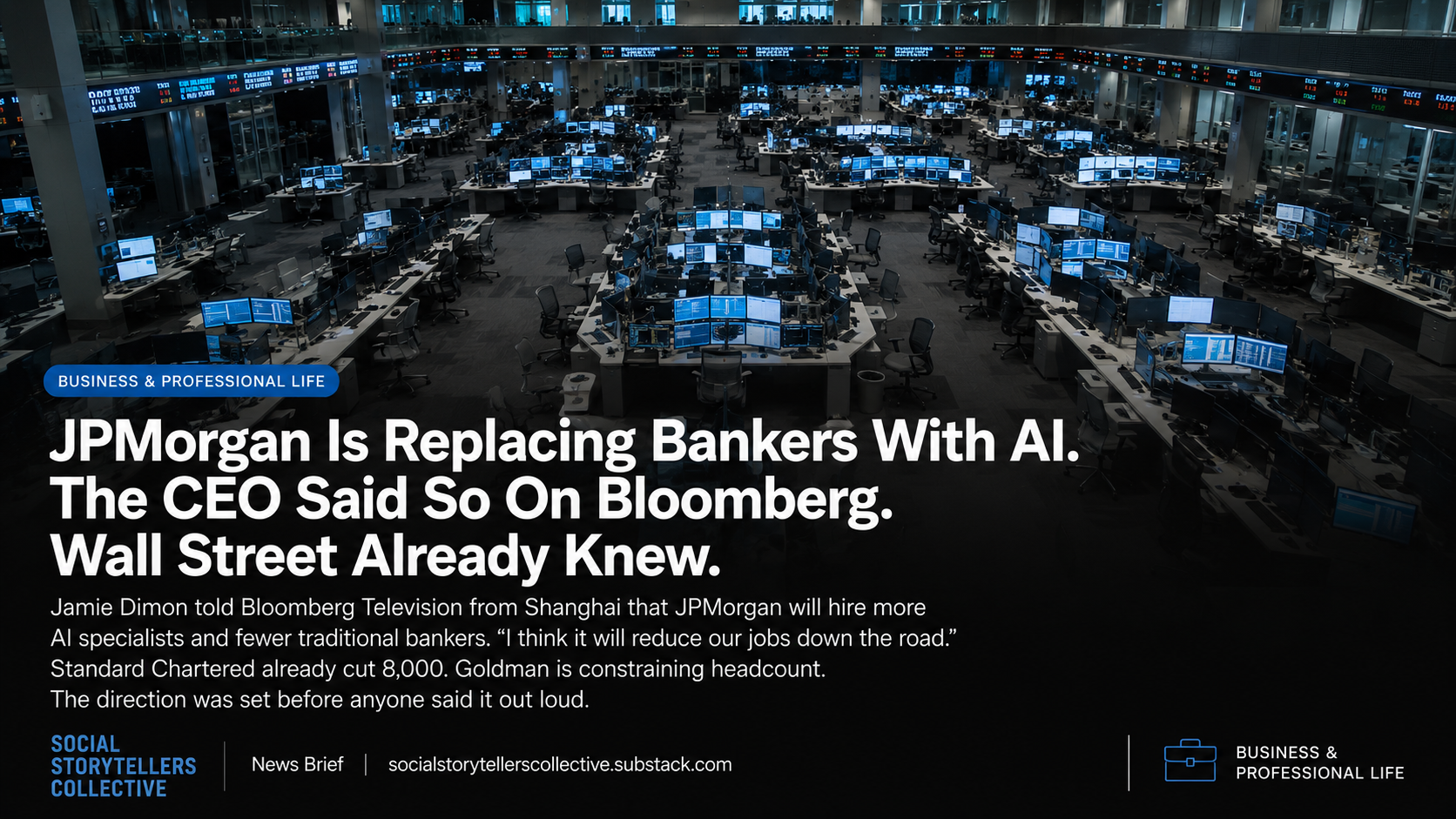
“I think it will reduce our jobs down the road.” Standard Chartered already cut 8,000. Goldman is constraining headcount. The direction was set before anyone said it out loud.
Jamie Dimon was at JPMorgan’s China Summit in Shanghai on Thursday when Bloomberg Television asked him about artificial intelligence and the bank’s workforce. His answer was more direct than most Wall Street CEOs have been willing to be publicly. “I think it will reduce our jobs down the road,” Dimon said. “There will be all different types of jobs, and I think we will be hiring more AI people and fewer bankers in certain categories, and it will make them more productive.”
JPMorgan Chase — America’s largest bank, with roughly 320,000 employees — has been investing in AI since at least 2012 and now spends approximately $2 billion a year on the technology. Dimon framed the transition as manageable: the bank’s annual attrition rate of about 10%, or roughly 25,000 to 30,000 employees, gives it room to absorb workforce changes gradually through retraining, redeployment, or early retirement rather than large-scale layoffs. The message was calibrated — not alarming, not dismissive, just directional. More AI. Fewer bankers. The math runs in one direction.
Dimon’s tone, as Bloomberg noted, was more measured than some of his peers. The same week, Standard CharteredCEO Bill Winters sparked significant backlash after announcing the bank would replace what he called “lower-value human capital” with technology to eliminate 8,000 support roles by the end of the decade. Winters later apologized for the phrasing. The substance of what he said — 8,000 jobs replaced by AI — did not change with the apology. At Goldman Sachs, CEO David Solomon has directed the bank to “constrain headcount” as AI absorbs knowledge work that would previously have required junior analysts. The pattern across Wall Street is consistent: blockbuster trading and investment banking revenue, historically the conditions under which banks hire aggressively, are now running alongside deliberate headcount restraint because the technology has made it possible to produce more with fewer people.
The jobs facing the greatest pressure are entry-level and back-office roles — the positions that have historically been the first rung of a career ladder in finance. Research, compliance, risk analysis, client reporting, document review — the categories where young professionals once learned the business by doing the work are the categories AI is now absorbing most efficiently. Dimon’s reassurance that there will be “all different types of jobs” is genuinely believed by some economists and genuinely contested by others. What is not contested is which roles are disappearing first.
The JPMorgan announcement lands in the same week that the Anthropic Fellows Program — offering $3,850 per week with no prior AI research experience required — and will.i.am’s ASU classroom of 75 students ranging from 18 to 70 years old are redefining who gets access to the AI economy on the way up. Dimon is describing what the AI economy looks like from the top of one of the world’s most powerful financial institutions. The Anthropic program and the ASUcourse are describing what it looks like from the entry point. The gate has widened — but it has not disappeared, and the people most likely to fall through the gap between the old economy and the new one are the ones who built careers in exactly the back-office and entry-level roles JPMorgan is now describing as replaceable.
Dimon was careful. Winters was not. Solomon is simply executing. The direction is the same across all three institutions. The language is the variable. And the people whose jobs are in the category being described — regardless of whether the CEO calls them “lower-value human capital” or assures them there will be “all different types of jobs” — are reading the same memo.
Social Storytellers Collective | Business & Professional Life Sources: Bloomberg Television; PYMNTS; Reuters. Read the full End of Day Closing Note — drops at 3PM CDT weekdays.