
Part of Culture in Motion — an ongoing series examining who defines culture, how it moves, and what it reveals about the moment.
When Forbes reported that Jay-Z is now worth an estimated $2.8 billion, the headline traveled the way these stories always do — framed as a milestone, a celebration, another marker of how far one man has come from Marcy. The number is large enough to feel symbolic. But the number is not the story. What it represents is.
Jay-Z did not become one of the wealthiest figures in American music by music alone. His catalog matters culturally, but his wealth is tied to ownership — equity stakes in companies, brands, and platforms that extend far beyond the recording booth. Roc Nation, Armand de Brignac, D’Ussé, Tidal, strategic investments across industries. Music created the visibility. Ownership created the scale. That distinction reflects a larger shift in what access actually means. For decades, artists were granted entry to platforms without ownership of them. They could shape culture without controlling how that culture was distributed, monetized, or sustained. What Jay-Z represents is a move beyond participation into infrastructure — and that changes what power looks like entirely.
The GQ cover story that dropped this week, timed to the 30th anniversary of Reasonable Doubt, is Jay-Z operating fully in that register. He told GQ editor Frazier Tharpe: “2026 is all offense.” Three Yankee Stadium shows — billed as JAŸ-Z 30, JAŸ-Z 25, and “Extra Innings” — sold out against virtual queues of up to 800,000 hopeful attendees. The Roots Picnic. The GQ interview. The streaming rollout of catalog records previously unavailable. As SSC examined in 10 Things the JAŸ-Z GQ Interview Quietly Revealed, this is not a comeback — it is a campaign, and every element is doing something deliberate. The move is coordinated and it is working.
And then there is the imagery.
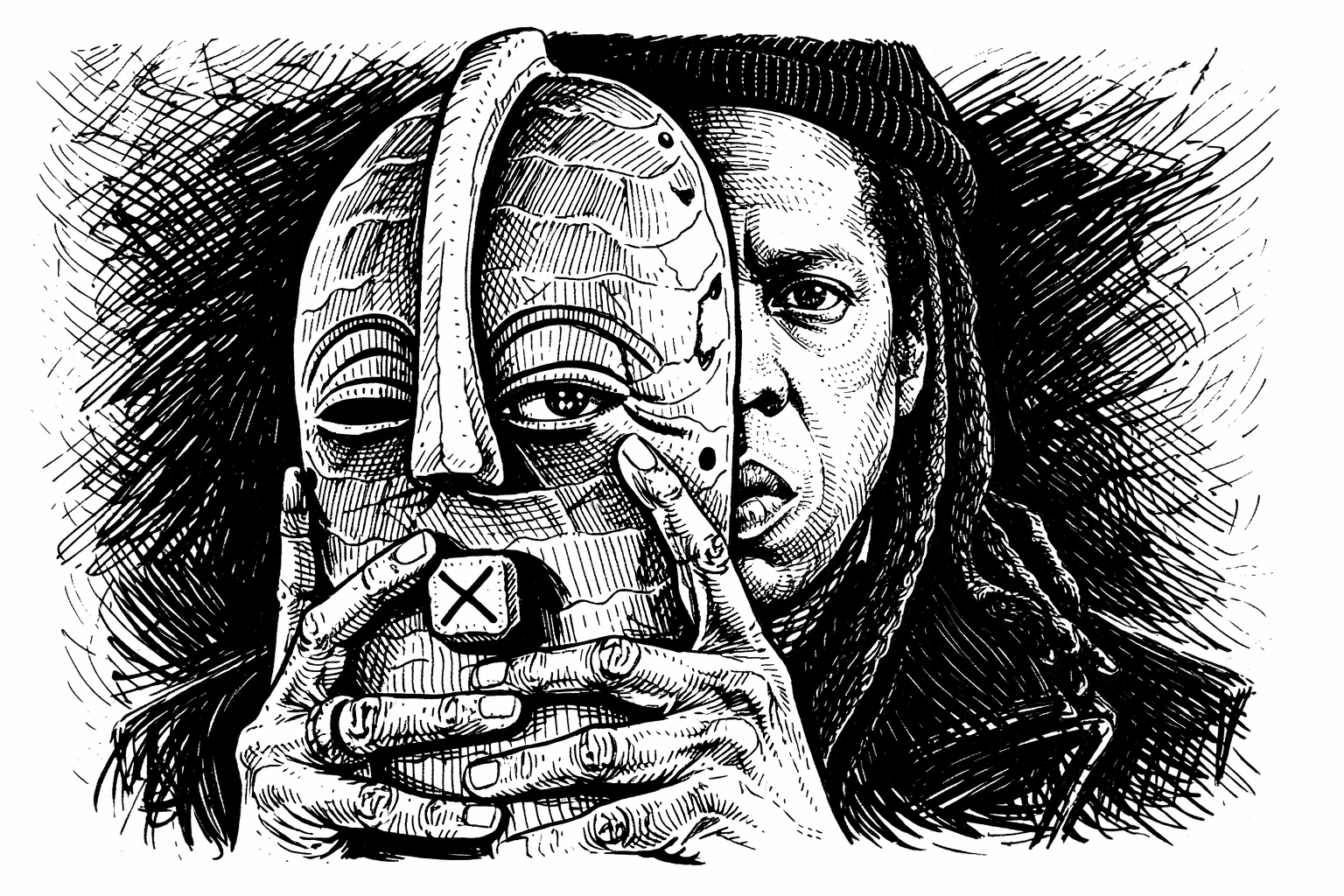
GQ tapped artist Rashid Johnson to photograph Jay-Z for the issue, drawing from the observational photographs of Harlem Renaissance photographer James Van Der Zee and the surrealist tendencies of Francis Bacon. In one image, Jay-Z partially covers his face with a mask as he stares into the camera. The artistic intent is real and defensible — Johnson is a serious artist whose retrospective at the Guggenheim drew widespread acclaim, and Jay-Z has collected his work for a decade. In a gallery context, the work reads clearly. But we love Jay-Z, and it’s because we love him that this needs to be said: in the current climate, with conspiracy theories that have followed him for years still circulating and people actively breaking down each frame of the photoshoot for hidden meaning, dark surrealist imagery with a mask does not land in a neutral space. The Illuminati rumors have never fully gone away. Choosing this visual language — however artistically intentional — is adding fuel to a fire that never fully went out. Someone in that room should have said something.
The broader story, though, is about what his position represents beyond the optics. The gap between Jay-Z’s model and what most artists can realistically access remains enormous. Ownership still requires capital, relationships, and timing that most artists — particularly Black artists without generational wealth or institutional backing — simply do not have. The artist who becomes the system is the exception so rare it functions more as mythology than roadmap.
That gap is the Access Shift. The system has not closed. It has narrowed at the top and concentrated there. Opportunities still exist, but they are increasingly sorted by who can move beyond visibility into ownership — and who remains, no matter how talented, on the participation side of that line. As Leena Alridge observed in her breakdown of the GQ interview, Jay-Z’s next step is not another album or another award. It is, in his own words, owning the building.
Why This Matters
We tend to measure success by who makes it in. Increasingly, the more important question is who owns what they make once they get there. Jay-Z’s wealth is not just a number. It is evidence of what happens when access shifts from visibility to ownership. The challenge is not understanding the model. The challenge is whether that level of access will remain exceptional — or whether the distance between those who hold it and everyone else keeps growing quietly, without announcement, in ways that show up not in headlines but in who controls the culture long after the moment passes.