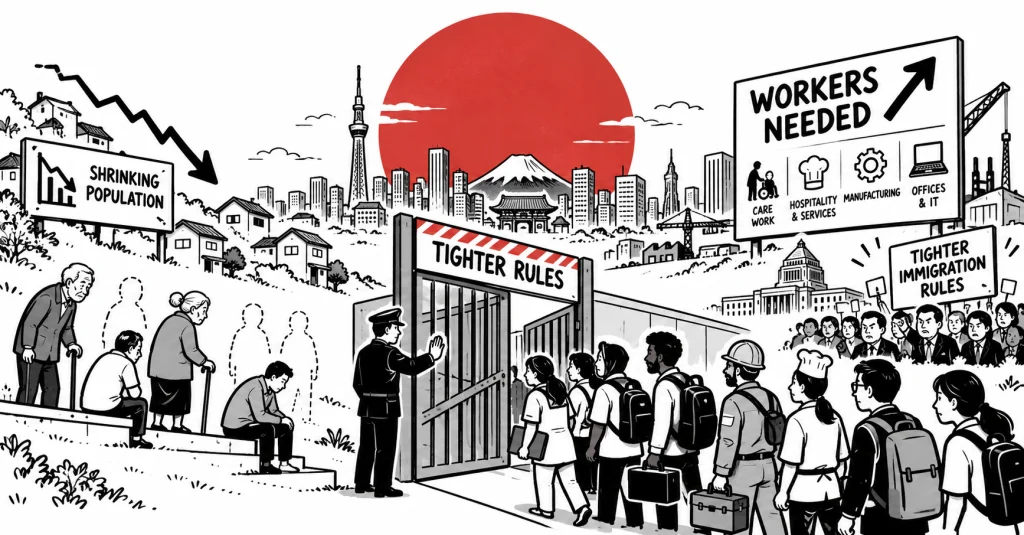
Japan’s population fell again while its foreign population reached a record, exposing a widening gap between the country’s demographic needs and its tightening politics on immigration.
Japan lost more than 3.17 million residents between 2020 and 2025, according to final census data released in late September and reported by The Japan Times. The population fell 2.5% to about 122.97 million, the third consecutive decline recorded by the five-year census. The number of Japanese nationals dropped even faster, falling 3.5% to 119.1 million, while the share of residents aged 65 or older rose from 28.5% to 29.4%.
One group moved sharply in the other direction. Foreign residents increased 39.8% to 3.84 million, the highest level on record, with Chinese nationals making up 24% of that population and Vietnamese nationals 15.9%. That growth added roughly 1.1 million people over five years, offsetting about a quarter of the decline in Japanese nationals and keeping the country’s overall loss from being considerably steeper.
The Workforce Problem Is Becoming a Migration Problem
The census puts Japan’s demographic challenge in unusually plain terms. Fewer Japanese workers are entering the economy, more are aging out of it, and foreign residents make up a growing share of the people who remain. Immigration has moved from the margins of Japan’s workforce story to the center of its basic arithmetic.
That dependence is deepening just as the government tightens the rules. Under Prime Minister Sanae Takaichi, the fee for permanent residency has risen to about $1,271 from $64, roughly 20 times the previous cost, and a five-year residence permit now costs about $475, up from $38, Fortune reports. Applicants for permanent residency must now earn at least about $36,428 a year, demonstrate Japanese language proficiency and show an understanding of local rules and customs, and the government can revoke that status over unpaid taxes, missed pension or health insurance payments, or violations of the law. Takaichi has described the changes as building an “orderly” system in which citizens and foreigners can live safely and securely, while critics describe the government’s posture toward foreigners as xenophobic.
A Bind Shared Across Wealthy Countries
Japan is far from alone in this position. Wealthy countries across Europe, North America and East Asia are aging while political resistance to immigration grows. Employers need workers, governments need taxpayers and communities need younger residents to sustain local services, yet migration is often debated as though it could be restricted without touching any of those needs.
The Numbers Are Already Answering Part of the Question
Japan has spent years on policies meant to raise birth rates, support families and keep more people working longer. Those efforts may slow the decline over time, but they cannot quickly replace millions of working-age adults, because a child born today will not enter the labor force for roughly two decades. Foreign workers can arrive now, and the census shows they already are.
None of that settles legitimate debates over migration levels, labor standards or integration, but it makes the trade-off harder to obscure. Japan’s citizen population is shrinking, and foreign residents are increasing fast enough to soften part of that loss. The political debate is usually framed around how many foreigners Japan is willing to accept. The census points to a harder question: how much population decline Japan is willing to absorb in order to limit them.
Sources: The Japan Times; Fortune