
The numbers haven’t fully caught up yet. They will.
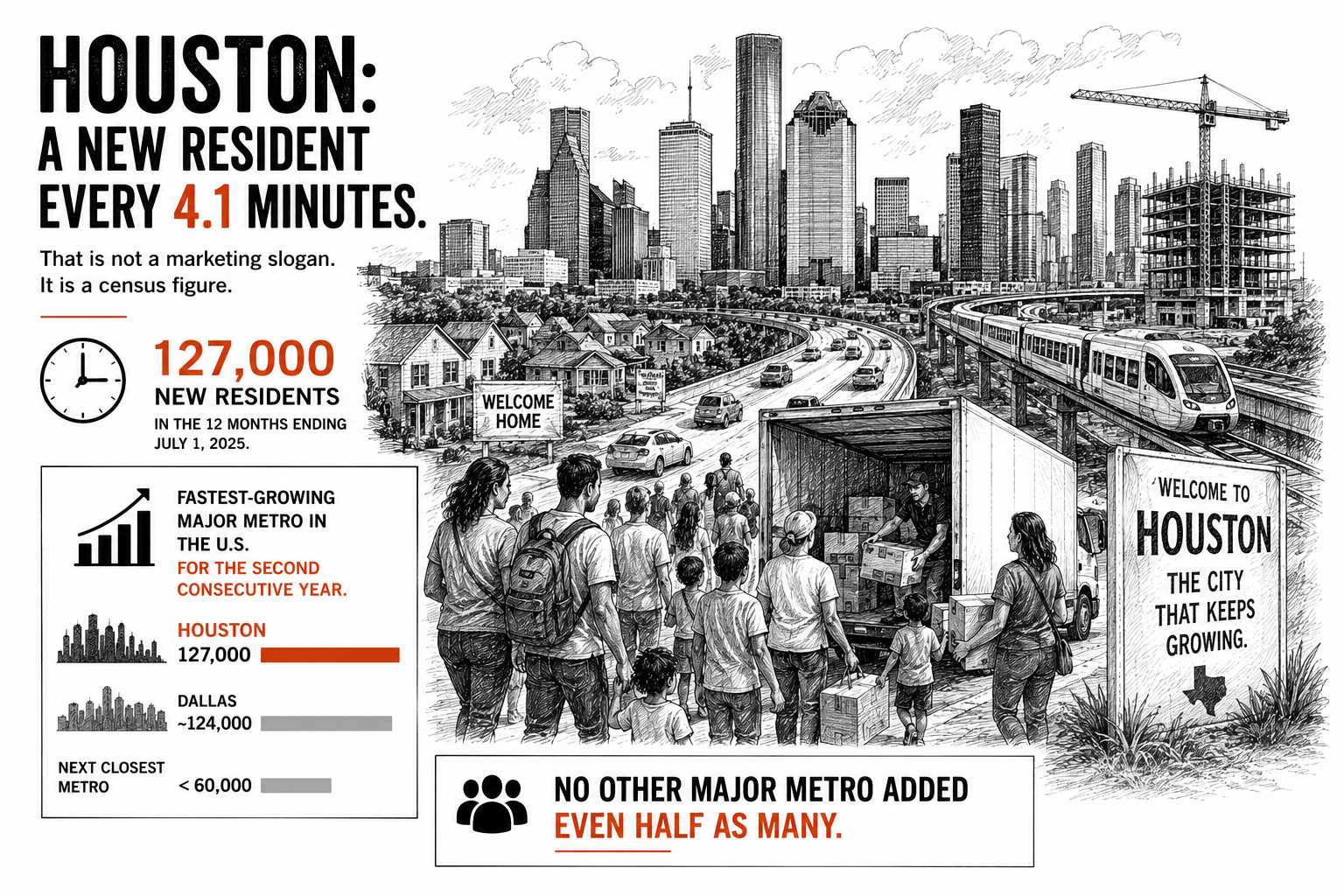
Houston added a new resident every 4.1 minutes last year. That is not a marketing slogan. It is a census figure — 127,000 new residents in the twelve months ending July 1, 2025, making Houston the fastest-growing major metro in the United States for the second consecutive year. Dallas came closest with roughly 124,000. No other metro added even half as many.
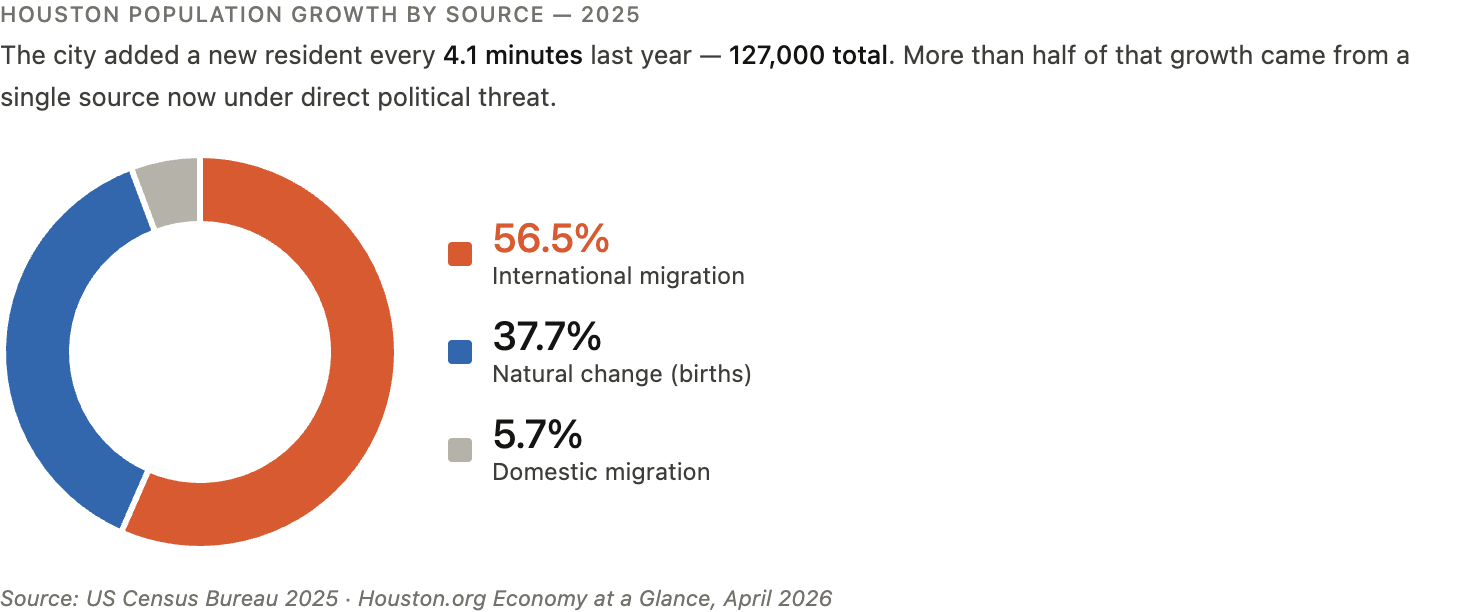
That growth is not self-sustaining. It is the product of a specific, deliberate, and now politically contested pipeline — international migration — that has powered Houston’s expansion in ways that no other American city has matched at this scale.
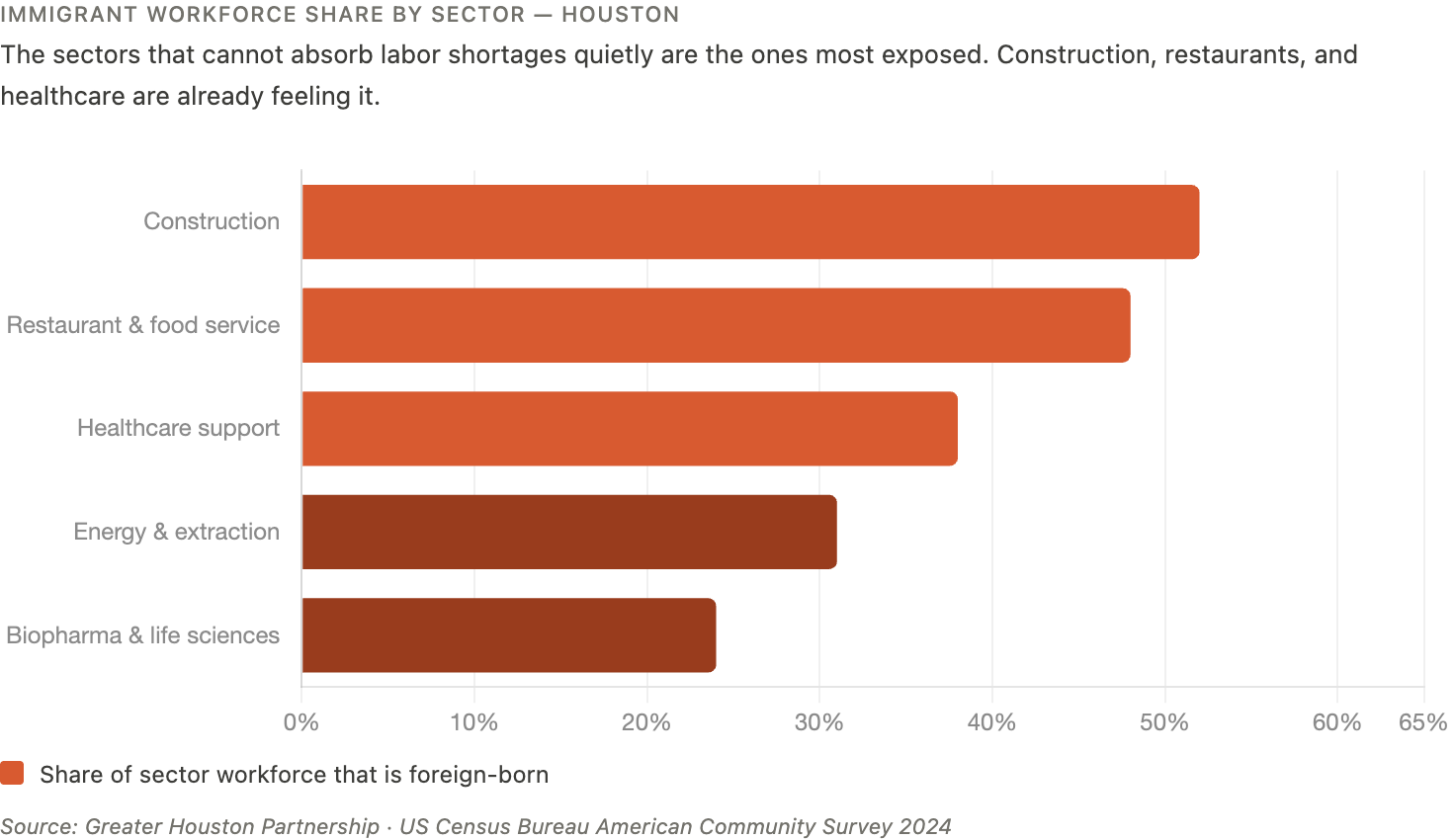
International migration represented 56.5% of Houston’s total population growth in 2025. Domestic migration — Americans moving to Houston from other states — fell 63.7% in the most recent data period. The city’s labor market, construction sector, restaurant industry, healthcare system, and energy infrastructure all run on a workforce that is 31.8% foreign-born. The immigration enforcement policies currently being implemented in Washington are not an external pressure on Houston’s economy. They are a structural intervention in the engine that makes the whole thing run.
What the lag in the data is hiding
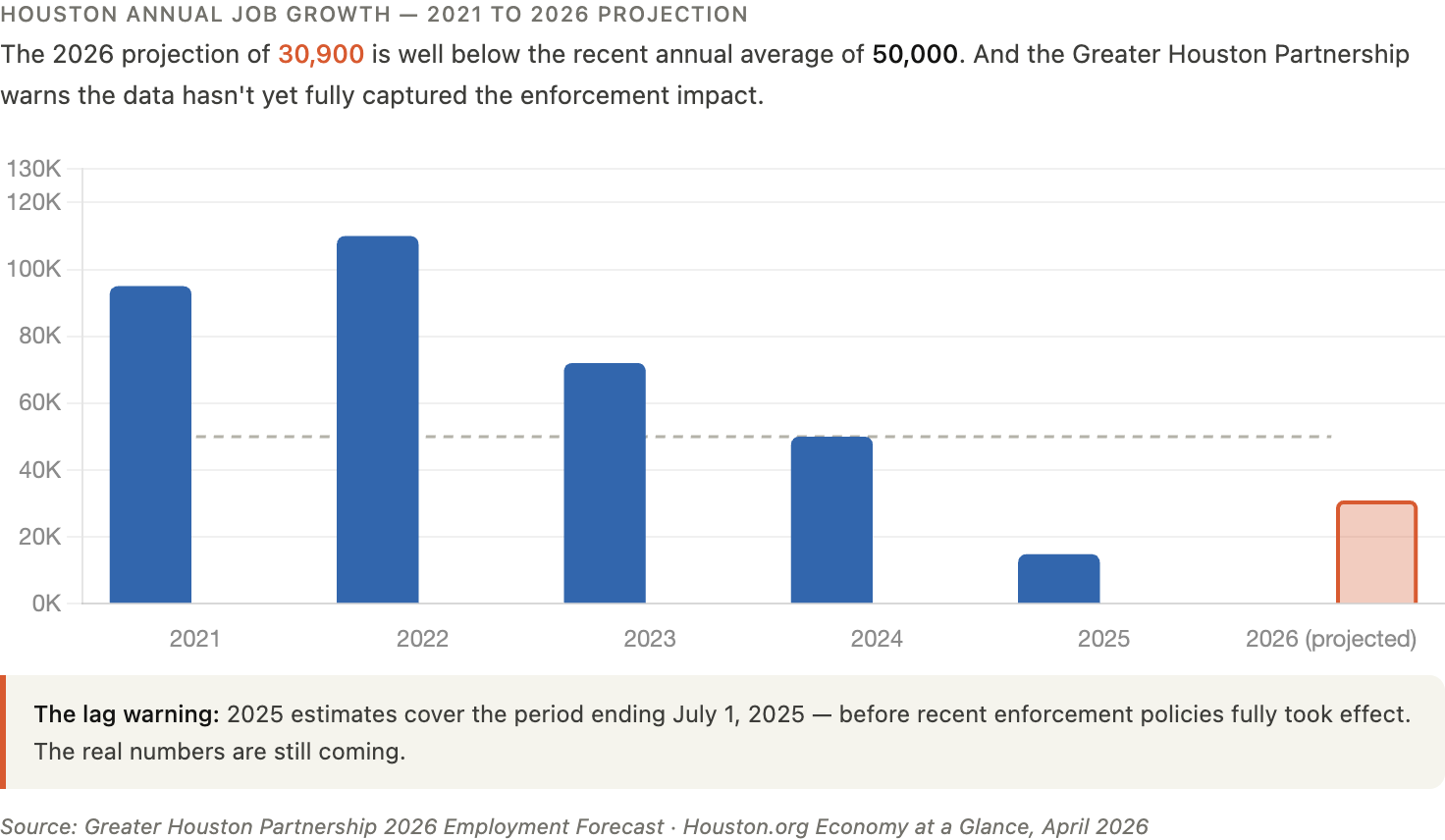
The Houston.org April 2026 economic report contains a quiet warning that deserves to be read carefully: the 2025 population estimates cover the twelve months ending July 1, 2025. The report notes explicitly that “some of the apparent strength in 2025 likely reflects inflows that occurred before recent immigration policies took effect.”
In plain language: the data that shows Houston still growing strongly is measuring a period before the full enforcement impact arrived. The real numbers are coming. The projection for 2026 job growth is 30,900 — significantly below the 50,000-job annual average of recent peak years. The construction sector added 16,000 jobs over the last year, but Dow — which employs 7,000 workers across six major Houston sites — announced plans to cut 4,500 jobs in early 2026, with nearly 4,500 contractors in Texas also potentially affected. The labor market is tightening from both ends simultaneously: fewer new workers arriving, and existing employers reducing headcount.
The sectors that cannot absorb this quietly
Some industries can adapt to labor shortages through automation, process changes, or price increases that customers absorb without noticing. Others cannot. The restaurant industry is the most visible because it is the most immediate — and because Texas restaurant owners are now saying publicly what they have been managing privately for months.
The energy transition is the less-discussed pressure point. Houston has positioned itself as the capital of a new energy economy — carbon capture, hydrogen production, battery storage, renewable infrastructure — that requires exactly the kind of construction and technical workforce being depleted by enforcement. The biopharma sector alone has seen job postings surge 68% year over year statewide, reflecting the expansion of the Texas Medical Center and satellite hospital networks across the suburbs. This is healthcare infrastructure being built for a growing population — built by a workforce whose legal status is increasingly precarious.
The model’s internal contradiction
Houston’s economic model has always been built on three pillars: business-friendly regulation, low taxes, and an abundant, affordable workforce sustained substantially by immigration. The political coalition that built that model is now running enforcement policies that are systematically dismantling the third pillar while the first two remain intact.
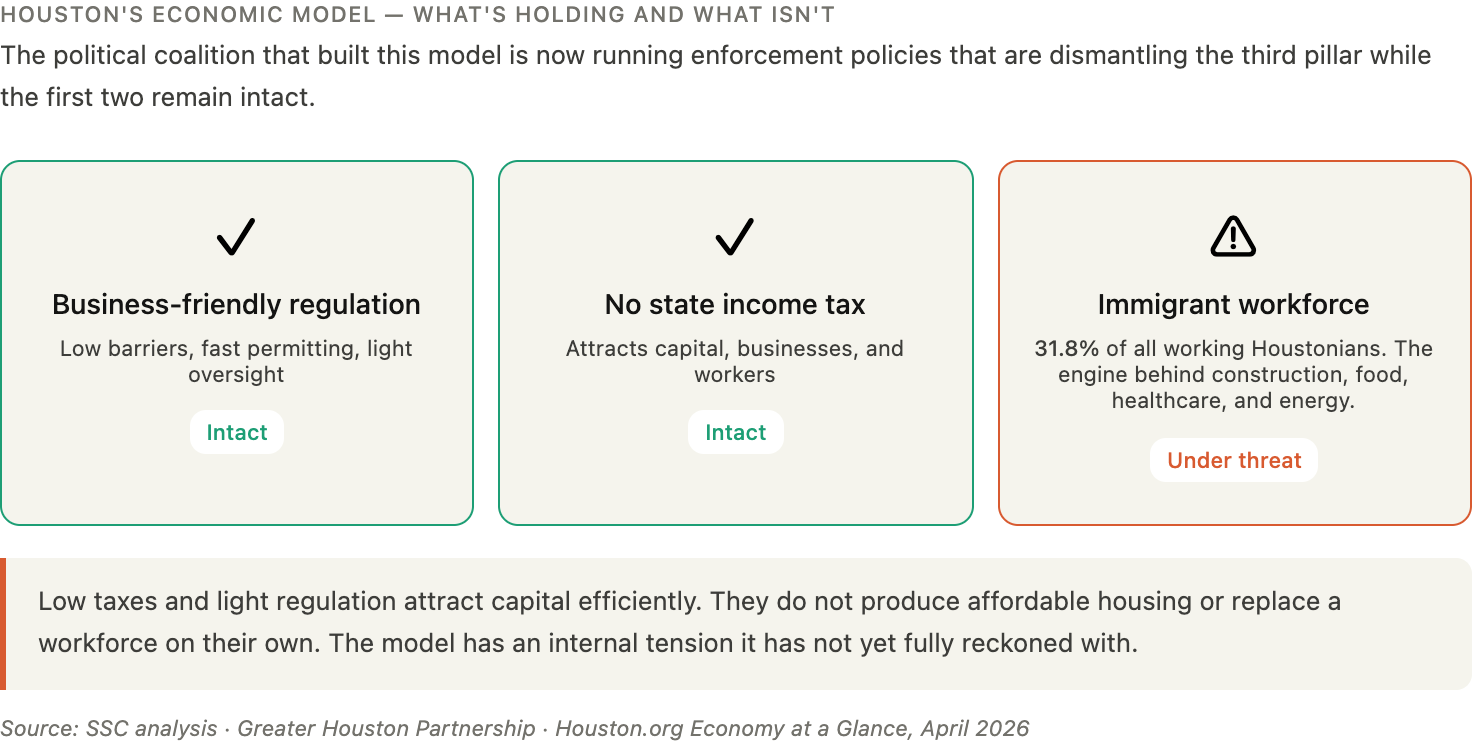
The consequence is a city that will continue to look strong in the aggregate numbers for another reporting cycle or two — and then will face a reckoning that the current data is not yet showing. The residents added every 4.1 minutes last year were building the city. The question the 2027 numbers will have to answer is: who is building it now?