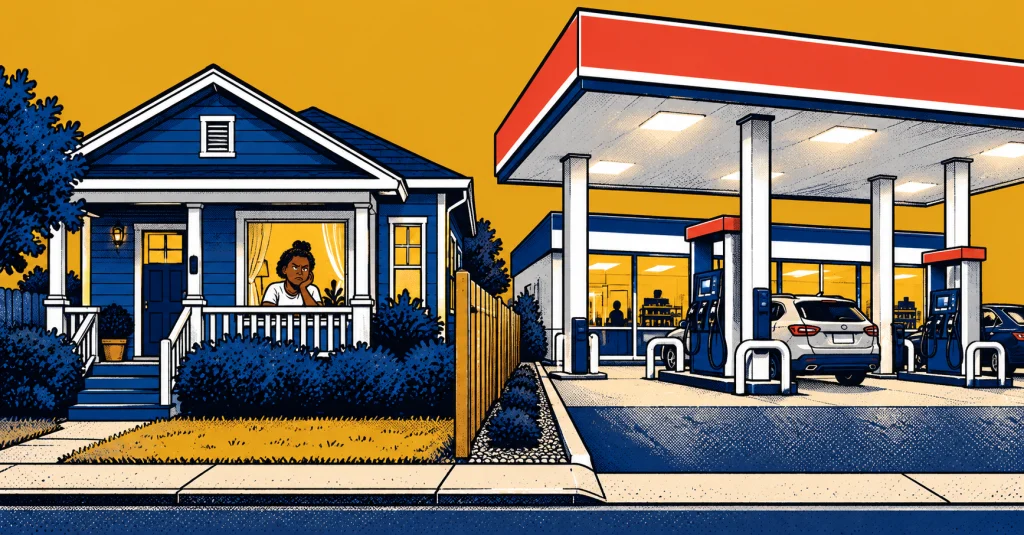
For drivers, a new gas station is a convenience. For its owner, it’s an investment. For the family next door, it can mean more cars pulling in and out, bright lights, delivery trucks, noise and worries about fuel emissions. Houston has no conventional zoning to keep homes and businesses apart the way many U.S. cities do, and those competing interests are now at the center of a proposal to limit where gas stations can go.
On October 21, city officials presented a proposed Retail Fuel Station Ordinance to the City Council’s Economic Development Committee. The rules would restrict new stations near residential areas. They follow complaints from residents and preservation groups in neighborhoods including Third Ward and Old Sixth Ward.
The proposal sets up a two-step review. A station on a major thoroughfare wider than 80 feet would qualify automatically. A station on a narrower road would face a second test: it could go forward only if less than half the surrounding area is residential. Developers who fail that test could ask the Planning Commission for a variance. The Houston Chronicle reported that officials are still deciding whether to measure nearby homes within 50 or 100 feet of a proposed site.
The rules would apply only to new applications. Existing stations would not be forced to move. The proposal goes to the Planning Commission on November 12, with a public hearing before the commission on December 17. City Council would hold its own hearing and vote after that, possibly as early as January. The details could still change along the way.
Houston’s approach to land use is why this debate matters so much. The city is known for having no conventional zoning, but that doesn’t mean anything goes. Building codes, parking rules, deed restrictions and development ordinances already shape what gets built. Still, Houston allows homes and businesses to sit side by side in ways most cities don’t.
That flexibility has helped Houston grow quickly. Businesses can set up near their customers, and landowners have more choices about how to use their property. But it also creates friction when a busy commercial use lands next to homes. A quiet residential street can suddenly see customers, delivery trucks and turning cars all day long.
City data shows how common this is. Of the 188 gas station applications filed over the past four years, 95 percent were on major thoroughfares. Yet 52 percent had homes within 50 to 100 feet of the site. In other words, the ordinance is responding to a real pattern, not a hypothetical one. It also raises a question: are road width and distance to homes the right ways to measure a station’s impact?
Residents pushing for limits point to quality of life, neighborhood character and public health. Developers and property owners want predictable permitting and the freedom to run lawful businesses. Rules that are too strict could limit new services or lead to inconsistent decisions. Rules that are too loose could leave neighbors’ complaints unresolved.
Not every gas station near a home has the same effect, either. Traffic flow, environmental controls, hours and site design all matter. Those factors could shape which projects qualify automatically and which need a closer look.
The debate points to a bigger question: how does a city without traditional zoning manage the side effects of growth? Houston has long treated its flexibility as an economic advantage. Residents are now asking what that flexibility should look like when new businesses change life around their homes.
The city isn’t abandoning its land-use model. It’s considering a narrow fix aimed at one type of business. Whether that satisfies residents, leaves room for development and produces rules the city can enforce will depend on the final ordinance officials put before the public.