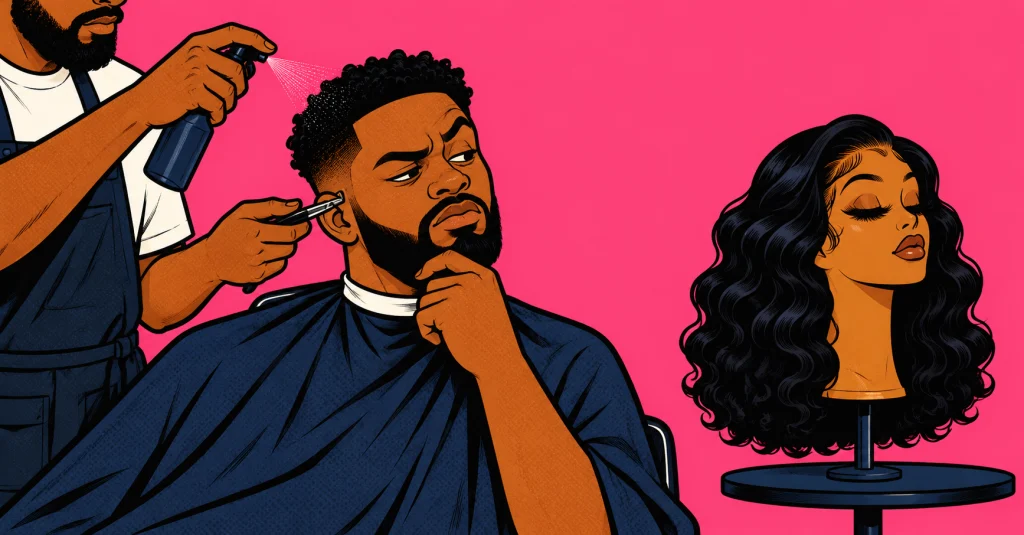
Picture a man settling into the barber’s chair with specific instructions. The hairline needs to be filled in, the patchy spots in the beard need color, the gray needs to disappear, and the finished result should look precise from every angle. There is nothing ridiculous about wanting a good cut, and plenty of men leave the shop with a hairline sprayed on and a beard dyed darker than it grew. The comedy begins when the same man walks out ready to announce that women do too much to their appearance: the lashes are excessive, the wig is deceptive, the makeup should come off. He wants a natural woman, but he is not natural either, and his own enhancements never seem to interfere with the principle.
Grooming is ordinary, and men should be able to enjoy it, a point SSC has made in asking who decided men taking care of themselves was corny. So should women. The problem is the moral judgment attached to whose work is visible. A man’s improved appearance gets accepted as proof that he takes care of himself, while a woman’s can prompt an investigation into which parts are hers, what she paid and whether she has somehow misled the public. Hair becomes testimony, eyelashes become a character reference, and a conversation about taste turns into a claim that a woman owes strangers an unaltered version of herself before they decide whether to respect her.
A Preference Is Not a Permission Slip
There is room for personal preference without any of this. You can like short nails, minimal makeup or a certain hairstyle, and nobody needs to find every look appealing. But a preference describes what you enjoy, not authority over somebody else’s body. Announcing that a woman would look better without half her choices assumes your approval was the assignment. She may like the dramatic lashes, enjoy changing her hair or have dressed for a room you were never going to enter, and her appearance can serve a purpose beyond earning your favorable review.
The expectation gets absurd when the desired result is polished but the process has to stay invisible. Hair should be full, skin should be clear and the body should meet whatever specifications are in fashion that year, yet the products, appointments, styling and effort, some of them costing more than $2,000, are supposed to leave no trace. So what exactly is being requested? A person whose appearance needs little maintenance, or a person who does the maintenance quietly enough to preserve the illusion? Those are different expectations, and treating them as the same puts women in a contest whose rules can change after they have already played.
A Wig Is Not a Lie
Wigs make the double standard easy to see because they expose the assumption that appearance must be a permanent disclosure. Everyone uses clothing, haircuts, lighting and camera angles to present themselves, and men have their own versions of a wig, from a painted-in hairline to a full hair system. A wig does not turn its wearer into a dishonest person any more than a hairline enhancement does. Nor does cosmetic work automatically prove insecurity, vanity or a desire to please men, since those judgments require knowledge of someone’s motives that a photograph cannot supply. Women can make choices other people dislike without those choices becoming public evidence against them, and the same courtesy that makes a man’s grooming unremarkable should extend beyond the barber’s chair.
That does not mean every beauty practice is harmless, every marketing claim is honest or every standard should be accepted. There are serious conversations to have about cost, pressure, medical risk and the feeling that an ordinary face is never finished, and those conversations need more than ridicule aimed at the person working through them. A man can question a demanding beauty culture while also considering which of its demands he rewards. If he expects women to look immaculate and then mocks them for the work, he is helping maintain the very pressure he claims to dislike, and his part in it belongs in the discussion alongside his preferences.
The Standard Is Consistency
Enjoy your haircut, your skincare, your whitening strips or whatever makes getting ready more satisfying, and let other adults enjoy their choices too. Men already understand this when it comes to their own faces, as the debate over why the beard stays and the mustache goes shows. In a relationship, people can talk about attraction and expectations with care while recognizing that affection does not come with ownership. Outside a relationship, passing a woman on the internet does not obligate her to explain her hair.
A man with a detailed grooming routine already knows that appearance takes decisions, time, money and a little help from a can. He can extend that understanding to women without approving of every look. His hairline will survive the generosity.