
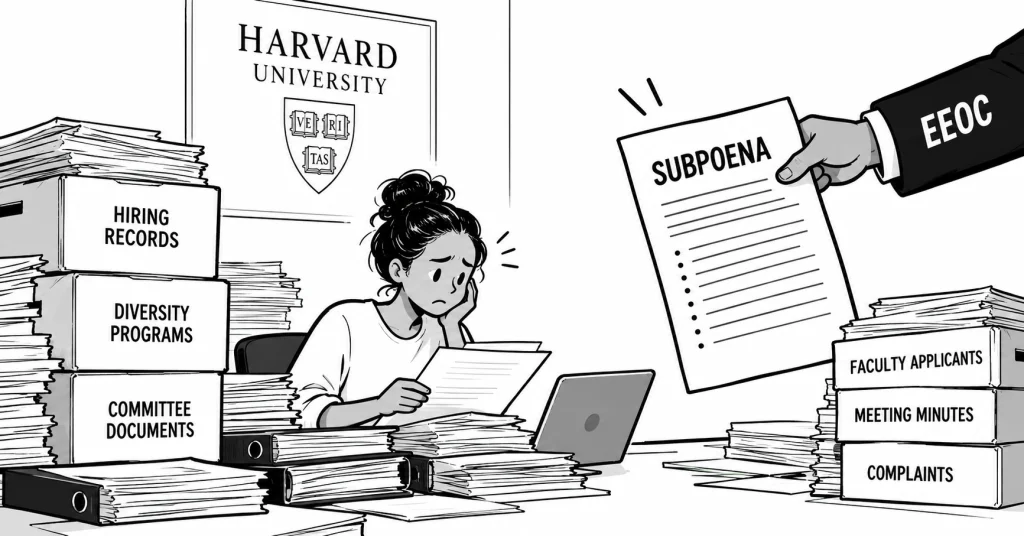
The federal agency says it needs additional records to investigate alleged employment discrimination. Harvard says more than 700 requests amount to an excessively broad investigation that would burden operations across its 13 schools.
More than 9,000 pages of information have not settled the dispute between Harvard University and the Equal Employment Opportunity Commission. The agency filed a subpoena-enforcement action on September 29, asking a federal court to compel additional disclosures in an investigation of Harvard’s faculty employment practices. Harvard says the subpoena contains more than 700 separate requests, involving hundreds of people, according to Higher Ed Dive’s reporting on the court filings. The EEOC argues that the university is withholding relevant information. Harvard disputes the demands’ validity and scope. Before any determination of discrimination, the immediate fight is over how extensively the government can examine the university’s employment decisions.
The Investigation Reaches Across Years of Hiring Decisions
The underlying charge dates to April 2025, when EEOC Chair Andrea Lucas alleged that Harvard may have used discriminatory recruiting, development and promotion practices dating back to 2018 to increase faculty diversity. The agency contends that programs directed toward people from underrepresented backgrounds may have excluded other employees or applicants based on protected characteristics. Its allegations extend to Harvard Medical School and affiliated hospitals and include student employees and trainees. These remain allegations under investigation. The subpoena action asks the court to require production of evidence; it does not establish that Harvard’s diversity objectives or employment decisions violated federal law.
The requested material reaches beyond a single rejected applicant or contested promotion. According to the reporting, the EEOC seeks hiring committee guidance, diversity-office meeting minutes and agendas, records concerning a diversity fellowship program, discrimination complaints and detailed information about faculty and tenure applicants. It also wants information about officials allegedly responsible for implementing faculty diversity goals. The agency says those records could illuminate employment trends underlying its charge. The breadth makes this an inquiry into how Harvard designed and carried out its practices over time, with potentially extensive work required to locate records across departments, programs and institutions.
Harvard Disputes Both the Burden and the Purpose
In a June petition attached to the agency’s court application, Harvard argued that compliance would impair operations across its 13 schools and impose costs disproportionate to the information’s relevance. The university pointed to what it described as a vague charge without a specifically identified aggrieved individual. It also said it had offered 68 days of availability, totaling hundreds of hours, to discuss the requests with the agency. Those assertions challenge the EEOC’s account that Harvard continues withholding information despite good-faith efforts to obtain it. The dispute therefore concerns both the reach of the subpoena and whether the parties have meaningfully worked toward resolving their disagreements.
Harvard also alleges that the investigation forms part of the Trump administration’s effort to pressure the university into accepting ideological demands. The EEOC, by contrast, says it is seeking information to determine whether Harvard violated Title VII of the Civil Rights Act of 1964. The university’s retaliation claim should be assessed alongside the agency’s stated enforcement purpose, rather than treated as an established explanation. The broader conflict over Harvard’s funding and international students supplies context, but this proceeding has a specific question: whether the court should enforce the employment-record demands Harvard has challenged.
The Process Carries Consequences Before a Finding
The case illustrates how scrutiny of DEI practices can become an operational issue before an investigation reaches a conclusion. Producing years of hiring and promotion records requires institutions to identify responsive material, coordinate across offices and address sensitive employment information. Employers watching the dispute have reason to examine how clearly their own policies explain eligibility and selection criteria. Yet the existence of an investigation does not establish that a program is unlawful. The substantive concern is whether employment decisions discriminate against individuals; the evidence must connect an institution’s stated objectives to what happened in recruiting, development, hiring or promotion.
The next consequential step is the court’s response to the EEOC’s enforcement request, including whether the disputed demands should be enforced or narrowed. Additional disclosures could help the agency assess its allegations, while limits could constrain the investigation’s reach. Either outcome would still leave the underlying discrimination question to be resolved. For Harvard and other employers, the case puts documentation, investigative authority and institutional capacity in the same frame. Its significance will depend on what the records establish—and whether the eventual findings justify the breadth of the inquiry used to obtain them.