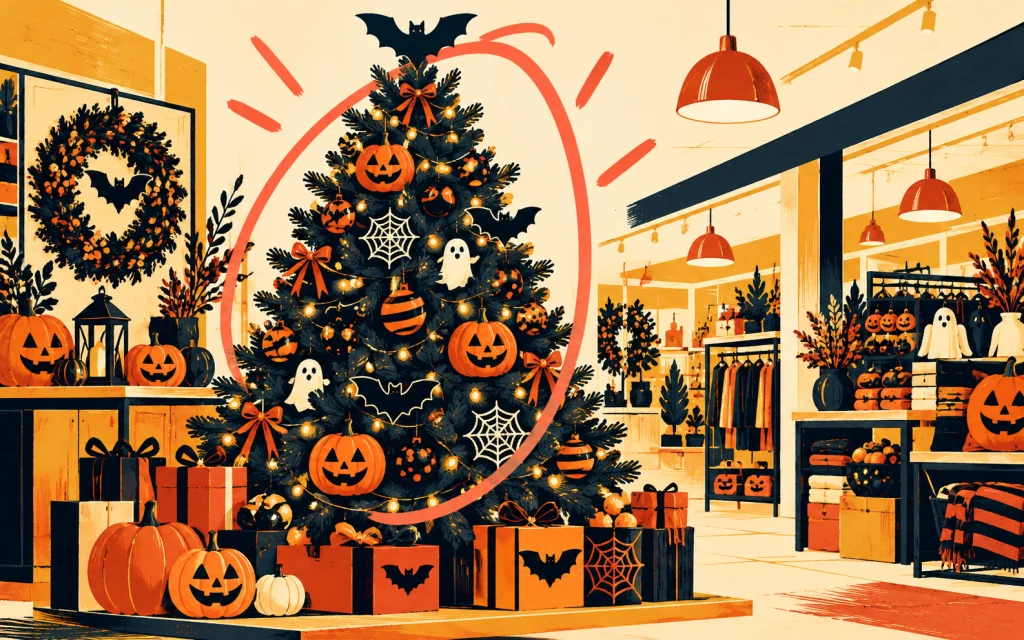
Retailers are turning a one-night holiday into a season of decorating, shopping and social rituals. The shift says as much about the business of celebration as it does about costumes.
BY SOCIAL STORYTELLERS COLLECTIVE NEWS DESK
OCTOBER 12, 2026
Halloween used to have a relatively contained retail calendar: buy candy, find a costume, carve a pumpkin and wait for October 31. Now the shopping list can include an artificial tree, themed wreaths, ornaments and enough decorations to keep a home transformed for weeks. British retailers have begun calling the phenomenon “Halloweenmas,” a mashup that captures how the holiday is borrowing Christmas’s decorating habits without its formal obligations. The Guardian reported October 11 that the number of Halloween-themed products available through wholesale platform Faire grew from 425 in 2021 to 2,632 in 2025, an increase of more than 500%. This is not merely a larger candy aisle. It is the construction of another retail season.
The holiday that keeps expanding
One of the clearest signals comes from home decor. UK retailer Wilko reported that sales of artificial Halloween trees in September were 200% above the same month a year earlier, according to the Guardian. Party retailer The Box Party said it had purchased 40% more stock for the season. These figures describe particular businesses and platforms, not the entire global Halloween economy. Still, they show how merchants are extending the range of products attached to the celebration. A costume is often a single-use purchase. A tree, wreath or set of ornaments can become a repeatable ritual, inviting annual refreshes and earlier shopping.
That shift is especially appealing to retailers because it spreads demand across more weeks and more departments. A customer might begin with home decor in September, purchase party supplies in early October and return for candy and costumes at month’s end. Seasonal merchandise moves beyond supermarkets and costume shops into crafts, interiors, cosmetics and gift retail. The economic incentive is clear: create more reasons to visit stores without depending on one weekend’s sales. The question for consumers is whether the longer season creates more enjoyment or simply more occasions to spend.
Celebration as self-expression
Retail analysts quoted in the Guardian point to younger adults as important drivers. Mintel research cited in the report found that 40% of Halloween buyers used social platforms to purchase products directly. For consumers ages 16 to 34, the holiday can function as a chance to experiment with makeup, fashion, themed gatherings and visual identity. Unlike Christmas, Halloween has relatively few fixed rules about how a home should look or what a celebration should include. That flexibility makes it adaptable to both elaborate parties and inexpensive do-it-yourself projects.
The trend also complicates the familiar argument that consumers have stopped spending on discretionary items. Households may feel squeezed and still devote money to celebrations that offer a social payoff. Spending on a costume or decoration is not necessarily evidence of financial comfort; it can reflect a choice to protect moments of fun amid uncertainty. Retailers understand that emotional dimension. They are not simply selling plastic pumpkins. They are selling the possibility of an occasion worth organizing.
Halloweenmas may prove to be a lasting annual habit, or some of its more elaborate products may fade as novelty wears off. What is already visible is a broader business strategy: transform isolated events into seasons, and seasons into identities customers can buy into. The more interesting story is not whether Halloween has become Christmas. It is how thoroughly modern retail has learned to expand the calendar around the moments people want to share.