
Dalton Eatherly, the IRL streamer known online as ChudTheBuilder, built an audience of more than 170,000 followers on Kick by doing one thing consistently: approaching Black people in public spaces, using racial slurs, and livestreaming the confrontations. He is well known for regularly using racist remarks against Black individuals and asking anyone who challenges him to stop “chimping out.” Last week, X locked his account for hateful conduct violations — the same week the screenshots circulating online showed six posts flagged for removal, each using dehumanizing language targeting Black people. The lock came after Kick had already permanently banned him. He is now streaming on Pump.fun.
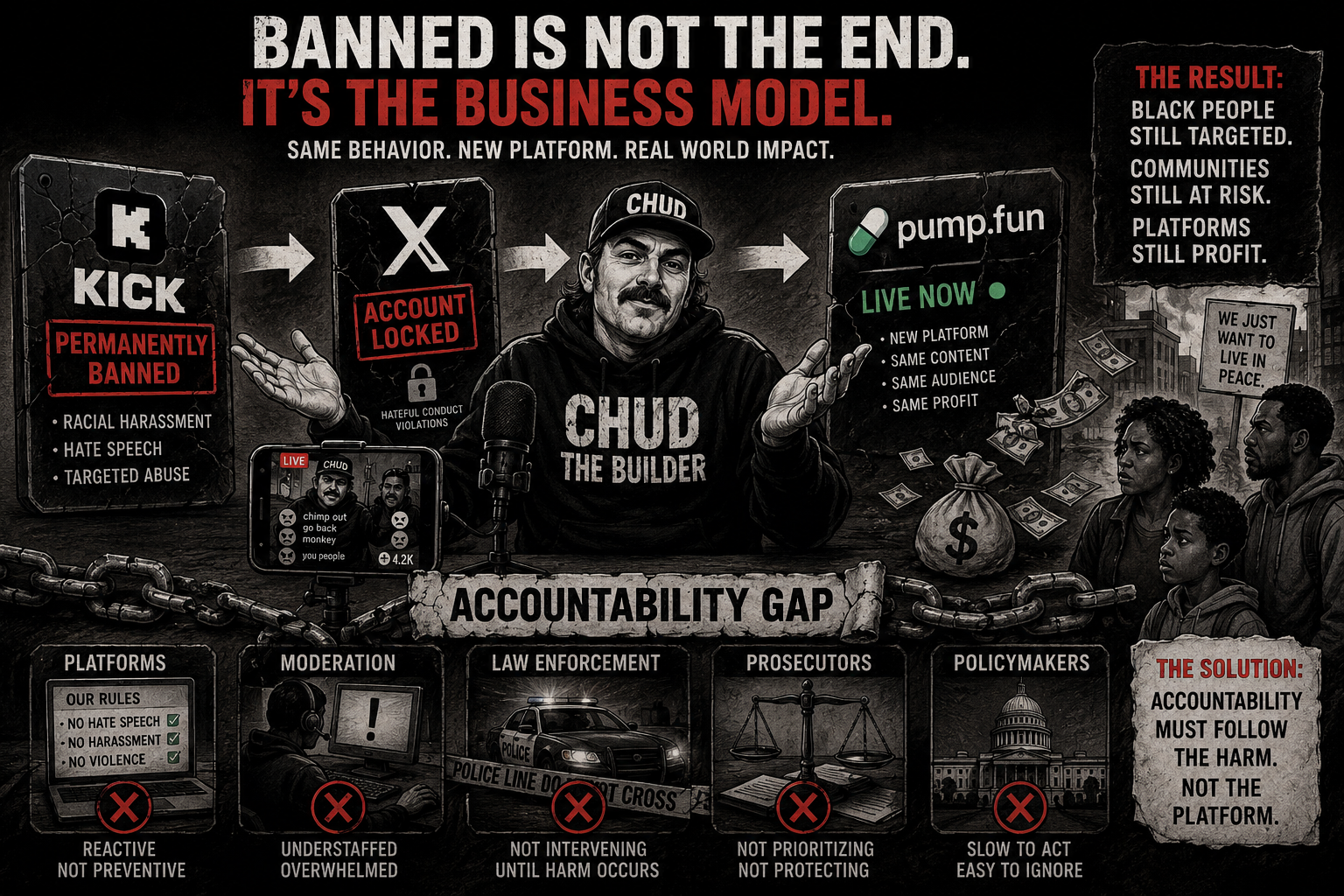
That sequence — violation, enforcement, migration, continuation — is the actual story. Not the content itself, which is neither new nor surprising, but the infrastructure that keeps allowing it to move.
Kick initially banned Eatherly for three days after he approached a group of Black men and used a racial slur directly to their faces on a live stream. The platform demonetized his channel and removed his verification badge during that period. He appealed. The appeal was denied and the ban was extended indefinitely — not because Kick acted on principle from the start, but because public pressure made inaction too costly. Clips of the streamer allegedly harassing Black Americans went viral and the platform faced sustained backlash before making the permanent ban decision. Enforcement followed exposure, not policy.
X’s account lock this week follows the same pattern. The posts flagged for removal — documented in screenshots — used dehumanizing language targeting Black people and framed incidents of violence as confirmation of racial inferiority. X’s hateful conduct policy explicitly prohibits promoting violence or threatening people on the basis of race, ethnicity, or national origin. The content was not ambiguous. It was in plain view, generating thousands of impressions, before the lock was triggered. The question worth asking is not whether the platform eventually acted. It is why the threshold for action is set where it is, and whose experience of harm the platform is actually optimizing against.
The American Freedmen Legal Fund has filed a formal notice with Pump.fun documenting a pattern of harassment, threat-based conduct, and ongoing legal proceedings tied to the account — a signal that civil society organizations are doing enforcement work that platforms have declined to do proactively. That dynamic matters. When the burden of flagging documented harm falls on advocacy organizations rather than on platform moderation systems, it tells you something about who those systems are designed to protect.
The free speech framing Eatherly uses to defend his content is worth naming for what it is: a rhetorical strategy, not a legal or ethical argument. He describes his conduct as “edgy, harmless humor” and positions himself as a free speech patriot targeted by activists — a framing that has proven durable with a specific audience precisely because platforms have been slow to classify targeted racial harassment as the conduct it functionally is. Approaching Black people in public spaces, using dehumanizing language on a livestream with a monetized audience, is not political speech. The First Amendment does not obligate private platforms to host it, and the fact that it took sustained public pressure to trigger enforcement on content that was never ambiguous is not a free speech story. It is a prioritization story.
The migration to Pump.fun is the detail that most clearly reveals what is at stake. Pump.fun is a crypto-adjacent livestreaming platform with minimal moderation infrastructure and financial incentives structured around engagement. When a creator is deplatformed from Kick and locked on X, the next stop is not silence — it is a platform where the same content can generate revenue with fewer constraints. The infrastructure of harm does not end when one platform acts. It relocates.
Platforms are not neutral pipes. They make choices about what content generates revenue, what conduct triggers enforcement, and how long documented harm has to circulate before it becomes a moderation problem. ChudTheBuilder’s presence across multiple platforms simultaneously — building an audience on Kick, amplifying on X, monetizing on Pump.fun — was not a bug in those systems. It was the systems working as designed, until the cost of inaction became visible enough to force a response. That calculus has never protected Black people. It has only protected platforms.