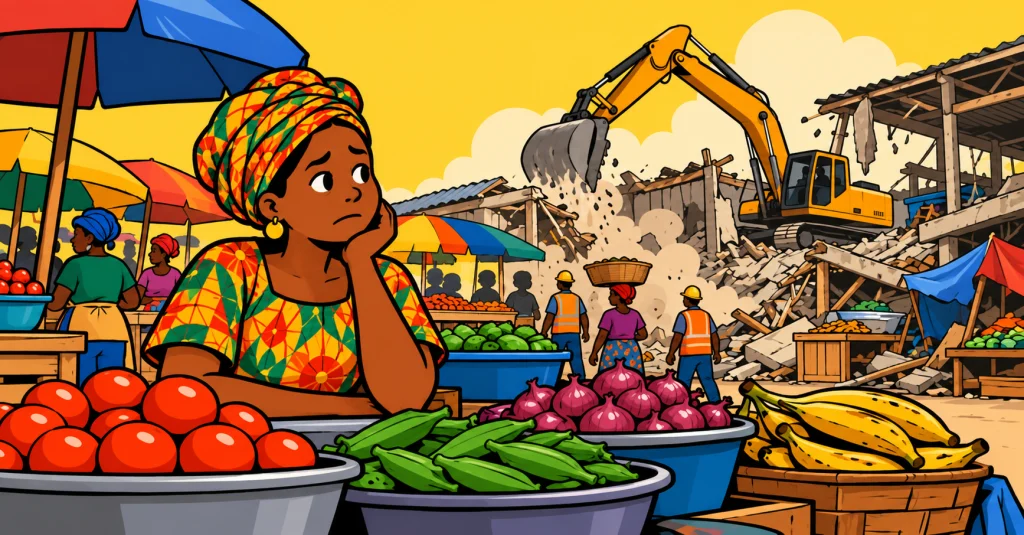
For a market trader, a familiar selling location is more than a place to arrange merchandise. It is where returning customers know to find them, where goods are delivered and where daily sales generate the money needed to restock inventory and support a household. When that space disappears, even temporarily, the consequences can begin long before a new building takes its place. Traders in Accra’s Madina Market are confronting that uncertainty as local authorities demolish an aging section of the commercial complex to make room for a modern facility.
The La Nkwantanang-Madina Municipal Assembly began demolishing the old Zonal Council structure inside Madina Market on October 22, following a structural assessment that raised concerns about the building’s safety. Municipal Engineer Mohammed Danjumah Ahmed said testing recorded concrete-strength readings as low as 11 Newtons per square millimeter, prompting fears that continued use of the deteriorating structure could endanger traders and shoppers. Ghana’s 3News reported that municipal authorities considered the demolition necessary to prevent a potential structural failure.
The demolition is limited to the affected Zonal Council section, not the entire Madina Market. Officials plan to use the cleared site for a modern 24-hour market intended to increase trading capacity, improve facilities and create a more organized commercial environment. Citi Newsroom reported that the assembly has designated alternative trading space near the existing market to help affected businesses continue operating during redevelopment.
But having an alternative location available is not necessarily the same as maintaining a functioning business. Market traders often depend on visibility, regular foot traffic, established customer relationships and access to transport routes. Moving to a temporary location can require rebuilding those relationships, communicating with customers and adjusting how inventory is stored and transported. For businesses operating on narrow margins, even a short disruption can affect household income and the ability to purchase stock.
Some affected traders initially opposed the demolition because of its potential impact on their livelihoods. As information about the building’s condition became clearer, some expressed greater acceptance of the safety concerns while continuing to press authorities for swift reconstruction. Additional local reporting described traders operating along nearby roadsides and seeking a firm timetable for returning to permanent premises.
The municipal assembly says traders whose records have been verified will receive priority when stalls in the replacement market are allocated. That assurance could help protect established businesses, but important questions remain. How will officials document eligibility for traders who may have operated informally? Will temporary spaces provide comparable access to customers? What will the new stalls cost, and will longtime occupants be able to afford them? A confirmed construction schedule and publicly explained allocation process would give traders more certainty about their future.
The dispute also illustrates the challenges of modernizing aging public markets across rapidly growing African cities. Municipal governments face pressure to improve sanitation, infrastructure, fire safety and commercial capacity, particularly in crowded trading centers. Yet redevelopment can create economic losses before any promised improvement materializes. Projects designed to strengthen local commerce therefore depend not only on the quality of the finished buildings but also on how the transition is managed.
Madina’s planned 24-hour facility could eventually provide safer and more efficient commercial space. Better infrastructure may allow businesses to operate longer, serve more customers and reduce the risks associated with deteriorating structures. Those benefits are plausible, but they remain prospective while the demolition and reconstruction are underway.
For traders, the immediate concern is more concrete: where they can sell today, whether customers will find them tomorrow and when they will be able to return to permanent stalls. The success of the redevelopment will depend on whether the assembly protects those livelihoods while delivering the safer market it has promised.