
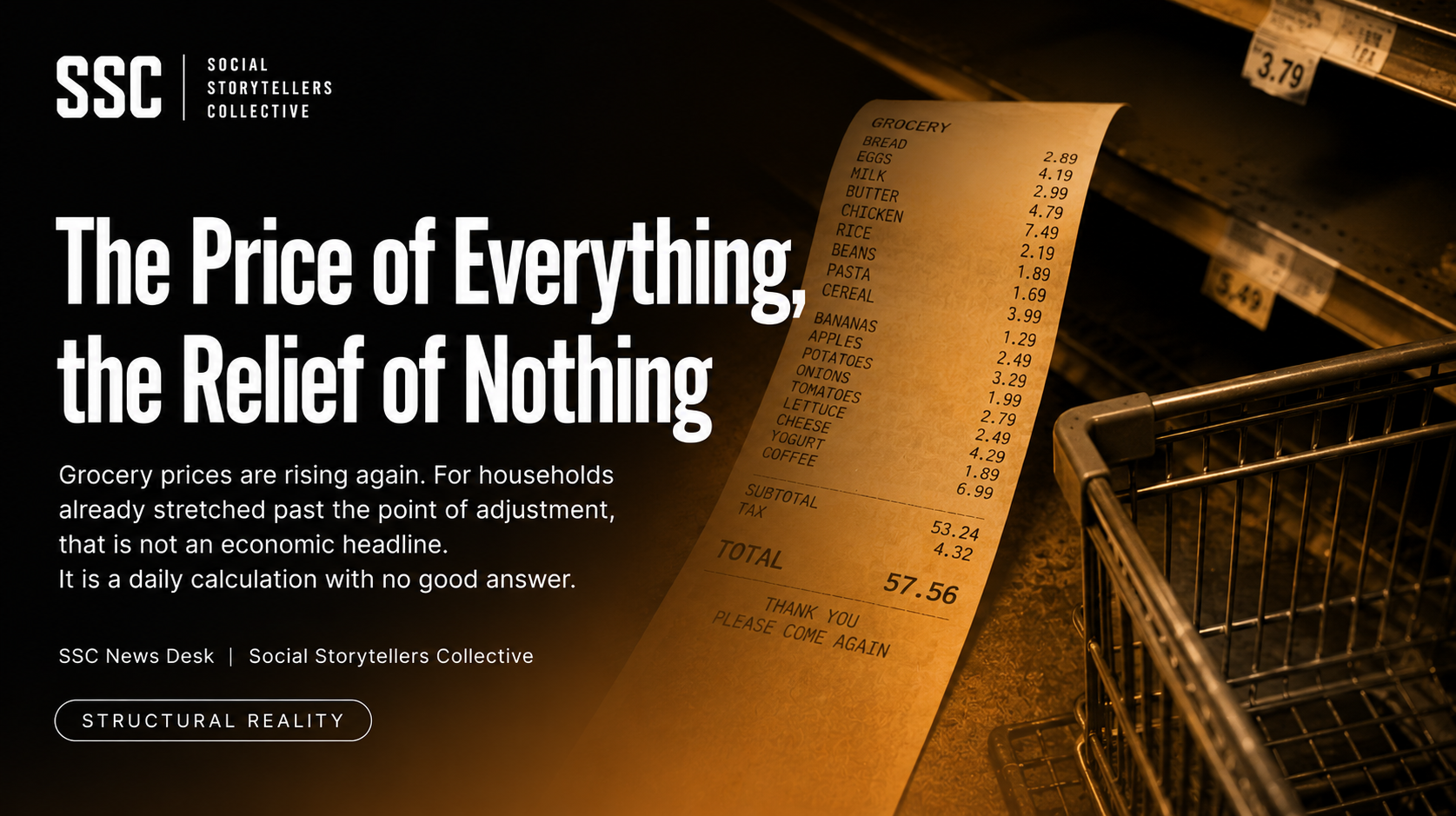
Grocery prices rose in April by the most in nearly four years, and economists say the combined impact of the Iran war and a potential El Niño weather pattern will add to those pressures well into 2027. The Bloomberg headline that circulated this week described it as a new inflation threat. For the households already inside the food insecurity numbers, the threat arrived a long time ago. What is new is that it is getting worse on multiple fronts simultaneously — and the policy decisions that could have cushioned the blow have been moving in the opposite direction.
SSC reported on May 14 that the compression was already visible across every essential category. Groceries, gas, electricity, and joblessness were converging before the latest inflation data confirmed it. A grocery budget that ran $200 every two weeks is now $350. A gas tank that cost $40 to fill now costs $78. Those are not unusual households. They are what the baseline looks like when policy, weather, and geopolitics land on the same people at the same time.
The Iran war set off price shocks for gasoline, diesel, and airfare, while tariffs on a wide range of imported goods have increased the cost of foods including fresh produce and beef. Those two pressure points are compounding each other. Fuel costs drive transportation and refrigeration costs across the entire supply chain, which means the Iran war’s energy shock does not stay in the energy category — it migrates into every item that moves by truck, every item that requires cold storage, every input that requires fertilizer. North American fertilizer prices are up 20 percent since fighting began. Weather forecasters are projecting an unusually strong El Niño will form in August, persisting into 2027 and threatening droughts in major growing regions for rice, coffee, and cocoa. The timing means the full weight of these compounding pressures has not yet arrived at the checkout counter. What households are paying now is not the peak.
The people least equipped to absorb what is coming are the people already carrying the heaviest load. Nearly 1 in 4 Black households — 24.4 percent — and 1 in 5 Hispanic households experienced food insecurity in 2024, at least double the rate for white households at 10.1 percent. These disparities reflect the impact of structural barriers rooted in systemic racism and other forms of discrimination that result in higher rates of poverty. Those numbers were recorded before the current inflation pressures fully materialized, before the Iran war’s energy shock moved through the supply chain, and before the One Big Beautiful Bill cut $187 billion from SNAP over ten years. The USDA announced in September 2025 it would discontinue its annual household food security report — meaning there will be no authoritative federal data to track what happens next, at precisely the moment when what happens next matters most.
That last detail is not administrative. It is strategic. Cutting the program that measures food insecurity at the same time you are cutting the benefits that reduce it removes the evidentiary basis for accountability. You cannot be held responsible for a crisis the government has stopped measuring. The people living inside that crisis — the 48 million people in food-insecure households recorded in the last available data — do not stop experiencing it because the federal government stops counting them.
The grocery price story is being covered as an economic event with multiple contributing factors: tariffs, weather, war, a depleted cattle herd. That framing is accurate as far as it goes. What it does not capture is that food inflation is not a neutral burden distributed evenly across the population. It is a compounding pressure that lands hardest on households spending the highest share of their income on food, carrying the most medical debt, most likely to have exited the labor market, and least likely to have savings that turns a price spike into an inconvenience rather than a crisis. The same households SSC’s healthcare and labor coverage has documented absorbing the structural weight of policy decisions never designed with them in mind are the households now facing a grocery bill that is going to keep climbing through 2027. As SSC noted in May, the asymmetry between who makes the policy decisions driving these costs and who absorbs them is not a side effect. It is the pattern.
Analysts have found that food prices rise sharply after major shocks but fall only slowly and partially afterward — leaving households permanently reset to a higher baseline. The price spike becomes the story. The permanent recalibration of what a family can afford to eat becomes background noise. For the 48 million households already navigating that recalibration, it is not background. It is the whole picture.
Related SSC coverage: “The Cost of Staying Afloat Is Rising” (Will Davison, May 14) · “The Numbers the Headline Isn’t Telling You” (Bryson Davis, May 23) · socialstorytellerscollective.substack.com