
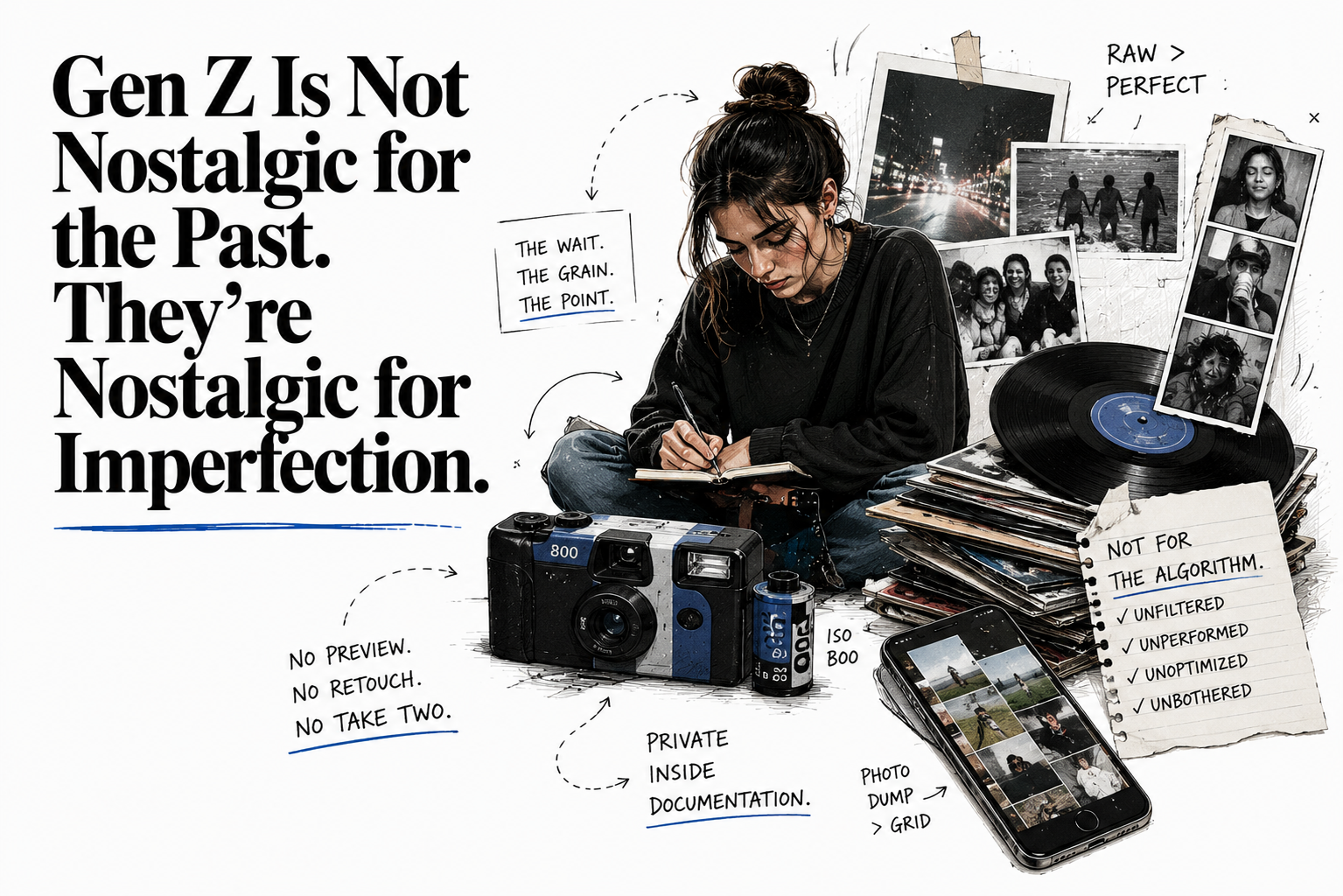
The disposable camera did not make a comeback because Gen Z discovered photography. It made a comeback because they grew up inside the most perfectly lit, filtered, and algorithmically optimized visual culture in human history — and found it exhausting.
This is the thing that gets misread as irony or affectation: the 22-year-old buying film camera rolls and shooting on grainy ISO 800 stock is not pretending to live in a different era. They are making an active choice to produce images that cannot be immediately reviewed, retouched, and optimized. The waiting is the point. The grain is the point. The photo that is slightly dark and slightly off-center and cannot be fixed before posting is, specifically, the point.
The same logic is showing up across cultural formats. Vinyl record sales have grown for 17 consecutive years, with the majority of buyers now under 35. Journaling — handwritten, analog, illegible to algorithms — has become one of the most searched wellness behaviors among users aged 18 to 24. The “raw photo dump” aesthetic, in which someone posts unedited, unflattering, contextless images from a phone roll, generates significantly higher engagement than polished grid posts among audiences in that demographic. The preference for imperfection is not random. It is legible as a preference.
What Gen Z is nostalgic for is not a time they actually experienced. They are nostalgic for the conditions under which a moment could simply exist — unoptimized, unperformed, not immediately evaluated by an audience. The feeling they are reaching for is privacy-inside-documentation: the photo that was taken but not for anyone. That feeling was once ordinary. In 2026, for the generation that has never known a digital life without an audience, it feels like relief.
The industry reading this as “retro trend” is missing the signal. It is not about aesthetics. It is about permission — specifically, the permission to produce something that does not need to be good.