
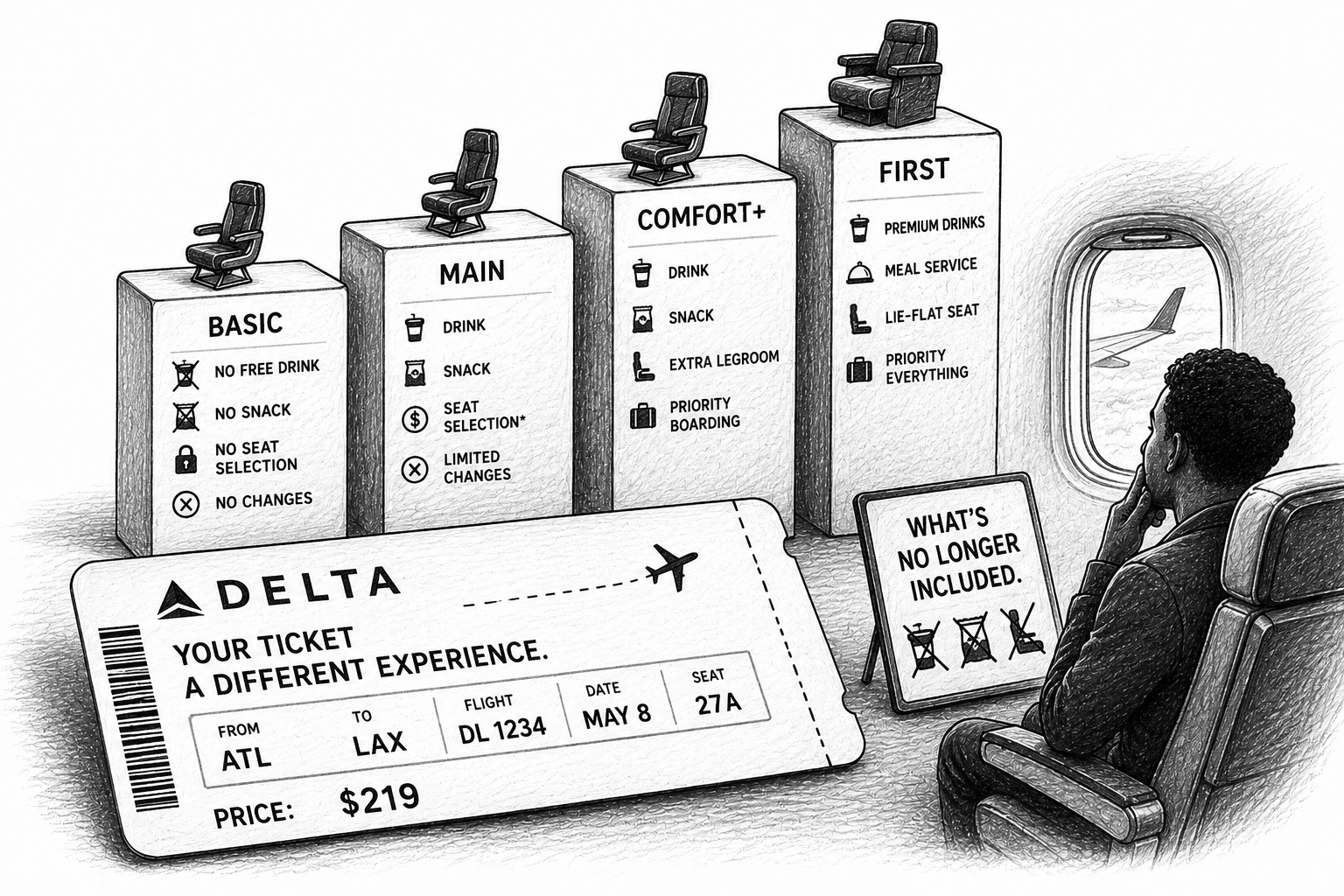
The immediate instinct is to read this as a pricing story. It is more precise than that. Delta is not dramatically raising fares. It is adjusting the structure around them — cutting snack and beverage service on short routes, tightening loyalty benefits, and narrowing what entry-level tickets actually deliver. The headline price may look stable. The experience attached to it is being redefined in real time.
That strategy only works in a specific kind of market — and Delta is now operating in one. The competitive landscape has thinned. When Spirit Airlines exited, it took with it something the industry rarely names directly: the pricing pressure it applied across every overlapping route. The “Spirit Effect” was real and measurable. Legacy carriers didn’t lower fares because they wanted to — they lowered them because Spirit made higher pricing difficult to sustain. As The Last Spirit Flight Just Landed documented, Spirit’s exit removed a floor the market built itself around. Delta doesn’t need to win on generosity anymore. It can win on control.
What’s happening is a shift from price competition to value segmentation. Basic economy becomes more restrictive. Perks that once felt standard become tiered or removed. Loyalty programs evolve from broad retention tools into targeted ones. Even something as small as a complimentary drink becomes a signal: not everything that was once included still is. The airline isn’t selling a seat anymore. It’s selling a ladder of experiences, each rung priced separately — and the distance between rungs is widening.
The financial picture makes the logic visible. Executive compensation remains strong, margins are protected, and operational discipline is framed as efficiency. That contrast — between tightening the passenger experience and maintaining top-line stability — reflects a system that no longer needs to distribute value evenly to remain competitive. It only needs to distribute it strategically. As Airlines Raise Baggage Fees Nationwide as Fuel Costs Surge showed, the fee structure was already being restructured before Spirit’s exit. Delta’s current moves are the next phase of the same recalibration — each adjustment individually defensible, collectively representing a sustained narrowing of what the standard ticket actually includes.
For Delta, this isn’t reactive. It’s structural. The airline is optimizing for a market where fewer players set the tone, and where consistency, reliability, and brand perception matter more than undercutting competitors on price. In that environment, reducing service on short-haul flights isn’t cost-cutting. It’s recalibration — aligning the product with a new competitive baseline that no longer has to account for the carrier that was always willing to go lower.
The broader implication is that travelers will feel the shift less in one dramatic moment and more across a series of smaller adjustments. Fewer inclusions. More conditions. Higher thresholds for the same rewards. The system still works. Flights still run. But the gap between what’s advertised and what’s delivered continues to widen — and the travelers absorbing that gap most directly are the ones for whom the difference between included and not included was never a minor inconvenience. It was the reason they chose the ticket in the first place.
Delta doesn’t need to raise prices to change what flying costs. It just needs to change what the ticket actually includes.