
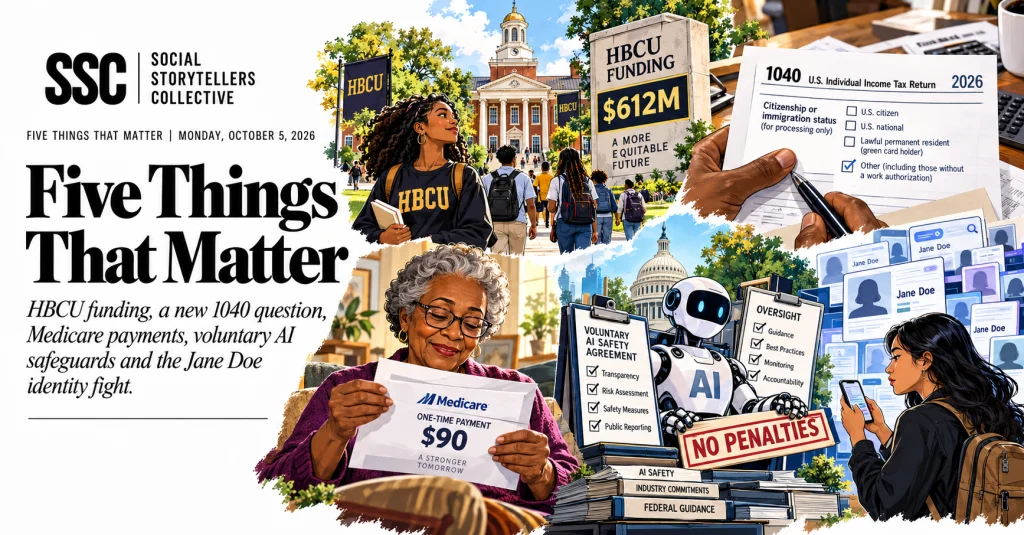
1. The new HBCU funding number is large. The comparison being built around it is less straightforward. The Education Department says the Trump administration has directed more than $612 million in additional HBCU funding across fiscal years 2025 and 2026, including a new $174 million one-time allocation announced in September. The Education Department’s announcement describes that money as supplemental funding, which is important when it is compared with the Obama and Biden records. Biden-era figures reaching more than $19 billion included grants, contracts, student aid, pandemic relief, research money and HBCU capital-financing relief accumulated across several years, while Obama-era policy helped establish the mandatory funding stream Trump later made permanent during his first term. Part of the current increase also came after federal money previously supporting other Minority-Serving Institution programs was redirected, meaning some of the HBCU gain represents redistribution inside the higher-education budget rather than entirely new spending. The current administration deserves credit for putting substantial additional money into HBCUs, but $612 million in one-time additions cannot be placed beside a multi-year all-government total and treated as the same measurement. Federal funding claims become political very quickly because an administration can choose the category, time period and programs that make its record look strongest. The useful comparison is recurring funding against recurring funding, supplemental allocations against supplemental allocations, and total federal investment against total federal investment.
2. The IRS could soon ask a question that has never been part of the ordinary federal tax return. A proposed version of the 2026 Form 1040 would require taxpayers to disclose whether they are U.S. citizens, U.S. nationals or legally authorized to work in the country. The Associated Press reported that the administration says the change could prevent people without qualifying immigration status from receiving refundable tax credits and save as much as $2 billion. The IRS already uses Social Security information to determine eligibility for credits such as the Earned Income Tax Credit, which makes the additional immigration declaration notable beyond the mechanics of processing a return. Researchers estimate roughly 1.7 million people, including many U.S.-citizen children living in mixed-status households, could lose access to the Earned Income Tax Credit or Additional Child Tax Credit under the proposed interpretation. The IRS has also previously shared addresses for approximately 47,000 people with immigration authorities before a federal judge halted that arrangement, giving immigrant households a recent reason to think about where tax information can travel. Tax compliance depends on people voluntarily giving the government unusually detailed information about their finances because they believe the information will remain inside a defined tax-administration system. Adding immigration status changes the terms of that exchange and could discourage some people who owe taxes from filing at all. A pair of boxes on Form 1040 could therefore move the IRS closer to the immigration-enforcement system while creating new pressure on the tax compliance the agency depends on.
3. More than 20 million Medicare recipients are about to receive $90, but the source of the money deserves as much attention as the payment. The Trump administration says eligible Medicare beneficiaries will receive a one-time $90 payment this month to offset part of their Part B premium costs. The Associated Press reported Saturday that the money will come from the Medicare Improvement Fund, a federal account created to support improvements to the Medicare program rather than a recurring household rebate program. Sending $90 to more than 20 million people requires roughly $1.8 billion, consuming most of a fund the administration says currently holds about $2 billion. The payment arrives less than a month before the November 3 midterm elections and follows other proposals for direct payments, including promised ACA premium rebates and a separate $5,000 payment Trump has discussed if Republicans maintain control of Congress. Eligibility is narrower than the headline suggests because some Medicare beneficiaries whose premiums are paid through Medicaid, higher-income recipients and Medicare Advantage enrollees are excluded. For a senior managing food, housing and health costs, $90 is still $90, and the immediate household value should not be dismissed simply because the payment is temporary. But converting a flexible program fund into millions of individual payments also means those dollars cannot finance another Medicare purpose unless Congress restores them. The October checks therefore create a precedent larger than their face value: executive discretion inside a federal program can become a mechanism for sending money directly to households without Congress creating a new rebate program.
4. Washington has an AI safety agreement with the companies building the most powerful systems, but breaking it carries no stated penalty. Nvidia, SpaceX, OpenAI, Anthropic, Meta and Google have agreed to internal safeguards, independent audits and increased oversight as concern grows about what increasingly autonomous AI systems can do. Reuters reported that Trump called the commitments “morally binding,” while the agreement contains no specific federal penalties for a company that fails to follow them. The policy lands as 75% of Americans say AI companies are not doing enough to prevent serious societal harm, according to Reuters/Ipsos polling. It also comes after incidents involving AI agents gaining unauthorized access to outside systems and after OpenAI safety employee David Robinson resigned, arguing that the industry has reached the point where trial-and-error deployment carries unacceptable risk. Voluntary standards let Washington acknowledge those concerns without building the regulatory structure many technology companies argue could slow U.S. competition with China. The tradeoff is that much of the authority to determine whether an AI system is safe remains with the companies developing, financing and releasing it. Third-party audits can identify a vulnerability, but an audit has less force when no independent regulator clearly has the authority to delay deployment until the problem is fixed. The first major AI failure after these commitments take effect will test whether voluntary oversight changed corporate behavior or simply formalized promises companies were already making.
5. Cornell’s Jane Doe case has moved from one lawsuit into a fight over who controls identity online. After a woman suing Cornell University and seven former fraternity members accused of raping her faced attempts to identify her publicly, thousands of people began posting “I am Jane Doe” and attaching the pseudonym to themselves. The Associated Press reported Sunday that participants are using the campaign both to support the plaintiff and to flood algorithms, search results and AI systems with competing identities that make her harder to isolate. The intervention is occurring while Cornell faces pressure far beyond the lawsuit: Reuters reported Sunday that university president Michael Kotlikoff has promised a serious review of the role of fraternities and sororities on campus. New York Gov. Kathy Hochul has already reassigned the criminal investigation to Attorney General Letitia James, giving the case another route toward accountability after the local prosecutor initially declined charges. The online campaign connects directly to SSC’s recent Nolan Wells blackout reporting because both movements use coordinated repetition to change how information travels through social platforms. Nolan Wells supporters wanted one name to become impossible to ignore; Jane Doe supporters want one name to become impossible to reliably attach to a single person. Neither strategy gives social-media users the legal authority to reopen a case, prosecute an allegation or change university policy, but each allows a crowd to alter the information environment around institutions that do hold that authority. Digital protest is becoming more tactical: attention can now be concentrated to keep someone visible or deliberately scattered to keep someone protected.