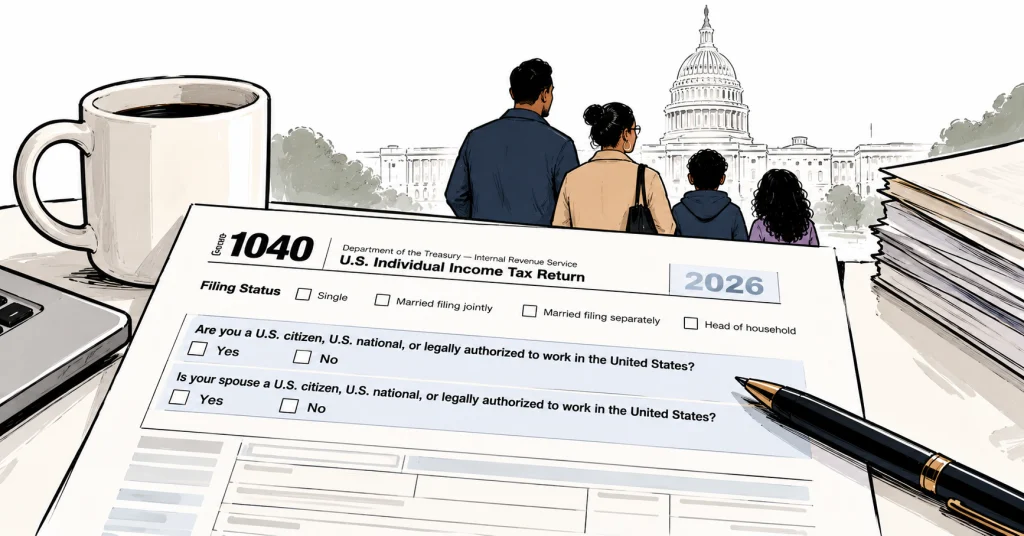
The proposed 1040 would ask every filer about citizenship or work authorization. The IRS already knows who qualifies for the tax credits the administration says it is trying to protect.
The federal income-tax return could soon contain a question it has never routinely asked: whether the person filing it is a U.S. citizen, U.S. national or legally authorized to work in the country. A draft 2026 Form 1040 includes mandatory yes-or-no citizenship and work-authorization boxes for taxpayers and spouses filing jointly. A related form used to claim refundable credits contains a similar question. The Trump administration says the requirement could prevent people without qualifying immigration status from receiving refundable tax benefits and save the government as much as $2 billion. Researchers estimate the policy could also cost roughly 1.7 million people access to the Earned Income Tax Credit or Additional Child Tax Credit, including more than 880,000 children. Many of those children are U.S. citizens.
The IRS Already Checks Eligibility
The administration’s stated purpose is to prevent people who are not eligible for federal benefits from claiming refundable tax credits. But the IRS already uses Social Security information to verify eligibility for the Earned Income Tax Credit. A valid Social Security number is required; an Individual Taxpayer Identification Number, commonly used by immigrants who cannot obtain a Social Security number, does not qualify a filer for the EITC. That existing verification system is one reason tax-policy advocates are questioning what additional administrative purpose the citizenship question serves.
The people affected extend beyond undocumented immigrants. AP reports that the proposed eligibility interpretation could affect people protected by DACA, people with Temporary Protected Status and some temporary workers, including H-1B visa holders. Researchers estimate 671,000 people, including 309,000 children, could lose the Earned Income Tax Credit. Another 1.1 million people, including 574,000 children, could lose the Additional Child Tax Credit.
The Tax System Depends on People Continuing to File
The IRS processed about 3.8 million returns using ITINs in the National Taxpayer Advocate data cited by AP. Those taxpayers paid $14.4 billion in federal income taxes and another $6.5 billion in Social Security and Medicare taxes. ITIN filers include several categories of taxpayers, but undocumented workers are among the people who rely on them because they cannot obtain Social Security numbers.
A mandatory immigration-status declaration changes the incentive structure. Someone without legal status would be asked to state that fact directly on a federal tax return under penalty of law. The alternative is making a false declaration, which carries its own legal risk. A third option is not filing. That possibility creates a tension between immigration enforcement and tax compliance: the government can gather more information about immigration status while simultaneously making some taxpayers less willing to enter the tax system at all.
There Is Already a Data-Sharing History
The concern is not theoretical. The Treasury Department previously agreed to provide taxpayer information to Immigration and Customs Enforcement to help identify people living in the country without authorization. A federal judge halted that arrangement after finding it violated taxpayer privacy protections, but not before the IRS had already provided ICE with addresses for approximately 47,000 people, according to AP. Treasury says information collected through the proposed 1040 question would remain subject to federal privacy and disclosure laws. It has not said whether the new citizenship-status data could be shared with immigration authorities.
Tax administration traditionally works because people disclose highly sensitive financial information under an expectation that the IRS will use it to assess taxes. Adding an immigration-status question creates another potential function for the same form. A document used to calculate income, deductions and credits can also become a declaration about whether the filer has permission to live or work in the country.
For most taxpayers, the change would be another pair of boxes on a form already filled with them. For mixed-status families, DACA recipients and other immigrants, those boxes could determine access to tax credits or create a record they fear may eventually be used somewhere else. The administrative change is small enough to fit on one line of Form 1040. Its consequences reach considerably further.