
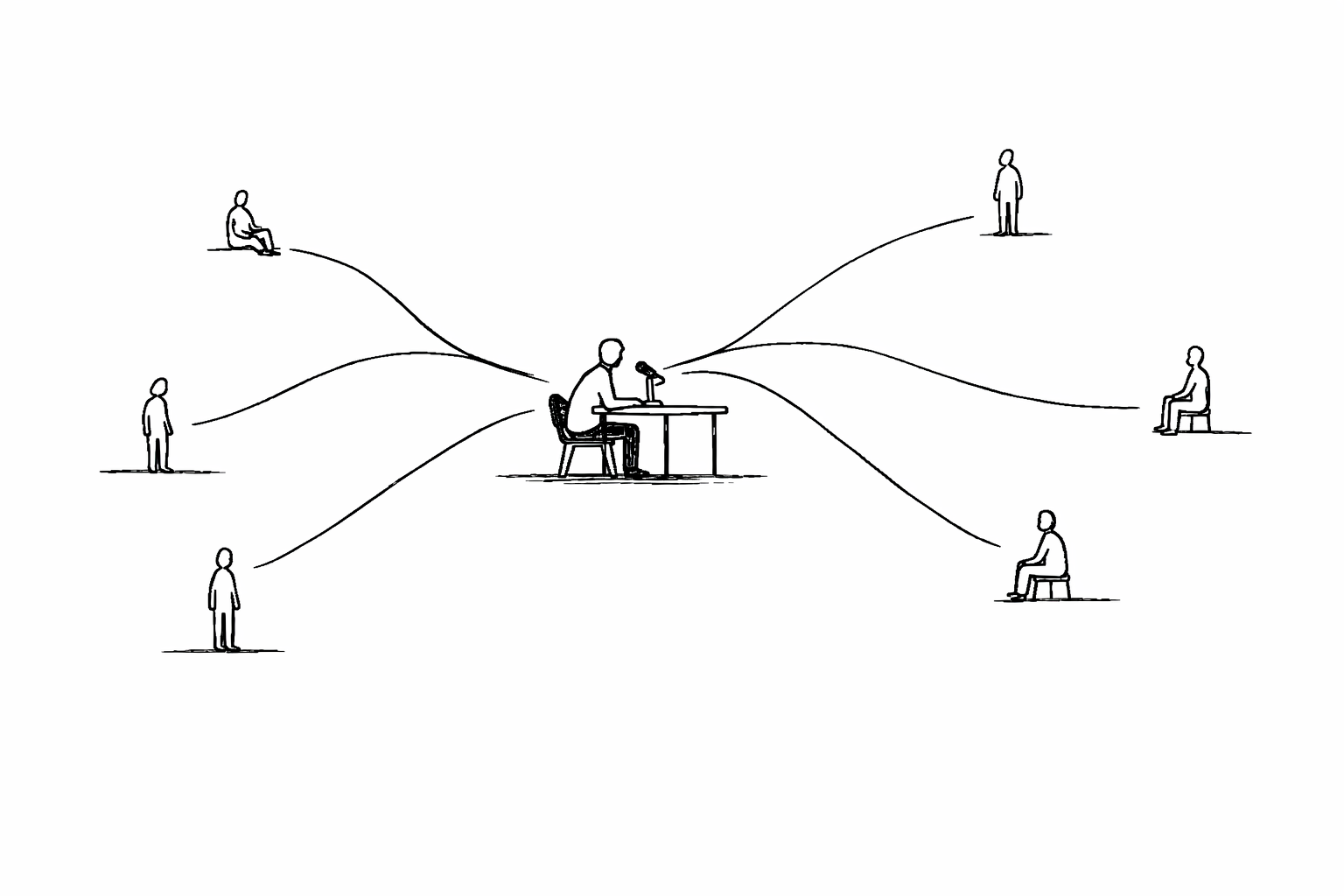
You can see the shift in where the message shows up first. Major announcements, personal resets, and carefully framed explanations are no longer breaking through traditional interviews or press conferences. They are appearing on podcasts — released directly to audiences who are already listening, already trusting, and less likely to interrupt. Podcasting is no longer a niche channel; U.S. podcast advertising revenue alone is projected to approach $2.6 billion in the coming years, reflecting how central the medium has become to modern media strategy. The setting feels informal, conversational, even intimate. But the outcome is often more controlled than anything that came before it.
Podcasts offer something that traditional media increasingly cannot: an environment with minimal friction. There is no live fact-checking, no editorial framing in real time, and rarely an incentive for the host to disrupt the flow of the conversation with aggressive questioning. The tone is set before the first question is asked, shaped by the relationship between host and guest and by the expectations of the audience. What presents as open dialogue is, in practice, a space where the speaker can move through their narrative without being forced to defend it at every turn.
This shift is happening alongside a broader erosion of trust in traditional institutions, including journalism. A 2024 Pew Research Center report found that only about 32% of Americans say they trust information from national news organizations — a long-term decline that has not reversed. As confidence in those institutions weakens, public figures are not retreating from communication. They are relocating it. As I explored in The Trust Gap: Why Traditional Media Is Holding Its Ground, trust hasn’t disappeared from media — it has migrated toward formats that feel more consistent, more direct, and more personal. Podcasts are the beneficiary of that migration. But there is a difference between a format that earns trust through continuity and one that borrows it through intimacy.
The result is a gradual blurring of boundaries that once felt more clearly defined. An interview becomes indistinguishable from promotion, a conversation carries the structure of a strategy, and authenticity becomes harder to separate from performance. For the listener, the experience feels like access — an unfiltered window into how someone thinks or explains themselves. For the speaker, it functions as narrative management, delivered in a format that resists interruption and minimizes challenge. As explored in From Parasocial to Personal, that sense of intimacy is real even when the relationship is entirely one-sided — and it is precisely that intimacy that makes the format so effective as a communications vehicle. The distinction between being heard and being examined begins to collapse.
That collapse has consequences that are easy to overlook because the format feels familiar. When fewer conversations take place in environments designed to challenge and contextualize claims, the burden of interpretation shifts more heavily onto the audience. Narratives arrive more complete, more polished, and less contested — which can make them feel more credible even when they have not been meaningfully interrogated. At the same time, traditional journalism loses some of its ability to shape how information enters public discourse, not because it has disappeared, but because it is no longer the primary venue where those narratives are introduced.
What is emerging is not a replacement for media, but a reconfiguration of where influence lives within it. Podcasts have become a space where control and credibility can coexist, where a message can feel organic while still being carefully constructed. The appeal is clear: fewer constraints, direct access to audiences, and a format that rewards continuity over confrontation. But as more of the most important conversations move into spaces designed for comfort, the role of scrutiny becomes less certain.
If the interview is no longer defined by its ability to challenge, but by its ability to carry a message without disruption, then the question is not whether podcasts have changed the media landscape. It is whether the conditions that once made public conversations accountable are still present — and if they are not, where that accountability now lives.