
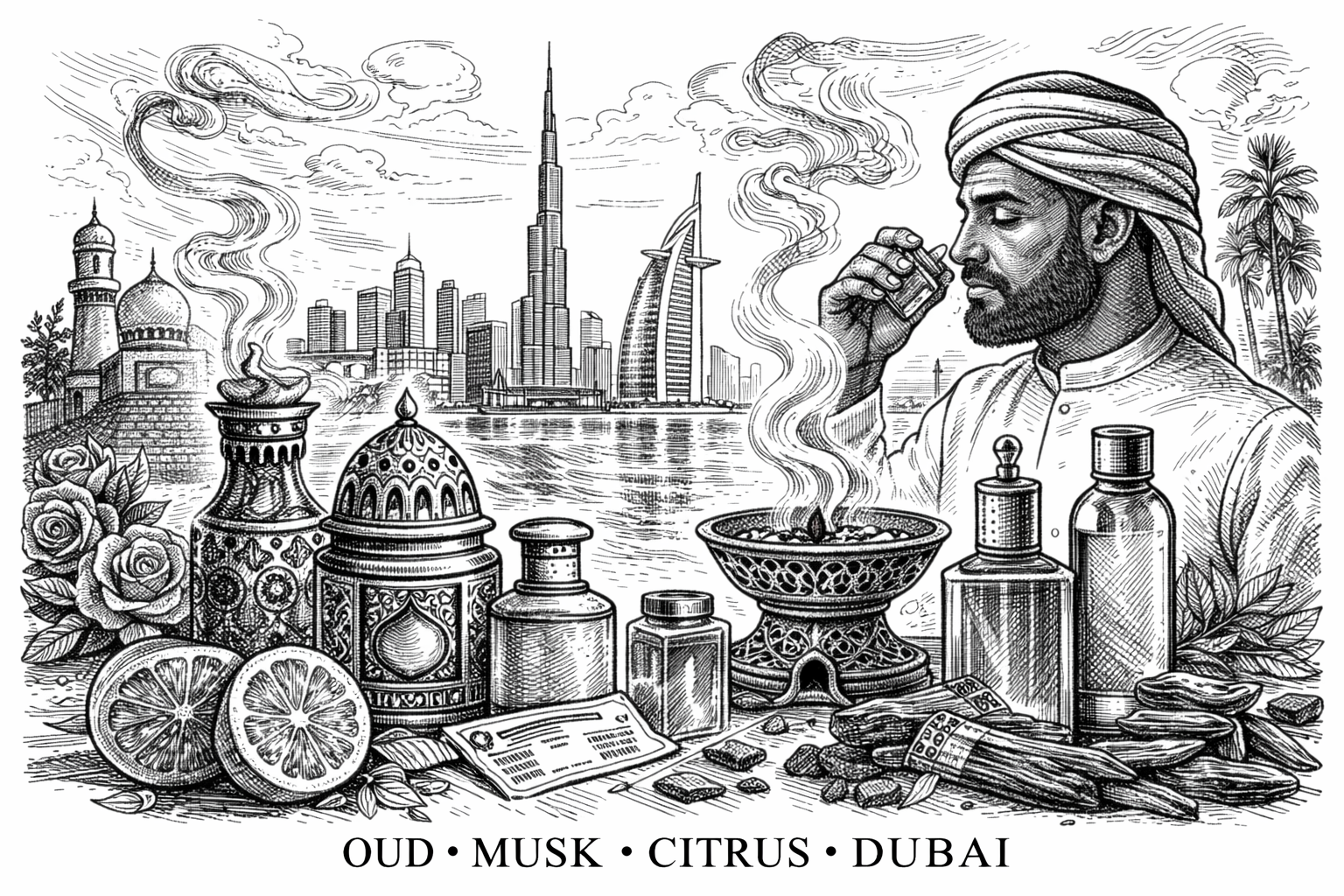
I have never smelled a fragrance made in Dubai that I did not love. That is not hyperbole. It is a record. Every encounter has been the same: rich, immediate, unapologetically present — the kind of scent that doesn’t sit quietly on the skin but announces itself the moment you enter a room. And then it lingers. Not fades. Lingers. It insists on your attention in a way that most fragrance never attempts. And almost every time, before I’ve fully processed what I’m smelling, I feel a strong and very specific desire: I need to own this.
That reaction is not accidental. It is the point.
My palate has always pulled in a specific direction. Oud and musk as the foundation — deep, resinous, grounded in something that feels older than trend. Lavender and citrus for lift and air, the top notes that open a composition before the weight arrives. Masculine profiles that don’t apologize for taking up space. What I was drawn to long before I had the language for it turns out to have a geography. Most of what I love traces back, in one way or another, to the Gulf — and specifically to how Dubai has turned a regional fragrance philosophy into one of the most compelling sensory cultures in the world.
The first time you experience fragrance from Dubai, it doesn’t feel like a product. It feels like a statement. For many people, that first encounter becomes a turning point. Once you adjust to that level of depth and projection, everything else starts to feel lighter — almost incomplete. That is not a flaw in the design. That is the design.
What Dubai represents in the fragrance world is not simply quality. It is a fundamentally different philosophy about what fragrance is for.
In much of the Western market, perfume has long been framed as subtle enhancement — clean notes, skin scents, something that sits close and almost private. A finishing detail. In the Gulf, fragrance operates on an entirely different register. It is social. It is expressive. It is part of how presence is constructed and how memory is made. You don’t wear scent to be discovered. You wear it to be remembered.
That philosophy is not a marketing invention. It is rooted in tradition that predates the modern luxury industry by centuries. Ingredients like oud, amber, rose, and musk are not trends in the region. They are foundations. Oud in particular carries cultural weight that no Western rebrand has fully captured. Derived from agarwood — a resinous heartwood that forms when certain trees respond to fungal infection — it produces a deep, complex scent that evolves over time, shifting and warming as it interacts with the skin. It is among the most expensive raw materials in global perfumery, with high-grade agarwood trading at prices that can exceed those of gold by weight. In the Gulf, it is also among the most culturally embedded, present in homes, ceremonies, and daily life in ways that predate the contemporary fragrance industry entirely.
Oud is the anchor. But it is rarely alone. In the compositions I return to most — and in the ones that stop me cold in a store or on someone passing in a hallway — the oud is accompanied by musk that gives the whole thing gravity and skin-warmth, and lifted by lavender or citrus that prevents the depth from becoming heavy. That structure — dark foundation, bright opening, masculine throughout — is not a Western innovation. It is the architecture of Gulf perfumery, built over generations before niche fragrance houses in London and New York discovered it was sellable.
That is where Dubai becomes significant — not as the origin of these traditions, but as the infrastructure that refined and scaled them. As a global commercial hub positioned at the intersection of heritage and modern luxury, Dubai transformed regional scent practices into an international industry without requiring those practices to become unrecognizable in the process. Brands like Ajmal Perfumes, founded in 1951, and Rasasi have built portfolios that translate traditional oud-forward and oriental profiles into globally distributed products while maintaining the intensity and complexity that defines the region’s approach. Swiss Arabian, operating since 1974, has similarly bridged Eastern fragrance tradition and international accessibility. These are not novelty exports. They are mature industry players with decades of formulation depth, now finding audiences that the Western fragrance market — oriented for generations toward restraint — never cultivated.
The global fragrance market reflects this shift. The broader industry was valued at approximately $50 billion in 2023 and is projected to reach $80 billion by 2030, with the Middle East representing one of the fastest-growing regional segments and oud-forward profiles driving significant share of premium category growth. Major Western houses — from Dior to Tom Ford to Maison Margiela — have released oud-centric lines in recent years, a move that would have been commercially marginal a decade ago. The fact that heritage Gulf brands held that ground long before the trend arrived is a structural advantage the market is only now beginning to properly price.
But what most separates Dubai’s fragrance culture is not the ingredients themselves. It is the method of construction. In Gulf fragrance tradition, scent is rarely a single layer applied from a bottle. Oils, sprays, and the smoke from burning bakhoor — a blend of wood chips, resins, and fragrant materials — are combined, often in sequence, to create something personal, evolving, and unrepeatable. The result is not a signature in the sense of a fixed brand identifier. It is a composition that shifts throughout the day, deepening as it warms, changing as the hours move, and lingering — always lingering — well after the person has left the room.
For someone drawn to oud and musk, that evolution is everything. A fragrance built on those materials does not perform once and disappear. It opens with one face and reveals another two hours later. The citrus that announced it in the morning has burned off by afternoon, leaving the resinous core to do the slower, quieter work of staying present. Lavender, when it appears, functions as a bridge — softening the darkness just enough to keep the composition from becoming impenetrable, giving the masculine weight somewhere to breathe. This is not accident. It is architecture.
That layering fundamentally changes the relationship between person and product. Fragrance stops being something you apply and becomes something you construct. It is closer to dressing than grooming — a considered, cumulative act with aesthetic and social intention built in. The Western model optimizes for ease and consistency. The Gulf model optimizes for presence and individuality. Those are different design philosophies producing different outcomes, and the global consumer is increasingly drawn to the one that delivers more.
For Black consumers specifically, the resonance of Gulf fragrance culture is not accidental or superficial. Oud, musk, and amber have long circulated through African American fragrance culture — through oil vendors in urban markets, through independent Black-owned fragrance businesses that carried these profiles for decades before they became luxury shorthand. The connection is both aesthetic and diasporic. The fragrance traditions of the Gulf share ingredient lineages and cultural logics with traditions across the African continent, and for many Black Americans, encountering a Dubai-made oud blend does not feel foreign. It feels like recognition. The luxury market’s current celebration of these profiles is, in part, a belated institutional acknowledgment of something Black fragrance culture has known for a long time.
My own attraction to these profiles is not separate from that history. It is part of it. When I reach for something dark, grounded, and structurally masculine — when I want a fragrance that holds through a full day and leaves an imprint rather than a memory — I am participating in a sensory tradition that moves across the African diaspora and the Gulf in ways that predate the department store counter and the designer bottle entirely. Dubai packaged that tradition for the world. But the instinct behind it was never new.
The growing global pull of Dubai’s model reflects a broader consumer shift — away from performance and toward identity, away from categories defined by restraint and toward ones defined by intention. Longevity, projection, and layering complexity are no longer niche concerns. They are increasingly the terms on which fragrance is evaluated. Dubai has always operated on those terms. The rest of the market is catching up.
The real difference is not that Dubai fragrances smell better — though many do, by the measures that matter most: complexity, longevity, and the capacity to shift and evolve across hours of wear. The real difference is what they ask of fragrance itself. Not to complement who you are, but to become part of how you are known.
That is a higher standard. And once you experience a fragrance built to it — once something lingers long enough and deep enough that you find yourself reaching for your wallet before you’ve finished the thought — the ones that weren’t start to feel like they were never quite finished.