
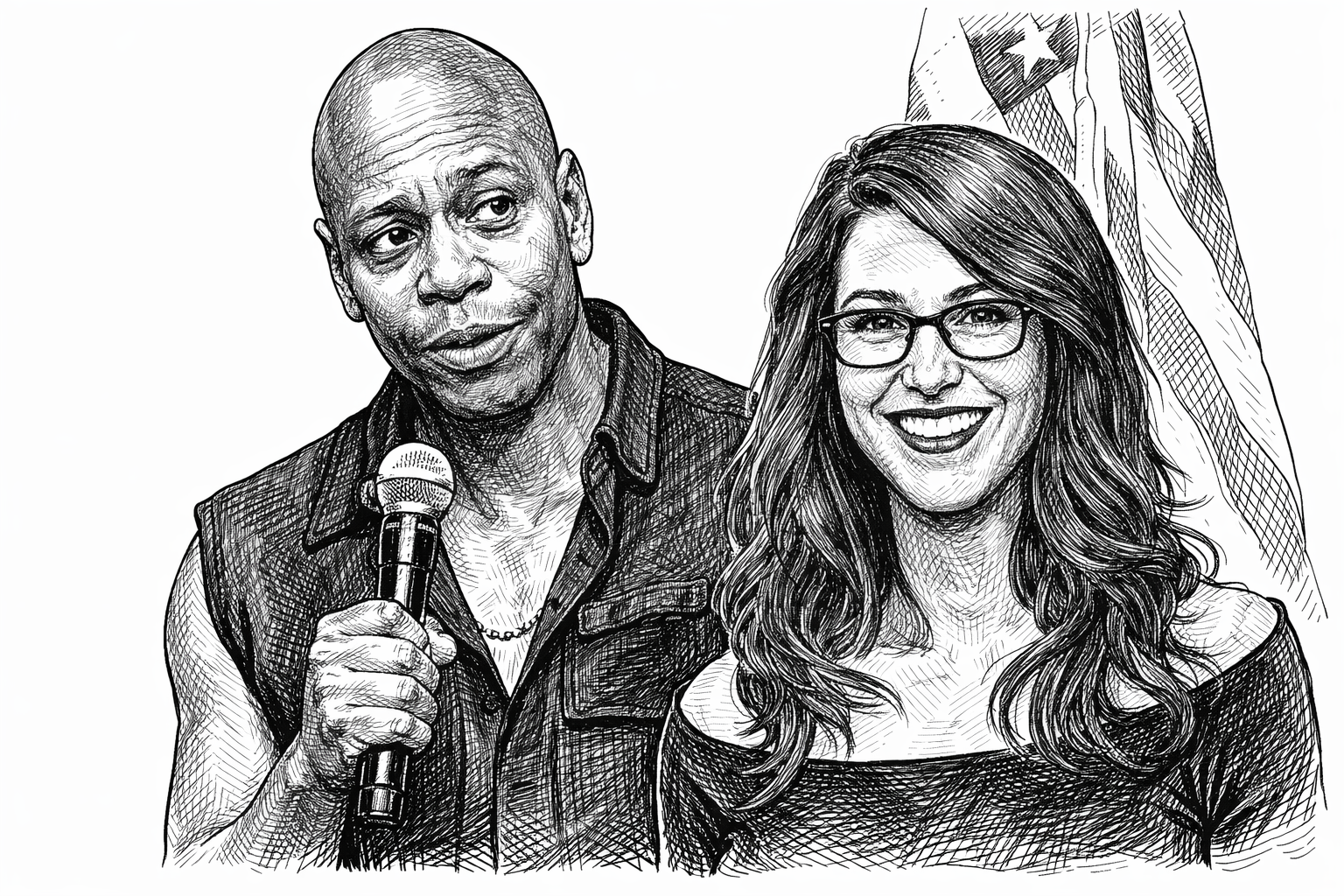
In a recent interview highlighted by Variety, Dave Chappelle drew a distinction that cuts deeper than the headline. His frustration was not simply about disagreement — it was about transformation. Jokes he framed as commentary, provocation, or exploration were, in his view, absorbed into a political apparatus that stripped them of context and redeployed them as messaging. The incident he described involving Lauren Boebert illustrates how quickly that transformation happens. A routine photo becomes, after the fact, a political signal tied to gender debates. What begins as performance becomes endorsement by proximity. What was once ambiguous becomes declarative. And the creator is no longer the one defining the meaning.
This is not unique to Chappelle, and it is not new. It reflects a lineage that runs through the history of Black American comedy specifically — a tradition in which cultural production has been among the most mined for political use by actors across the ideological spectrum, often without the consent, compensation, or contextual integrity of the original work. Richard Pryor’s routines on race, policing, and power were absorbed into both radical politics and mainstream entertainment simultaneously, often stripped of the pain that made them precise. Dick Gregory built a career that moved deliberately between comedy and civil rights activism, only to watch that movement get flattened into biography rather than argument. Chappelle’s situation is different in its specifics but consistent in its structure — Black comedians who use their platform to engage seriously with race, identity, and power tend to find that engagement extracted and redirected in ways that serve agendas they did not sign up for. The cultural production travels. The creator’s authorship does not always travel with it.
What makes the current moment distinct is the infrastructure accelerating the extraction. Comedy, music, and casual imagery now move through algorithmic systems that reward amplification over nuance, and the version of any joke or image that travels fastest is the one most stripped of its original context. That is not an accident of distribution — it is the design of it. A platform optimized for engagement will always surface the most legible, most reaction-generating version of a piece of content, which is almost never the most accurate or complete version. Once political actors engage with that already-simplified version, the content stops operating as expression entirely. It becomes infrastructure — a shorthand for positions that carry real consequences in policy debates, electoral messaging, and cultural warfare that the original creator never consented to enter. In that transition, intent does not disappear, but it loses control in a way that is nearly impossible to reverse.
That irreversibility is where the long-term cost concentrates. Chappelle’s catalog is now permanently entangled with political positions and cultural debates that will follow it regardless of what he says or does next. The routines exist in the archive, clipped and redeployable, their meaning no longer tethered to the context in which they were created. Attempts to reclaim that meaning — through new material, through public statements, through interviews like the one Variety highlighted — tend to generate more content for the same extraction machine rather than resolving the original displacement. The artist becomes a respondent in a conversation they did not start, defending intentions in a forum that was never designed to honor them. That dynamic is exhausting in ways that are underreported, and it has a chilling effect on the kind of ambitious, ambiguous, politically engaged comedy that produced the work being debated in the first place. What the system is optimized to produce is not the sharpest cultural commentary. It is the most portable version of it — and those are not the same thing.
The question this moment raises is not whether artists should engage with politics. Many of the most important voices in American cultural history have done exactly that, and the work is richer for it. The question is whether the current media and platform environment has made that engagement structurally untenable — whether the systems through which culture now circulates have so thoroughly collapsed the distance between expression and political deployment that any attempt at nuanced commentary is simply raw material for the next news cycle. For Black artists in particular, who have never had the luxury of being apolitical in the first place, that collapse is not a new problem. It is an old one with new infrastructure behind it. And the gap Chappelle is pointing to — between what he was doing and what his work became — is not simply his story. It is a structural condition that the culture has not yet developed the language, or the platforms, to adequately address.