
WILL DAVISON
MAY 11, 2026
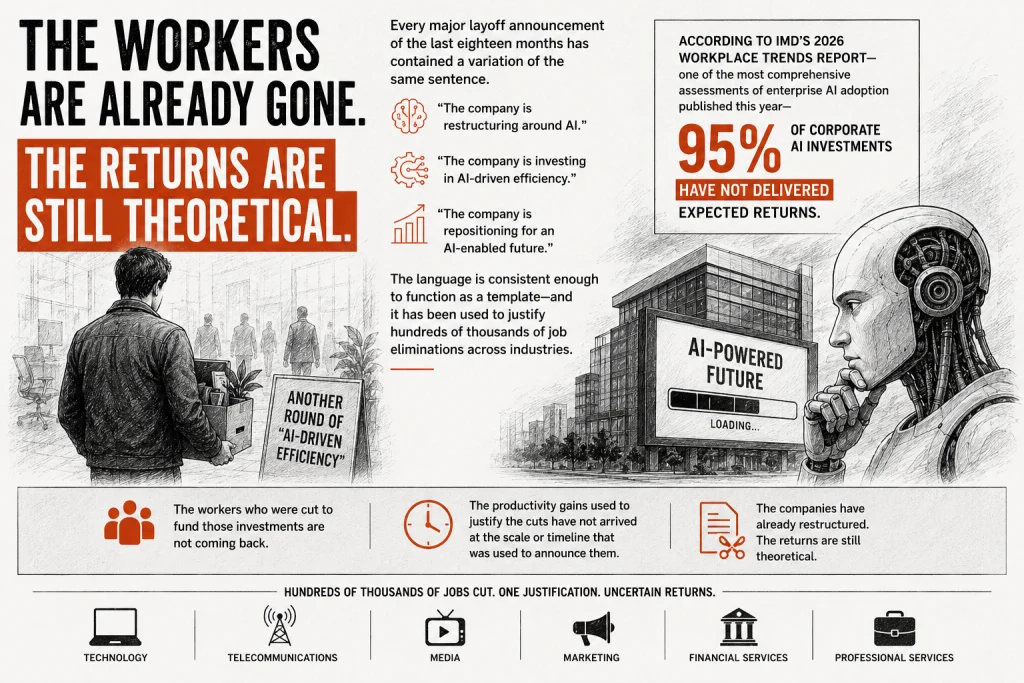
The workers are already gone. The returns are still theoretical.
Every major layoff announcement of the last eighteen months has contained a variation of the same sentence. The company is restructuring around AI. The company is investing in AI-driven efficiency. The company is repositioning for an AI-enabled future. The language is consistent enough to function as a template — and it has been used to justify hundreds of thousands of job eliminations across technology, telecommunications, media, marketing, financial services, and professional services.
There is a problem with that template. According to IMD’s 2026 Workplace Trends report — one of the most comprehensive assessments of enterprise AI adoption published this year — 95% of corporate AI investments have not delivered expected returns.
Ninety-five percent.
The workers who were cut to fund those investments are not coming back. The productivity gains used to justify the cuts have not arrived at the scale or timeline that was used to announce them. The companies have already restructured. The returns are still theoretical.
What enterprise AI actually looks like right now
IMD’s researchers describe the current state of corporate AI capability with a specific analogy that is worth sitting with: AI at its current level of enterprise deployment functions like an intern. Useful for specific tasks under close supervision. Capable of accelerating certain workflows when properly directed. Unable to exercise judgment, navigate ambiguity, or operate autonomously across the complex, context-dependent work that makes up most of what knowledge workers actually do.
That characterization is not a dismissal of AI’s potential. It is a precise description of where most corporate deployments actually are right now, as opposed to where the press releases suggest they are. The gap between the capability that companies are describing in earnings calls and restructuring announcements and the capability that IMD’s researchers are observing in actual enterprise deployments is significant — and it is the gap that workers and communities are being asked to absorb.
The productivity question is further complicated by a finding from Microsoft’s Q1 2026 Global AI Diffusion Report: workers globally report significant time savings from AI tools, but most receive no guidance on how to redirect that recovered time into activities that create measurable business value. The time is being saved. The productivity gains are not being captured. The efficiency is accumulating somewhere that is not showing up in the output metrics companies are using to justify their restructuring decisions.
The bifurcation nobody is tracking
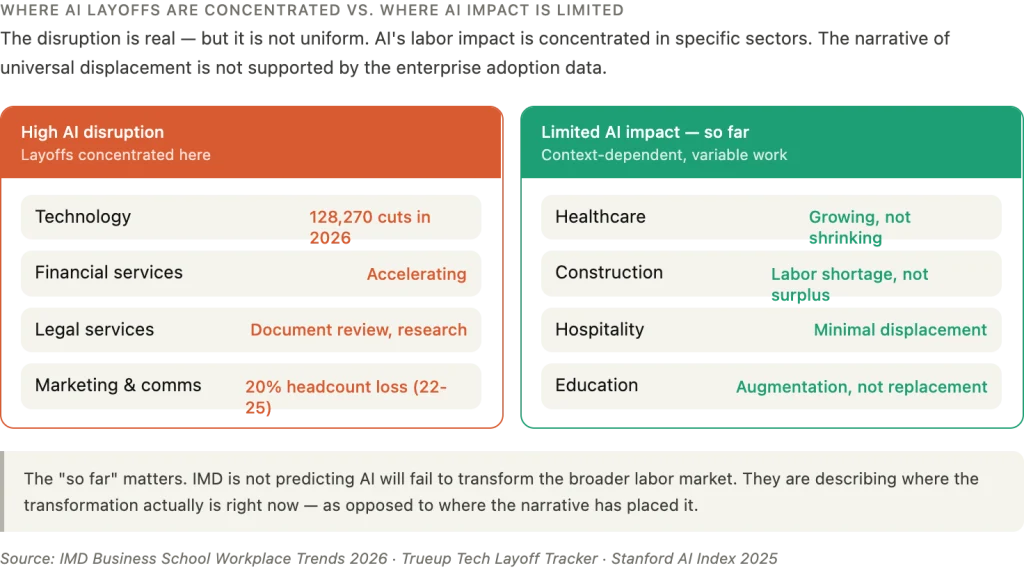
IMD identifies a bifurcated AI labor market that cuts against the uniform displacement narrative dominating public discourse. AI’s impact is concentrated in specific industries — primarily technology, financial services, and legal — and in companies of specific sizes — primarily large enterprises with the resources to implement and maintain complex AI systems. Smaller companies, service-sector employers, and industries with more variable and context-dependent work are seeing much more limited AI impact on their labor costs and productivity.
This means the layoff wave is real and the AI rationale is real — in certain sectors, for certain roles, in certain companies. But the extrapolation of that pattern to a universal labor market transformation is not supported by the enterprise adoption data. The people losing jobs in technology and finance are experiencing something genuine. The people working in healthcare, construction, hospitality, education, and most of the service economy are experiencing something much more limited — so far.
The “so far” matters. IMD’s researchers are not predicting that AI will fail to transform the broader labor market. They are describing where the transformation actually is right now, as opposed to where the narrative has placed it.
What the DEI data says about the efficiency argument
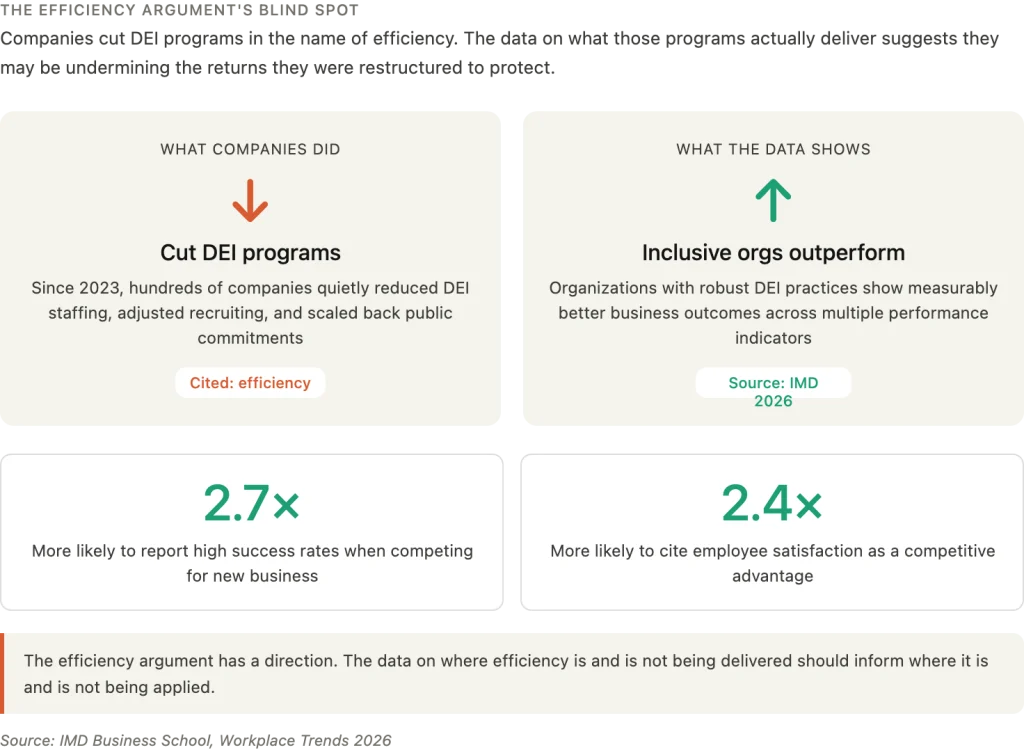
One finding in IMD’s report sits in sharp tension with the restructuring logic that has dominated corporate decision-making since 2023. Organizations with robust diversity, equity, and inclusion practices are 2.7 times more likely to report high success rates when competing for new business and 2.4 times more likely to cite employee satisfaction as a competitive advantage.
Since 2023, hundreds of companies have quietly reduced DEI staffing, adjusted recruiting language, and scaled back public commitments — in many cases citing the same efficiency pressures driving their AI restructuring. IMD’s data suggests that those two decisions — cutting DEI programs and cutting diverse workforce pipelines in the name of efficiency — may be undermining the same business outcomes the restructuring was designed to protect.
The efficiency argument has a direction. The data on where that efficiency is and is not being delivered should inform where it is and is not being applied.