
Part of The Access Shift — an ongoing series examining how access is being quietly reshaped across American life.
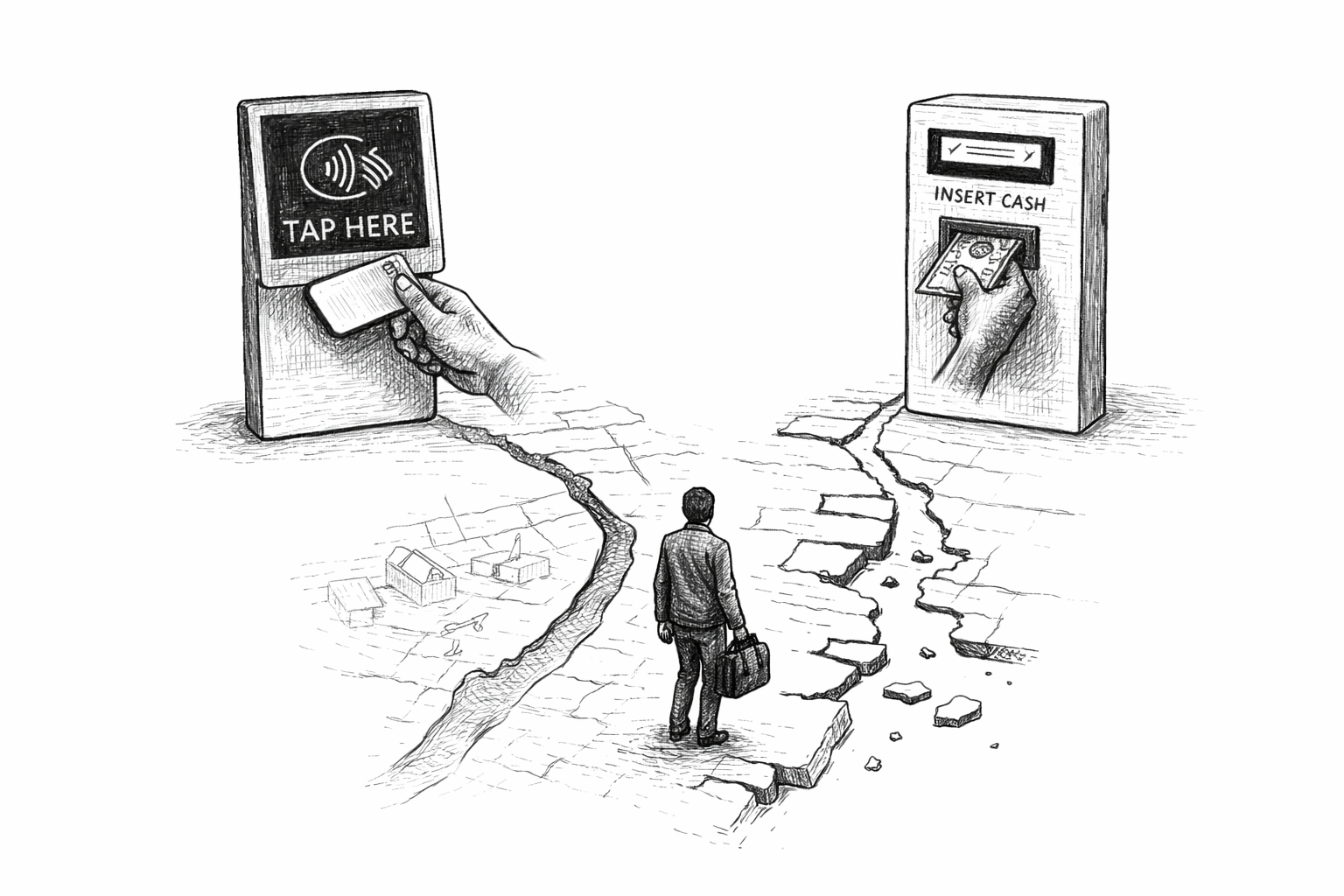
Public transit is being redesigned for speed and convenience. Digital payments. Mobile ticketing. Tap-to-ride systems that eliminate cash altogether. The shift is framed as modernization — an upgrade to match how people already move through the world. But that framing assumes something that isn’t universally true: that everyone has equal access to the financial infrastructure required to participate.
Millions of Americans remain unbanked or underbanked, operating outside traditional financial systems by necessity, not choice. These are the riders who rely most heavily on public transit — low-income workers, service industry employees, older adults, and disproportionately Black and Latino communities. For them, cash isn’t an inconvenience. It’s access.
In Austin and Houston, the shift is already taking shape. Austin’s transition to fully cashless transit is set for June 1 — positioned as a step forward in efficiency and rider experience. Houston has expanded digital fare systems and mobile payment options across its network. On the surface, these changes reflect progress. In practice, they introduce a new layer of friction for riders who are not fully integrated into the banking system. The pressure is compounded in cities like Austin, where displacement of Black and Latino communities is already accelerating — a pattern we examined in Who Gets Austin?
What emerges is a quieter form of exclusion — one that doesn’t rely on formal restrictions, but on assumptions. The system assumes a debit card, a smartphone, a digital wallet. It assumes stability. When those assumptions don’t hold, movement becomes conditional. Boarding a bus requires additional steps. Paying a fare requires additional tools. What was once immediate becomes complicated.
Workarounds exist — reloadable cards, retail payment networks, cash-to-digital conversion points — but they require awareness, proximity, and time. They add cost and complexity to a system that was once straightforward.
This is how access shifts. Not through formal restriction. Through design.
Why It Matters When access to movement becomes conditional, the impact extends beyond transit. It affects who can reliably get to work, who can respond to opportunity, and who can remain connected to the city itself. Systems designed to increase efficiency can, without intention, narrow access. And when that happens, the consequences are not evenly distributed.