
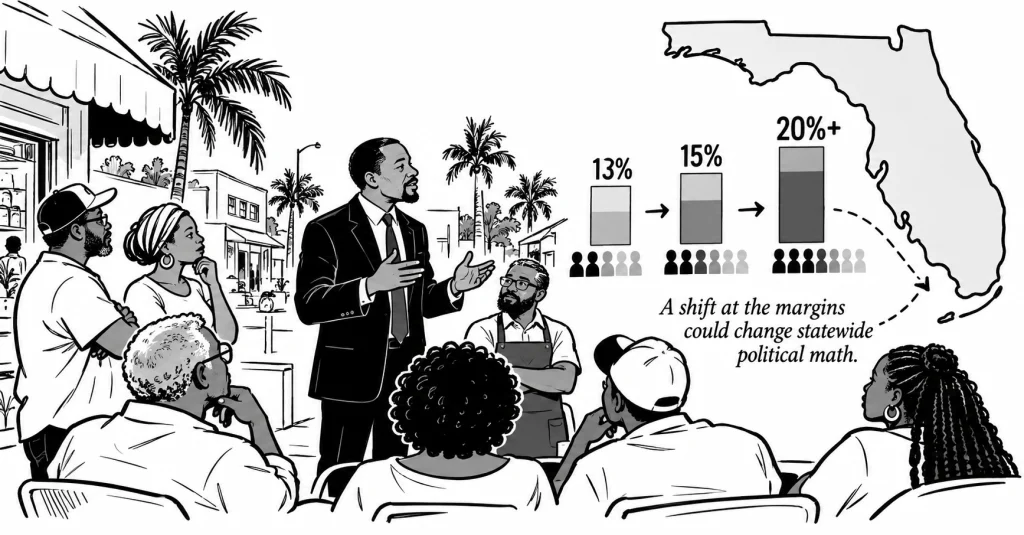
Republicans do not need to win the Black electorate to change Florida’s political math. Donalds is betting that taking a somewhat larger piece of it could be enough.
Byron Donalds is setting a number for his campaign that would once have sounded unusually ambitious for a Republican candidate in Florida: more than 20% of the Black vote. The Republican nominee for governor spent the weekend making targeted appearances with Black voters around Miami, a notable shift for a politician who has generally resisted making his own race central to his political identity.
The number deserves attention because Donalds does not need anything close to a majority of Black voters for the strategy to work. CBS News exit polling found Republican Gov. Ron DeSantis received around 13% of Florida’s Black vote in 2022, while Donald Trump’s 2024 presidential campaign received about 15%. Moving that share above 20% would still leave Democrats winning Black voters overwhelmingly. It could nevertheless alter the statewide coalition enough to matter in a competitive election.
Political Change Can Happen at the Margins
Black voters have been among the Democratic Party’s most reliable constituencies for decades. That history sometimes encourages political analysis to treat the electorate as fixed: Democrats win it, Republicans lose it, and movement inside the margin becomes secondary.
Donalds is betting on precisely that margin.
His pitch is also carefully constructed. At one event, Donalds argued that Florida should operate as a meritocracy and said voters care primarily about whether a candidate can govern effectively. At the same time, his campaign deliberately placed him in Black professional spaces, Black neighborhoods and Black-owned businesses. Race is being deemphasized rhetorically while being recognized strategically.
Some voters remain skeptical, particularly because of Donalds’ close association with Donald Trump. CBS spoke with attendees who said his Trump relationship complicated their view of him even when they were willing to hear his argument. Voting-rights advocates also questioned whether the outreach represented durable engagement or election-season targeting.
Twenty Percent Would Be Enough to Force a Reassessment
The more consequential question is not whether Black voters are suddenly becoming Republican. The available numbers do not support that conclusion. It is whether the Democratic advantage can shrink enough to alter how statewide races are built.
If a Republican candidate moves from roughly 13% or 15% of Black voters toward 20% while retaining strong support among other constituencies, Democrats need to compensate elsewhere. That can change where campaigns spend money, which neighborhoods candidates visit, what issues they emphasize and which voters either party believes are genuinely persuadable.
Donalds is therefore testing more than his own appeal. He is testing a political assumption: that Black voters remain so securely attached to one party that Republicans gain little by investing heavily in them.
The November result will tell us whether 20% was realistic. The fact that a statewide Republican nominee sees the number as worth pursuing already tells us something about how the electorate is being read.