
The American Black Film Festival has long been a gathering point for Black filmmakers, but its 30th anniversary underscores a more structural role. It is not just a festival. It is an ecosystem, one that connects creators, investors, distributors, and audiences within a space specifically designed to elevate Black storytelling. That function becomes increasingly important in an industry where access to distribution remains one of the most significant barriers to entry.
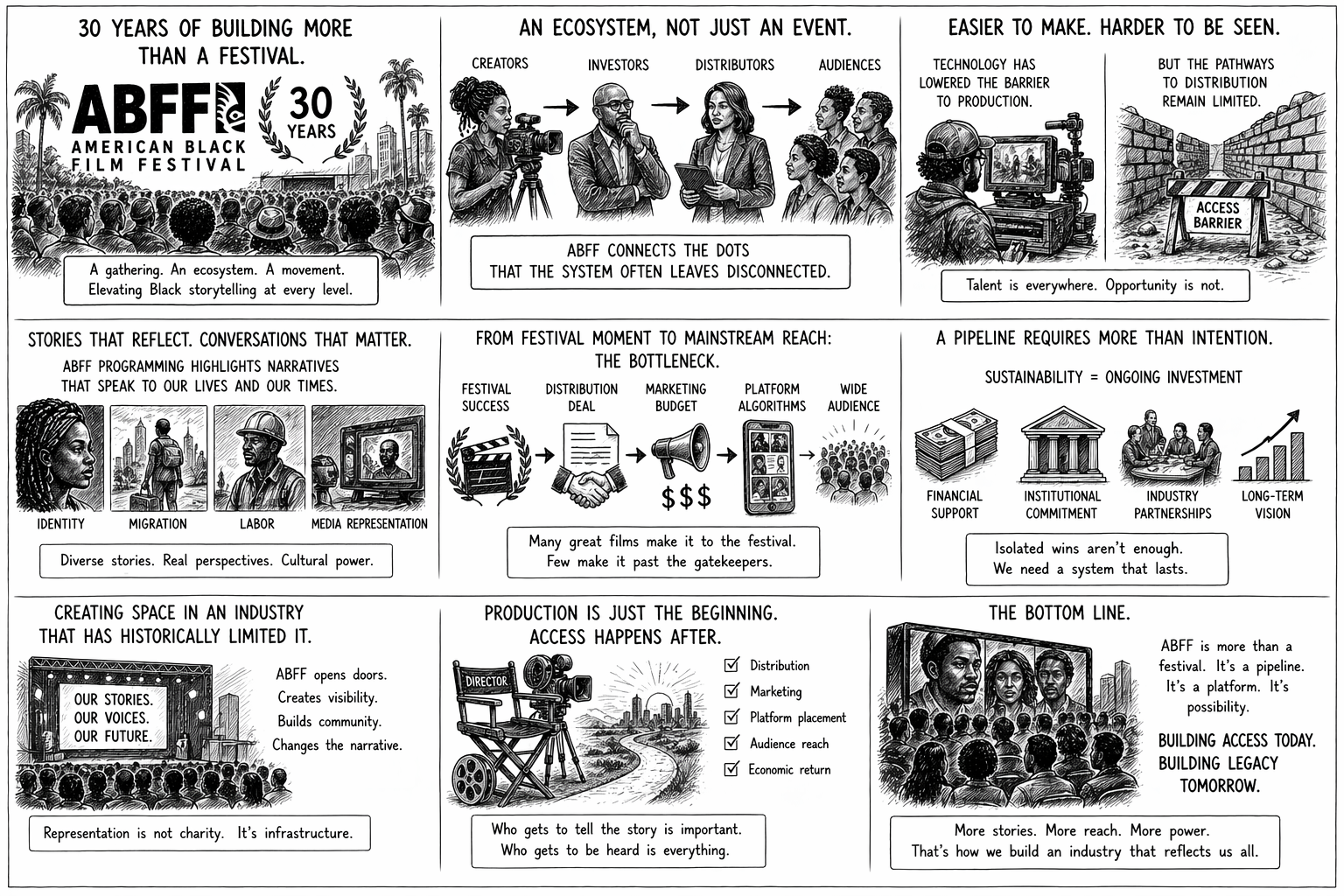
Independent filmmakers often face a paradox. Advances in technology have made it easier to produce content, but the pathways to widespread visibility and financial sustainability remain limited. Festivals like ABFF help bridge that gap by providing a platform where projects can be seen, evaluated, and potentially acquired. In this sense, the festival operates as a form of infrastructure, facilitating connections that might not occur within traditional industry channels.
The growth of ABFF also reflects broader changes in audience demand. There is a clear appetite for stories that reflect diverse experiences and perspectives, and Black filmmakers are contributing to that demand with work that spans genres, themes, and formats. The festival’s programming often highlights narratives that engage with identity, migration, labor, and media representation, aligning with larger cultural conversations about belonging and power.
However, the expansion of storytelling does not automatically translate into equitable distribution. While festivals can launch careers and generate attention, the transition from festival success to mainstream visibility is not guaranteed. Distribution deals, marketing budgets, and platform algorithms all play a role in determining which stories reach wider audiences. This creates a bottleneck where many compelling projects remain underseen despite strong initial reception.
There is also a question of sustainability. Building a pipeline is one thing; maintaining it requires ongoing investment, both financial and institutional. ABFF’s longevity suggests a level of stability, but it also highlights the need for continued support from industry stakeholders who can help scale the opportunities created within the festival environment. Without that support, the pipeline risks becoming a series of isolated successes rather than a consistent pathway.
The significance of ABFF lies in its ability to create space within an industry that has historically limited it. By functioning as both a showcase and a connector, the festival expands access to storytelling while exposing the structural challenges that remain. It illustrates that increasing representation at the level of production is only part of the equation. True access depends on what happens after the film is made, and who has the power to bring it to a broader audience.