
The history BTS wanted to honor is real and worth knowing. In 1896, seven Korean students — stranded in Vancouver and aided by the Korean Minister in Washington, D.C. — enrolled at Howard University, becoming the first Koreans in the United States to record their voices and traditional music, including the folk song “Arirang.” Howard opened its doors to those students at a moment when most American institutions maintained informal and often formal racial barriers. That a university founded in 1867 to educate formerly enslaved Black people became a sanctuary for seven displaced Korean men in 1896 is not incidental. It is the point. Howard’s founding commitment to the marginalized is what made that moment possible.
BTS released an animated teaser in March that referenced that history. The video showed seven Korean students recording on Howard’s Yard — with almost no Black people in the crowd surrounding them, despite federal statistics showing that 67% of Howard’s full-time undergraduates were Black during the 2024–25 academic year. Howard’s own campus paper noted the crowd “belied the institution’s history as one of the country’s foremost colleges with a predominantly Black student body.” The group included a disclaimer calling the video a “modern reimagining” that “may deviate from actual historical events,” but the disclaimer did not explain why the reimagining removed the people whose institution made the moment possible.
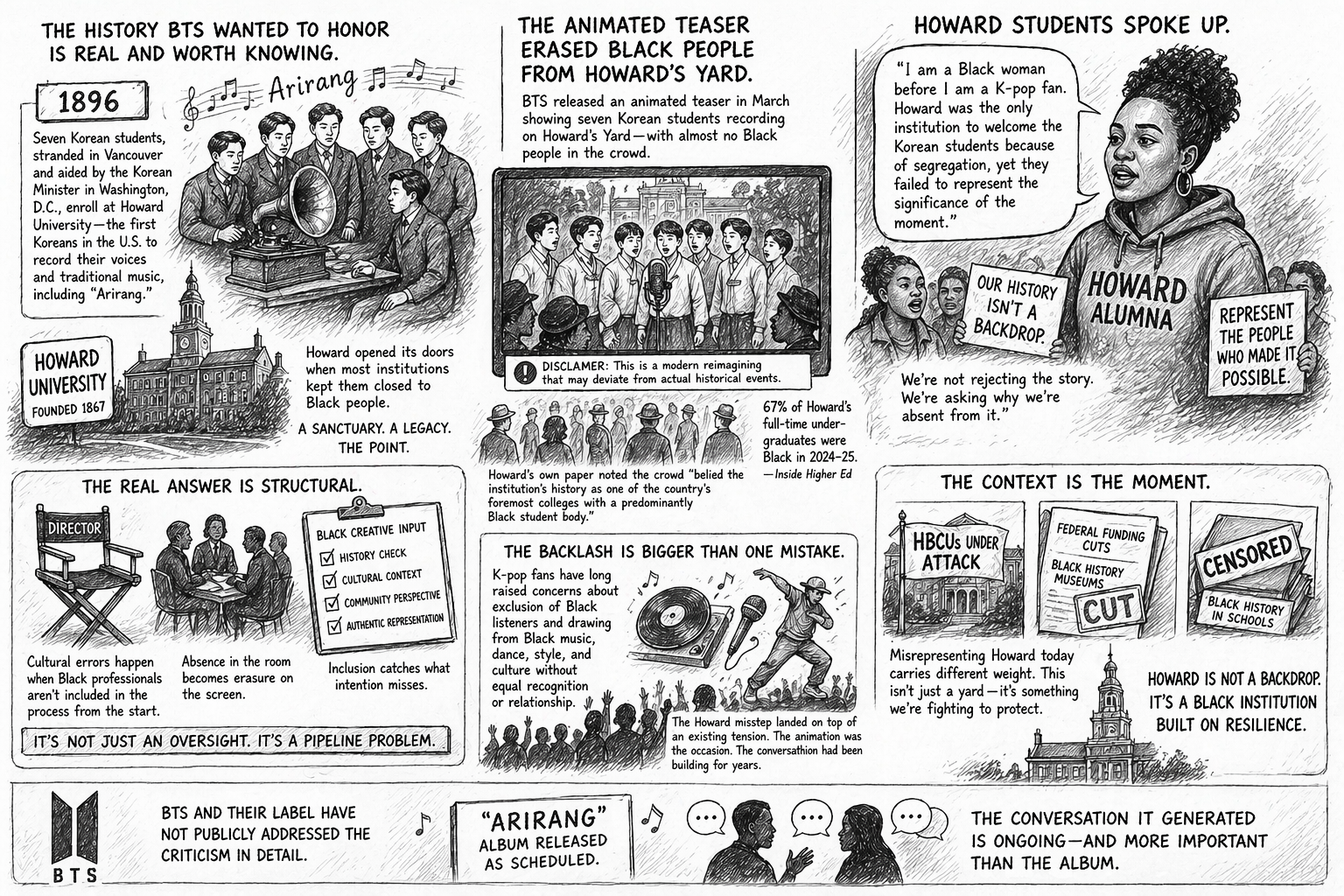
“I am a Black woman before I am a K-pop fan,” said one recent Howard alumna who had served as creative director of the university’s K-pop dance team. “Howard was the only institution to welcome the Korean students because of segregation, yet they failed to represent the significance of the moment.” Howard students were not rejecting the story BTS wanted to tell. They were asking why their own community was absent from it.
The immediate answer — that it was an oversight, an animation decision, not an intent — is probably true. It is also insufficient. Cultural errors like misrepresenting Howard as a predominantly white institution are more likely when Black professionals are not meaningfully involved in content creation or invited to offer input on Black-related projects that non-Black colleagues produce. The absence is structural before it is individual. BTS did not set out to erase Howard’s Black identity. A production pipeline that included Black creative input would have caught it before release.
But the backlash extended beyond the animation. K-pop fans noted how the fandom often excludes Black listeners from the community itself — particularly given ongoing critiques of K-pop artists drawing from historically Black music, including R&B aesthetics, hip-hop lyrics, dance styles, and music video conventions, without equivalent acknowledgment of or relationship to the community that created those forms. The Howard misstep landed on top of that existing tension. The animation was the occasion. The conversation it opened had been building for years.
That conversation matters because it is not really about BTS. It is about a pattern in which Black cultural spaces — HBCUs, Black musical traditions, Black aesthetic frameworks — get used as settings, sources, and inspiration by artists and industries that do not maintain reciprocal relationships with the communities those spaces belong to. Howard is not a backdrop. It is an institution that exists because of a specific history of Black educational exclusion and Black institutional resilience. When it appears in an animated video without the people who make it what it is, the history is being borrowed without the context that gives it meaning.
Howard students also pointed to the broader moment: HBCUs under political pressure, federal funding for museums of African American history being cut, Black history being restricted in school curricula. The mischaracterization of Howard by one of the world’s biggest cultural acts carries different weight in that context than it might have five years ago. The yard is not just a yard. It represents something the community is actively fighting to protect.
BTS and their label have not publicly responded to the criticism in detail. The Arirang album released as scheduled. The conversation it generated is ongoing — and more important than the album.
Culture in Motion | Structural Reality