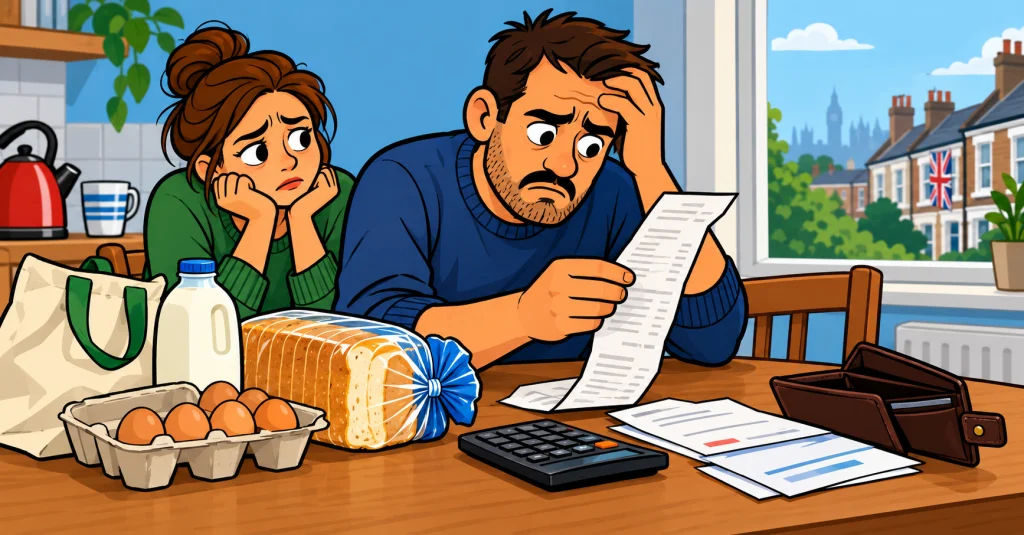
A household does not need an economist to tell it when money is getting tighter. The calculation happens at the supermarket, when a planned purchase goes back on the shelf, or at home, when a family postpones replacing an appliance because next month’s bills feel less predictable. Across Britain, those private calculations are adding up to a sharp deterioration in consumer confidence, raising concerns about how much additional economic pressure households can absorb.
The United Kingdom’s closely watched GfK Consumer Confidence Index fell 11 points in October to minus 24, according to new figures released October 23. The drop was the largest monthly decline since the beginning of the COVID-19 pandemic in April 2020. Outside that extraordinary period, the last comparable fall followed Britain’s 2016 Brexit referendum. The index had stood at minus 13 in September, when sentiment reached its highest level in more than two years.
Every major component of the October survey weakened, suggesting that the deterioration extends beyond one concern. Consumers became more pessimistic about their own finances, the broader economy and whether now is a good time to make substantial purchases. The measure tracking willingness to make major purchases fell 14 points to minus 22, reaching its lowest level in more than two years. Expectations for the general economy over the coming year declined 14 points to minus 36.
The results reflect a renewed squeeze on household budgets as the conflict in the Middle East drives higher energy costs and adds pressure to inflation. Britain is particularly sensitive to changes in fuel and energy prices because they affect household utilities, transportation and business operating expenses. When those costs rise, consumers have less money available for discretionary spending, while companies may face higher expenses that eventually appear in retail prices.
The survey does not mean that every British household is experiencing the same financial conditions. Some families have savings, secure employment and sufficient income to absorb temporary price increases. Others are already balancing essential expenses against one another. Consumer-confidence surveys measure attitudes rather than individual bank balances, but a broad deterioration can indicate that more people are preparing for difficult financial decisions.
That change in expectations matters because consumer behavior can reinforce an economic slowdown. When households postpone furniture purchases, reduce restaurant visits or delay other discretionary expenses, businesses receive less revenue. Retailers may respond by reducing orders, limiting expansion or adjusting staffing. Those decisions can affect workers’ earnings and job opportunities, creating additional pressure on household confidence.
The timing is especially difficult for Britain’s government. The results arrive ahead of a budget in which Chancellor John Healey faces competing demands to support households, maintain essential services and protect the public finances. Reuters reported that the decline was worse than economists had anticipated, with concerns about inflation, energy prices and the broader economic outlook influencing sentiment.
The Bank of England faces its own challenge. Rising inflation can create pressure for higher interest rates, but borrowing costs affect mortgages, consumer credit and business investment. Raising rates may help restrain inflation while making some financial obligations more expensive. Holding them steady can provide relief to borrowers but does not automatically resolve the underlying increase in household expenses.
The October confidence figures also arrive alongside evidence that consumer caution is affecting actual spending. British retail sales fell 0.4% in September, according to new official figures reported in the financial press. A single month’s decline does not establish a sustained downturn, but the combination of weaker sales and deteriorating expectations suggests consumers are becoming more selective about where their money goes.
Businesses will be watching the final months of the year closely. The autumn and holiday shopping period is important for many retailers, hospitality operators and consumer-facing companies. If households decide to reduce spending or trade down to less expensive products, businesses may have to compete more aggressively on prices and promotions. Companies with limited financial flexibility could be especially exposed.
There is also a difference between consumers who cannot afford to spend and those who choose not to because they are worried about what comes next. Both can reduce demand, but they represent different economic conditions. The first reflects immediate financial strain. The second reflects uncertainty about future employment, inflation, taxes and household obligations. October’s survey suggests that apprehension about the future is becoming an increasingly important part of the economic picture.
Britain’s consumer-confidence index is not a prediction of recession, and it does not establish how much spending will decline in the months ahead. It does, however, reveal a substantial change in how households are assessing their financial circumstances.
For consumers, the response may begin quietly: fewer nonessential purchases, delayed plans and more money held back as a precaution. For the broader economy, millions of those decisions can eventually become visible in retail performance, hiring plans and economic growth. The next test for Britain’s policymakers is whether they can ease the underlying pressures before caution turns into a more sustained pullback in household spending.