
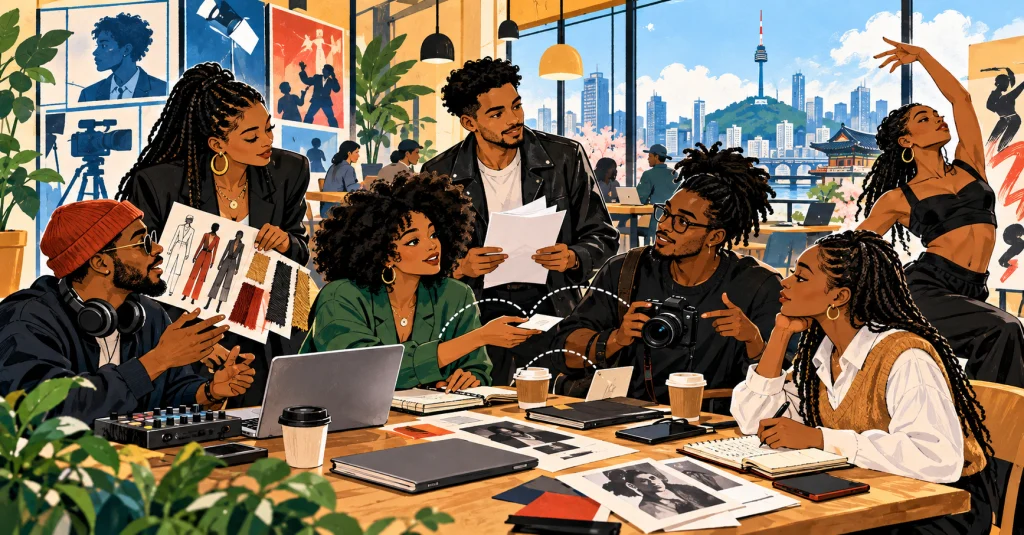
About 25 Black actors, models, writers, musicians, photographers, designers and dancers met in Seoul this month to form a professional network of their own. Their challenge isn’t visibility. It’s getting from being seen to being cast, hired and taken seriously.
On Sept. 20, about 25 Black creatives filled a café in Mapo-gu, in western Seoul, for the first meeting of Black Seoul Creatives, according to The Korea Herald. They included actors, writers, models, music producers, photographers, designers and dancers. The group was organized by Marie Noel, a German-Austrian filmmaker who founded a similar collective in Vienna in 2014. It came together around a problem most of the attendees knew well: building a creative career in a country where Black culture is highly visible, but Black professionals often work alone.
That contrast is hard to miss. Hip-hop and R&B are woven into K-pop’s sound, and Black American dance, fashion and slang shape much of what Korean pop culture exports to the world. Korean media has also grown more diverse, which Noel said is part of what draws people to pursue creative careers there. But the influence of Black culture hasn’t translated into a professional infrastructure for Black people working in it. There are few agents who know how to represent them, few casting directors who picture them outside a narrow set of roles and few established peers to learn from. The meeting in Mapo-gu was an attempt to build that infrastructure from the ground up.
Visible on Screen, Narrow in the Script
The people in the room described the same ceiling from different directions. Terris Brown, an American actor who appeared in Netflix’s So Not Worth It, told The Korea Herald that Black actors are often offered parts like “soldier number three” and feel pressure to play the comic relief. That’s the difference between being cast and being given a character. Jonathan Yiombi, a Korean-Congolese entertainer, had already made a YouTube video bringing together 12 Black entertainers working in Korea. Its tongue-in-cheek title, “The first Korean Black Association,” poked fun at Korea’s fondness for formal organizations while pointing to how rarely Black performers there had organized at all.
Language came up as the deciding factor more than once. Brigitte Ciss, a French model and YouTube creator known as Bibi, described her career as falling into two eras: before she spoke Korean and after. Fluency changed which rooms she could enter and how people treated her once she was inside. Paul Pryce, a Yale-trained actor and director, offered newcomers advice that turned the usual question around. Rather than waiting to be offered opportunities, he said, they should ask what they can add to Korea.
Why a Network Matters
The group’s value isn’t only emotional support, though that matters for creatives who may be the only Black person on a set. Networks are how creative industries actually work. They’re how actors hear about auditions before the role is filled, how photographers find clients, how writers learn which producers will take a meeting and how everyone learns what fair pay looks like. Without one, each Black creative in Seoul has to discover those rules alone, often in a second language, and negotiate from a position of isolation. A shared network turns individual experience into shared knowledge, and it gives the community a collective presence that casting offices and agencies can find.
It also comes as Korea’s population is changing. As of November 2024, 2.72 million people with migration backgrounds lived in South Korea, 5.2 percent of the population. That includes foreign nationals, naturalized citizens and Korean-born children of immigrants. Jeong Hoi-ok, a political science professor at Myongji University, told The Korea Herald that greater visibility for groups like this can help reduce prejudice and give multicultural young people role models they can see themselves in. For Korean-born children with African or Black heritage, like Yiombi, that visibility isn’t about living abroad. It’s about being recognized as part of the country they grew up in.
From Influence to Ownership
The story has a familiar shape. Across the world, Black culture often travels farther than Black people can, and its sound, style and energy become part of other industries while the creators behind it remain on the edges. SSC has tracked that pattern at home, from who owns a trend after it leaves the community to how Black cultural credibility moves faster than ownership. What makes Black Seoul Creatives notable is that its members aren’t asking anyone for permission. They’re building the professional network themselves, one meeting at a time.
The first gathering didn’t produce a formal plan, and the group’s next steps are still taking shape. But its premise is clear. Being visible in a culture isn’t the same as having a place in its industry, and the difference is often a network. In Seoul, about 25 people decided to start building one.
Sources: Park Ga-young, “Black creatives in Korea gather to build community,” The Korea Herald, Sept. 29, 2026.