
As the European Union prepares for a rapid expansion of data center capacity, an investigation by The Guardian found that major tech companies — including Microsoft — successfully lobbied to limit public access to facility-level data on energy use and emissions. Instead of site-specific reporting, most data will remain aggregated at the national level, obscuring the specific environmental impact of individual facilities in the communities that host them. The outcome is a reporting structure that is technically present and practically limited — designed to satisfy the appearance of accountability while protecting the information that would make accountability meaningful.
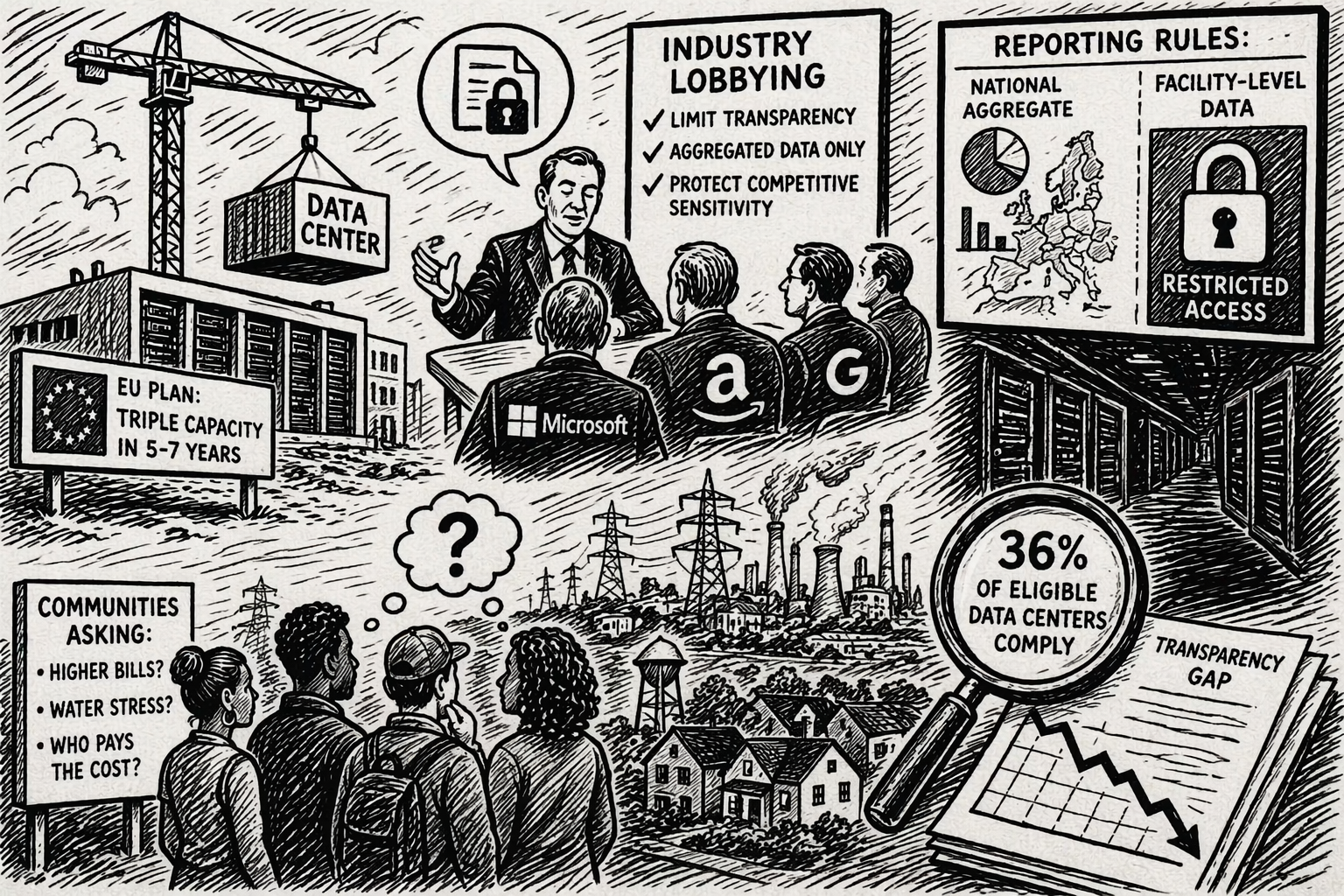
The scale of the expansion makes the transparency gap consequential rather than abstract. The EU aims to triple its data center capacity within the next five to seven years, driven primarily by demand for artificial intelligence and cloud computing infrastructure. Only about 36 percent of eligible data centers are currently complying with existing reporting requirements — meaning the baseline accountability is already incomplete before the expansion begins. The combination of rapid growth and limited transparency creates a gap between what is being built and what can be evaluated, assessed, or contested by the communities, policymakers, and regulators who are supposed to provide oversight. When the infrastructure grows faster than the visibility into its impact, the ability to course-correct shrinks in proportion.
The local dimension of what gets obscured at the national aggregate level is where the equity argument lives. Data centers are not neutral infrastructure. They require substantial electricity and water — resources that are not infinitely available and whose diversion to large-scale tech facilities can raise energy prices, strain water systems, and alter the resource landscape of the communities where facilities are sited. National-level reporting can show overall trends in energy consumption and emissions while completely hiding which communities are absorbing disproportionate infrastructure costs. The lobbying effort to maintain aggregated rather than facility-level reporting is a lobbying effort to make that distributional question unanswerable — to ensure that the people most affected by a specific data center cannot access the data that would allow them to quantify, challenge, or negotiate around its impact.
The pattern is not new, even if the technology producing it is. From manufacturing to fossil fuel extraction, periods of rapid industrial growth have consistently outpaced regulatory frameworks, with oversight struggling to keep pace until the costs of under-regulation became impossible to ignore. The data center expansion appears to be following that trajectory — infrastructure scaling at the speed of capital while accountability frameworks are shaped by the companies whose behavior they are supposed to govern. The AI narrative compounds this by framing the technology as a solution to inefficiency and environmental complexity while the infrastructure supporting it introduces new resource pressures that the technology’s benefits do not offset. The benefits of AI are concentrated in the companies deploying it and the consumers accessing it. The infrastructure costs are distributed across the energy grids and water systems of the communities hosting facilities that most residents had no meaningful role in approving.
What this moment clarifies is that the future of AI will not be defined solely by what the technology can do. It will be defined by how its infrastructure is governed — and by who has the information necessary to participate in that governance. When growth is paired with deliberately limited transparency, the ability to evaluate consequences becomes constrained not by the absence of harm but by the absence of data. That is not a regulatory failure. It is a regulatory outcome, shaped by the same companies whose expansion it is supposed to oversee.