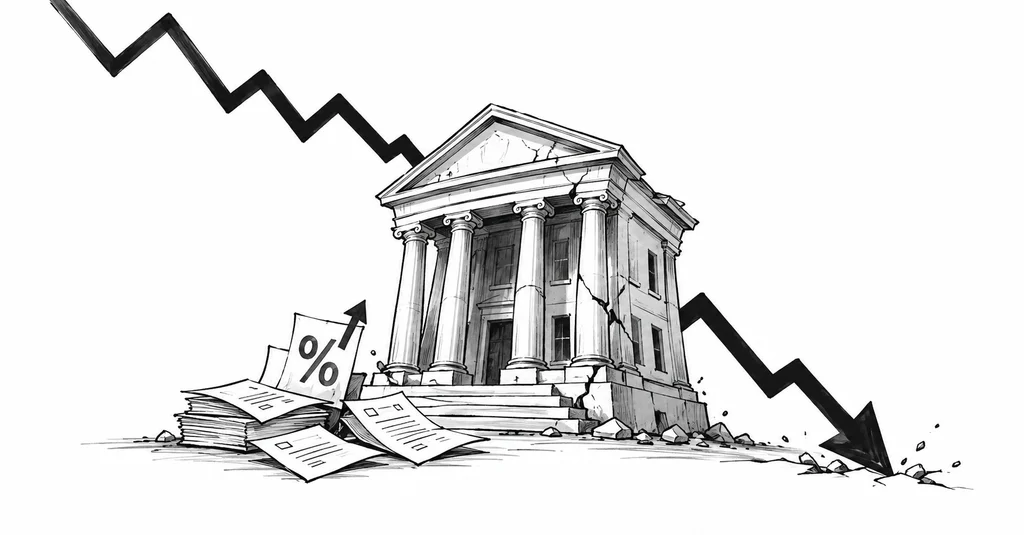
The S&P 500 is sitting near a record while the country’s biggest banks have shed roughly $270 billion in market value since summer. Their third-quarter reports will show whether higher rates are squeezing only bank stocks, or the people who borrow from them.
The stock market is hovering near record highs, and bank stocks are heading the other way. The KBW Nasdaq Bank Index is down more than 14% from its August peak, Yahoo Finance reported Monday, and over the past month Bank of America has fallen 13%, Goldman Sachs 12%, Morgan Stanley 11%, Wells Fargo 7%, Citigroup 6.5% and JPMorgan Chase 6%. By one estimate from BigGo Finance, the five largest U.S. banks have lost about $270 billion in combined market value since their summer highs.
The pressure starts with interest rates. The Federal Reserve raised its benchmark rate on Sept. 16 for the first time since 2023, a quarter-point increase to a range of 3.75% to 4%, according to Trading Economics, and officials including Gov. Christopher Waller have signaled that stubborn inflation may require more. The 10-year Treasury yield has climbed to about 5.24%, a multidecade high, after jumping roughly half a percentage point in September alone. For banks, that combination raises what they pay depositors and lenders, slows the deals and IPOs that generate investment banking fees and raises the odds that more borrowers fall behind.
On paper, profits still look healthy. Analysts expect third-quarter earnings at the largest banks to rise by as much as 20% from a year ago, StocksToday reported, with LSEG projecting JPMorgan earnings of $5.94 a share, up from $5.07. Some on Wall Street see the sell-off as a buying opportunity, including RBC Capital Markets analyst Gerard Cassidy, who said the fundamentals remain strong while warning that further Fed hikes would put credit costs at the center of investors’ attention, StockTwits reported. The gap between solid expected profits and falling share prices is the story, because it means investors are betting on trouble the banks have not yet reported.
JPMorgan, Goldman Sachs, Citigroup and Wells Fargo report on Tuesday, followed by Bank of America and Morgan Stanley on Wednesday. The figure that matters most for households is not earnings per share but how much each bank sets aside for loans it expects to go bad, along with what executives say about late payments on credit cards and auto loans. Rising loss provisions would signal that higher rates are reaching the people carrying the debt, not just the banks’ stock charts.
Higher rates split households in two. Savers with cash in high-yield accounts are earning more, while anyone carrying a credit card balance, a car loan or other variable-rate debt is paying more every month. The families with the thinnest cushion feel the borrowing side first, which is why the loan-loss numbers will say more about the economy most people live in than any headline profit figure.
Bank stocks are pricing in a harder road before the banks themselves have described one. Tuesday’s reports will show whether that fear is running ahead of the facts, or whether the strain is already showing up in the loan books.
Sources: Yahoo Finance; BigGo Finance; Trading Economics; StocksToday (LSEG estimates); StockTwits via Yahoo Finance