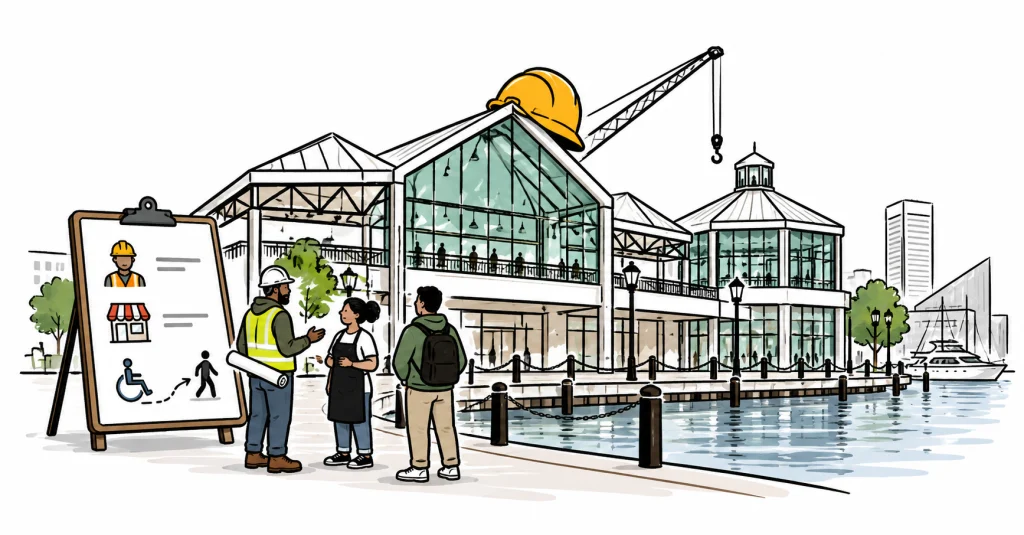
The waterfront’s future should include clear protections for workers, small businesses and public access throughout construction.
Baltimore welcomed more than 28.7 million visitors in 2025, generating more than $4.3 billion for the city’s economy, according to Visit Baltimore. Those numbers help explain why Harborplace’s future deserves attention beyond architectural renderings. Tourism means hotel shifts, restaurant tips, retail sales and transportation income. A waterfront redevelopment can promise a stronger destination while still creating uncertainty for people whose household budgets depend on business happening today. Baltimore should measure this project by how it handles both responsibilities.
DonnaAnn Ward, a Baltimore tour guide and owner of Beautiful Baltimore Tours, puts Black employment at the center of her October 5 guest commentary questioning Harborplace’s demolition. Her concern deserves serious consideration. Her calculations require more caution. The suggestion that 1,250 Black hotel workers could lose their jobs comes from assumptions about staffing, racial demographics and hypothetical layoffs. It is not an established employment forecast. A stronger public discussion would begin with an actual count of workers and businesses exposed to construction disruption, then identify what support each group needs.
Workers Need More Than a Finished Rendering
The redevelopment’s schedule already illustrates the difficulty of planning around a moving target. Baltimore Fishbowl reported in September that tenants had been told the pavilions would remain open through the New Year’s holiday, after earlier expectations of closure following July 4 and Labor Day. More than a dozen tenants were still operating. The reporting also described Creatively Black Baltimore’s planned transition to the World Trade Center and the additional time its organizers gained to exhibit Black artists’ work at Harborplace. That is a concrete example of how transition time can preserve opportunity.
For a small business, uncertainty can affect inventory purchases, staffing and the decision to sign another lease. For an employee, fewer customers can mean fewer hours before anyone announces a layoff. My view is that Baltimore and MCB should publish a practical transition plan alongside construction milestones: notice periods, relocation assistance, customer-access arrangements and a clear process for seeking help. Where public money supports infrastructure, residents should be able to see which protections accompany that investment. These would be commitments people can evaluate while the work is happening.
Access and Accountability Belong in the Plan
Ward’s traffic concerns also deserve scrutiny, although changing roads does not establish that hotels will fail or stadium attendance will collapse. MCB’s current project FAQ anticipates roadway work before the end of 2026 and closure of the Calvert Street spur after traffic reorientation in early 2027. It says Light Street will become two-way between Conway and Baltimore streets, with bicycle and pedestrian facilities relocated and kept open during construction. MCB also says Baltimore’s transportation department approved plans based on a traffic study. These are the developer’s stated arrangements; their performance should be monitored publicly.
That monitoring should include the experience of people arriving for early shifts, traveling by bus, making deliveries and navigating the waterfront with disabilities. MCB’s contractor registration page expresses a commitment to local businesses and employment opportunities for city residents. Baltimore should ask for measurable results: contracts awarded, residents hired, wages paid and businesses successfully relocated. Harborplace can evolve while honoring the people who helped make the Inner Harbor economically valuable. Doing so requires treating their livelihoods as part of the redevelopment budget and schedule, with progress reported as consistently as construction itself.