
The narrative around artists leaving or repositioning themselves relative to streaming platforms has largely been framed around payouts. The oft-cited figure — that Spotify pays between $0.003 and $0.005 per stream — has become the standard shorthand for what many artists, particularly independent and mid-tier acts, describe as structural exploitation. But what is unfolding beneath that conversation is a deeper and more consequential recalibration: a growing effort among artists to reclaim not just revenue, but the pathway between creation and audience.
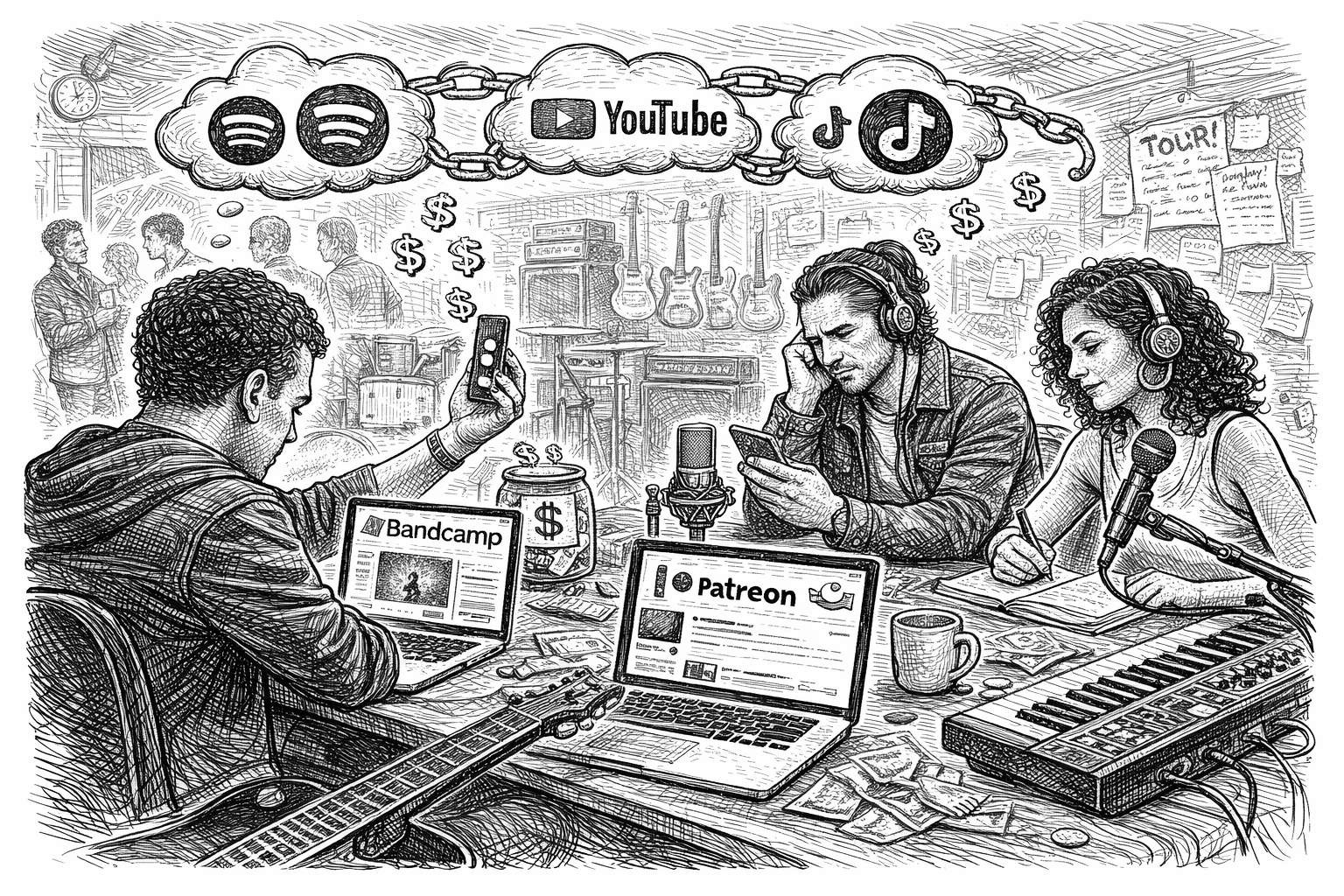
A meaningful number of independent and mid-tier artists are now experimenting with release windows that delay streaming availability, direct-to-fan platforms like Bandcamp and Patreon, and limited distribution strategies that treat exclusivity as leverage rather than liability. The logic is simple but significant: an artist who controls where and when their music is available is not just managing royalties. They are managing a relationship. The difference matters enormously in an era when platform dependency has quietly become the default operating structure of the music industry.
This shift comes as the streaming market matures past its explosive early growth phase. According to MIDiA Research, over 70% of streams now originate from algorithmic or editorial playlists — meaning that discovery itself is no longer primarily organic. Listeners are not browsing. They are being served. And the entities doing the serving are not the artists, not the labels, and not the listeners. They are the platforms. That concentration has consequences that go beyond royalty rates. When algorithmic placement determines visibility, artists are not just competing for ears. They are competing for positioning within systems they cannot audit, adjust, or appeal. An artist can release the strongest record of their career and watch it disappear because a recommendation engine didn’t surface it.
The financial stakes attached to that structural position are stark. A 2025 industry survey found that 77.8 percent of independent artists earned less than $15,000 from their music in the prior year, and financial strain — not lack of exposure — has become the number one cited career roadblock, named by 64 percent of respondents. Distribution has opened. The money has not followed at the same pace. Streaming revenue remains structured around scale, with payout rates that reward catalog volume and algorithmic placement over the kind of viral moment that can make an independent artist briefly famous without making them financially sustainable. The economics of that gap — and what artists are doing to navigate it — are the subject of SSC’s forthcoming reporting on independent music careers in the current landscape.
What is being reframed in this moment is the very definition of independence. For decades, independent meant owning your masters, avoiding major label contracts, and retaining creative control. Those things remain important. But the architecture of streaming has introduced a new layer of dependency — one that doesn’t require a contract to constrain you. Algorithmic infrastructure functions as a de facto label system. It shapes release strategy, touring visibility, sync opportunities, and long-term catalog value, all without a signature on paper.
As more artists step outside of default distribution models, the industry is being forced to reckon with a question it has avoided for most of the streaming era: whether scale without control is still a recognizable form of success. The short answer, increasingly, is no — at least not for the artists who built the cultural credibility that made these platforms worth using in the first place. The realization is arriving unevenly across the industry, but it is arriving.
SSC has covered the algorithmic dimension of this structural shift in Structural Reality — specifically how recommendation infrastructure concentrates visibility at the top of established catalogs while suppressing emerging and independent artists in ways that mirror broader patterns of economic gatekeeping. The streaming fight is not separate from that story. It is an extension of it.