
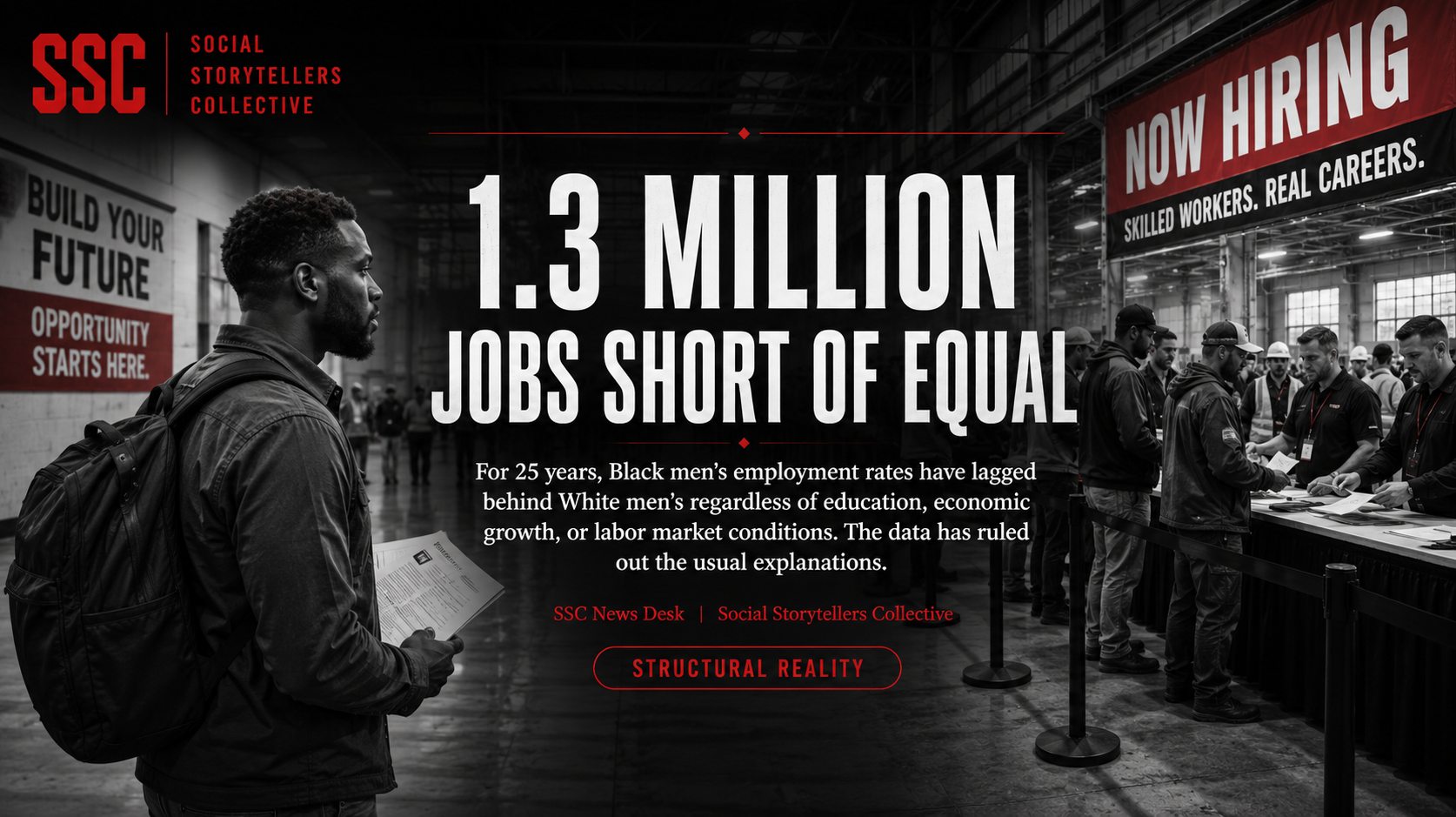
Based on “Understanding and Addressing the Extremely Low Employment Rate of Black Men” by Algernon Austin, Center for Economic and Policy Research, May 29, 2026
There is a number that American labor policy has spent decades refusing to say out loud.
For prime-age Black men — those between 25 and 54, in the years when employment should be most stable and most productive — the employment rate averaged 11.4 percentage points below the rate of White men every single year from 2000 to 2025. Not during recessions. Not during crises. Every year, across boom economies and contractions alike, the gap held. A new report from the Center for Economic and Policy Research, released today by researcher Algernon Austin, lays out both the scale of that gap and the systematic failure of every conventional explanation to account for it.
The conclusion the data forces is one that policy has long resisted: anti-Black discrimination is the primary driver. Not skills. Not culture. Not individual behavior. The system is doing exactly what it was built to do.
What the Numbers Actually Show
In 2025, nearly 90 percent of White, Hispanic, and Asian American men between 25 and 54 were employed. The rate for Black men in the same age group only approached 80 percent. That ten-point floor is not a blip. It has been the consistent reality for a quarter century, ranging from 7.4 percentage points below White men at its narrowest in 2024, to 15.5 points below at its widest in 2011.
The gap has a direct cost. In 2025, Black men ages 16 to 64 needed 1.3 million more jobs just to reach employment parity with White men. That deficit cost Black America roughly $65 billion in lost earnings in a single year — not over a decade, not in aggregate across generations. One year.
And those numbers are almost certainly an undercount. The state and federal incarceration rate for Black men is over five times the rate for White men, and incarcerated people are excluded from labor force calculations entirely. A 2021 analysis also found a 30 percent survey nonresponse rate for young Black men — and the men who don’t respond to government surveys are more likely to be jobless than those who do. The gap the data shows is the floor, not the ceiling.
Killing the Skills Argument
The standard explanation for why Black men are employed at lower rates tends to cluster around two claims: that Black men lack the hard skills employers need, or that they lack the soft skills — the interpersonal ease, the eye contact, the consumer-friendly affect — that get people hired and kept.
The CEPR report tests both arguments directly against the data. Both fail.
On hard skills, the report uses educational attainment as the most reliable available proxy. The results are instructive. Black men have higher educational attainment than Hispanic men. Hispanic men have a substantially higher employment rate — 86.7 percent compared to 77.6 percent for Black men from 2020 to 2024. White men have an even greater educational advantage over Hispanic men than they do over Black men, yet White and Hispanic men have essentially the same employment rate. Asian American men hold advanced degrees at more than twice the rate of White men and approaching six times the rate of Hispanic men — and their employment rate is only marginally higher than White and Hispanic men.
The pattern is clear: educational credentials explain wages. They do not explain why Black men’s employment rate is a low outlier.
The report goes further. When researchers look at jobs with the lowest hard-skill demands — positions filled by young men without high school diplomas, where credentials are essentially irrelevant — the Black-White employment gap does not shrink. It grows. Among young men without a high school diploma, the gap widens to 16.6 percentage points. If skills were the issue, removing the skills requirement should level the field. Instead it makes the disparity worse. That finding points directly away from skills as the explanation.
The soft-skills argument collapses with equal force. The report analyzes employment by occupational category ranked by soft-skill demands — jobs that require the most positive interaction with customers, coworkers, and supervisors versus those that require the least. If Black men’s low employment rate were driven by a deficit in interpersonal skills, they should perform better in low-soft-skill jobs and worse in high-soft-skill jobs.
The opposite is true. In occupational categories with the highest soft-skill demands — healthcare support, personal care — young Black men have a slight employment advantage over their White peers. In moderate soft-skill occupations, the rates are essentially equal. Where White men hold the sharpest employment advantage is in the occupational categories with the lowest soft-skill demands: construction, installation and maintenance, and production and manufacturing. In construction specifically, 10.6 percent of less-educated young White men work in the field. Only 2.5 percent of less-educated young Black men do.
These are not customer-facing positions. They are blue-collar jobs where showing up and doing physical work is what employers say they want. And they are precisely where Black men are shut out most severely.
What Discrimination Looks Like in Practice
When skills explanations fail, what remains is discrimination — and the research record on anti-Black hiring bias is both extensive and consistent.
Researchers have found that a majority of White adults hold anti-Black attitudes. White men have access to distinct and stronger social networks than Black men, and those networks drive hiring in ways that formal credentials cannot overcome. The occupational categories where White men hold the greatest employment advantage over Black men tend to earn above the overall median wage for less-educated workers. The one category where less-educated Black young men hold an advantage — office support — earns below the median. The labor market is not simply excluding Black men. It is excluding them most aggressively from the jobs that pay the most.
A computer repair training study cited in the report makes the structural mechanism visible. Black and Latino participants in the program achieved A+ certification at nearly identical rates — 53 percent and 54 percent respectively. After completing the training, Latino participants saw a meaningful increase in their employment rate relative to the Latino control group. Black participants saw no increase at all. The same credential, acquired at the same rate, produced different outcomes based on race. Hard skills did not move the needle for Black workers because the barrier was never about skills.
The Ripple Effect
The impact of Black male joblessness does not stop with Black men. A CEPR-commissioned survey of Black women found that the vast majority express serious concern about the high rate of joblessness among Black men — as mothers worried about their sons’ futures, as partners worried about economic stability, as community members who understand that employment and safety are connected.
The data on that last point is direct. Street crime concentrates in economically deprived communities. Summer jobs programs for youth have been found to reduce involvement in street crime. Subsidized employment programs reduce criminal recidivism. Research by John Laub and Robert Sampson found employment to be a significant factor in individuals ending criminal careers. The argument that Black male employment is a niche concern for a narrow constituency is not supported by the evidence. It is a community-wide and, by extension, a national issue.
What Structural Solutions Look Like
The CEPR report is explicit about what the data demands in response.
Affirmative action in hiring — not aspirationally but as active institutional practice — targeting qualified Black applicants for recruitment and genuine consideration. A national subsidized employment program directed at communities with chronically low employment rates. Investment in early childhood education, apprenticeships, and job training as longer-range infrastructure. The research on subsidized employment programs suggests they are fiscally defensible — the downstream gains in productivity, reduced poverty, and improved outcomes for children mean these programs pay for themselves over time.
These are not radical proposals. They are responses calibrated to a documented structural failure. What is actually radical is a quarter century of policy inaction in the face of a gap this consistent, this large, and this costly.
The Bottom Line
The employment gap for Black men is not explained by what Black men lack. It is explained by what the labor market does to them — consistently, measurably, across every education level, every sector, every economic condition for 25 years running.
In 2025: 1.3 million jobs. $65 billion in lost earnings. An 11.4 percentage point gap that education cannot close, soft skills cannot explain, and economic growth has not touched.
That is not a skills deficit. That is policy. And policy can be changed — if the people making it are finally willing to say what the data has been saying all along.