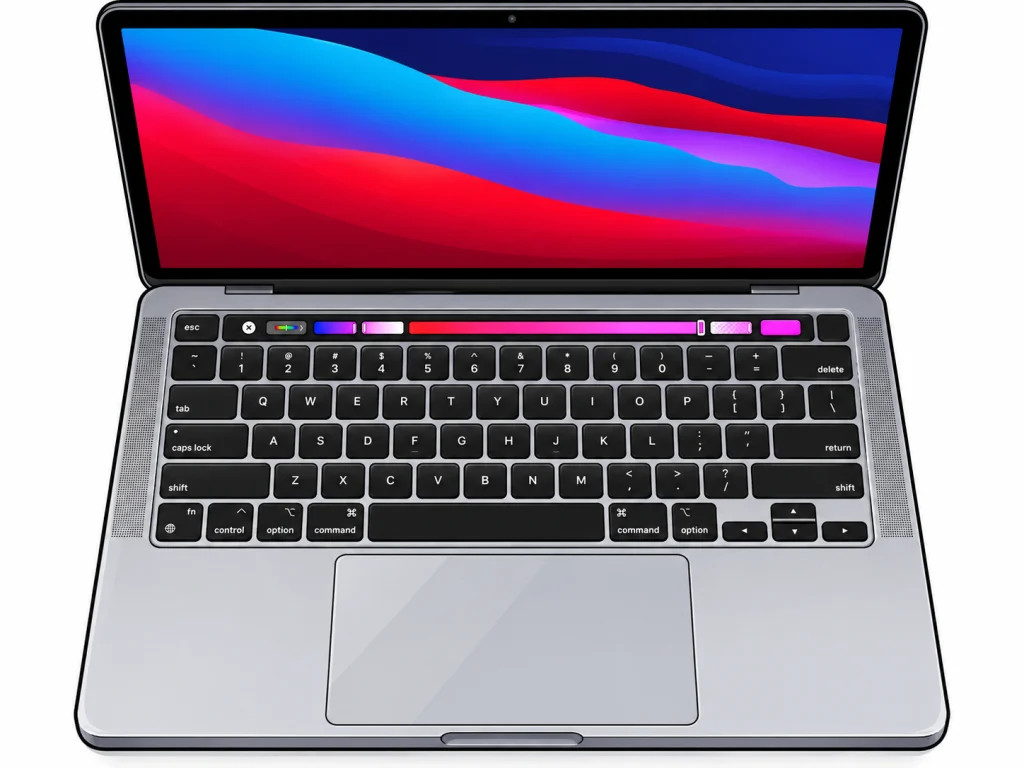
An October 28 product launch could introduce Apple’s first touchscreen MacBook Pro, challenging a design philosophy the company defended for years. The bigger story is how consumer expectations are reshaping what a computer should be.
For years, Apple maintained a clear boundary between its two most recognizable computing products. The iPad was designed for touching, swiping and interacting directly with a screen. The MacBook was built around a keyboard and trackpad, preserving a traditional laptop experience even as competing manufacturers embraced touchscreen displays. Apple argued that these were different devices serving different purposes. Now, after years of defending that separation, the company appears ready to reconsider.
Apple announced Monday that it will host a product launch experience in Los Angeles on October 28, using the phrase “Pro and tell” to tease its next announcements. According to Bloomberg’s reporting, the event is expected to introduce the company’s first touchscreen MacBook Pro, potentially alongside updated desktop computers and a redesigned iPad mini. Apple has confirmed the event but has not publicly confirmed the touchscreen laptop or its reported specifications.
If the reports prove accurate, the launch would represent more than another hardware upgrade. It would mark a significant change in how Apple thinks about the relationship between touch-based devices and traditional computers, and how willing the company is to reconsider long-standing design principles.
A Philosophy Apple Defended for Years
Apple’s resistance to touchscreen laptops dates back to the leadership of Steve Jobs, who publicly criticized the ergonomics of interacting with vertical touchscreens. At an October 2010 event, Jobs argued that repeatedly reaching toward an upright computer display would become physically uncomfortable over extended periods. The company’s position was straightforward: touch worked best on devices held in the hands or positioned closer to the body, while laptops were better served by keyboards, trackpads and mice.
Apple continued to defend variations of that philosophy long after Jobs’ death. Its executives maintained that the Mac and iPad offered different computing experiences, even as the iPad became more powerful and gained accessories that made it function increasingly like a laptop.
Meanwhile, the broader computer industry moved in another direction. Microsoft and numerous Windows manufacturers introduced touchscreen laptops, convertible notebooks and detachable computers, allowing customers to interact through touch, keyboards, digital pens and traditional pointing devices.
Those products demonstrated that some consumers valued the flexibility of multiple input methods. They did not establish that touchscreens were necessary for every laptop user, or that the approach was universally preferable.
Apple’s reluctance therefore remained defensible from a product-design standpoint. A conventional laptop can be highly effective without a touchscreen, particularly for people whose work depends on typing, editing documents, coding or navigating complex software.
But consumer expectations do not remain fixed. People who have spent years interacting with smartphones and tablets may increasingly expect direct touch capabilities across their devices, even when those devices serve different purposes.
What Apple Is Reportedly Preparing
According to Bloomberg, the anticipated touchscreen MacBook Pro would feature an OLED display, a lighter design and an interface incorporating Dynamic Island, a feature already familiar to iPhone users.
The touchscreen models are reportedly expected to retain the M5 Pro and M5 Max processors introduced earlier this year, while a separate entry-level MacBook Pro and a refreshed iMac may receive Apple’s newer M6 chip.
A redesigned iPad mini with OLED display technology is also expected.
These details remain unconfirmed until Apple formally introduces the products. Pricing, availability and the precise implementation of touch functionality could substantially influence how consumers respond.
What makes the rumored MacBook especially interesting is the possibility that Apple will introduce touch without abandoning the traditional laptop format. Rather than turning the MacBook into an iPad, the company could provide another method of interaction alongside the keyboard and trackpad.
That approach would allow Apple to preserve the Mac’s professional identity while acknowledging that customers may want greater flexibility in how they use it.
The Laptop Is No Longer Just a Laptop
The distinction between smartphones, tablets and computers has become less rigid as the devices have grown more capable.
Smartphones now support tasks once reserved for desktop computers, including video editing, document creation and sophisticated photography workflows. Tablets can function as portable workstations. Laptops increasingly incorporate features associated with mobile devices, including biometric authentication, high-resolution cameras and software ecosystems designed to work across multiple screens.
For consumers, these developments can create an expectation that devices should adapt to different tasks rather than require users to adapt to a single method of interaction.
A graphic designer might prefer a trackpad for precise editing but appreciate direct touch controls when navigating creative software. A student may use a keyboard for writing assignments while finding touch more convenient when reviewing presentations. A business professional might prefer traditional controls during extended work sessions but benefit from touch when quickly navigating information.
Those examples do not establish that a touchscreen MacBook would improve productivity in every setting. The benefits would depend on software support, interface design and how comfortably Apple integrates direct touch into macOS.
The challenge is not simply installing a touchscreen. It is ensuring that software originally designed around pointers and keyboards also works effectively when someone uses a finger.
Small menus, densely arranged controls and complicated navigation patterns can be frustrating on a touchscreen. Apple would need to demonstrate that touch is a meaningful addition to the Mac experience rather than an expensive feature that looks impressive during a product presentation but offers limited practical value.
A New Chapter Under Apple’s New Leadership
The timing also matters.
The October 28 event comes during a period of accelerated product announcements under CEO John Ternus, who succeeded Tim Cook in September. Apple recently introduced new smart-home devices and its foldable iPhone Duo, expanding the range of products competing for consumer attention.
According to Reuters, analysts have interpreted the faster announcement schedule as part of an effort to expand Apple’s hardware and artificial intelligence offerings.
It would be premature to attribute the touchscreen MacBook entirely to the new chief executive. Major hardware developments typically require years of research, engineering and supplier coordination, and reporting on Apple’s plans for a touchscreen MacBook predates the leadership transition.
Still, the product could become an early symbol of a company willing to revisit assumptions that helped define its previous era.
Apple has built much of its identity around the idea that thoughtful product design sometimes requires resisting features competitors embrace. That strategy has produced successful products, but it has also encouraged the perception that the company can be slow to adopt technologies customers already use elsewhere.
A touchscreen MacBook would complicate that narrative. It could demonstrate that maintaining a recognizable product identity does not necessarily require preserving every decision associated with it.
Innovation or Another Premium Upgrade?
There is also a financial consideration for consumers.
Apple’s MacBook Pro already occupies the premium segment of the laptop market. Adding OLED display technology and touchscreen capabilities could push prices higher, particularly if the new models are positioned above existing configurations.
That raises an important question about value. Is a touchscreen a meaningful improvement for professional users, or another feature that makes an already expensive computer more costly?
For consumers who rely heavily on keyboard-based workflows, the practical benefit may be limited. Others may find that direct touch reduces friction when navigating certain applications or performing creative tasks.
Apple will need to demonstrate that the feature improves how people work, rather than simply matching a capability Windows laptop buyers have had for years.
There is another potential consequence for Apple’s product lineup. A touchscreen MacBook could make the distinction between a MacBook and an iPad Pro harder for some customers to understand, particularly when both devices offer high-end displays, powerful processors and professional applications.
The company may ultimately welcome that overlap if it gives consumers more options. But it will also need to communicate why someone should choose one device over the other.
Sometimes Progress Means Reconsidering an Old Decision
Apple’s expected touchscreen MacBook launch is interesting precisely because the underlying technology is not new. Touchscreen laptops have existed for years. The anticipated innovation would be Apple’s decision to integrate that capability into a product category it previously kept separate from touch-based computing.
That makes the October 28 announcement a test of product philosophy as much as hardware engineering.
The company will have an opportunity to demonstrate whether its previous concerns about touchscreen ergonomics can be addressed through better design, more intuitive software and thoughtful integration.
It may also discover that many loyal MacBook users remain perfectly satisfied with keyboards and trackpads.
Either outcome would provide useful information about how people want to interact with their computers.
For a company frequently associated with defining the future of consumer technology, the next significant step may involve acknowledging that an idea it resisted for years deserves another look.
The touchscreen itself would not be revolutionary.
Apple changing its mind about where touch belongs could be the more consequential development.