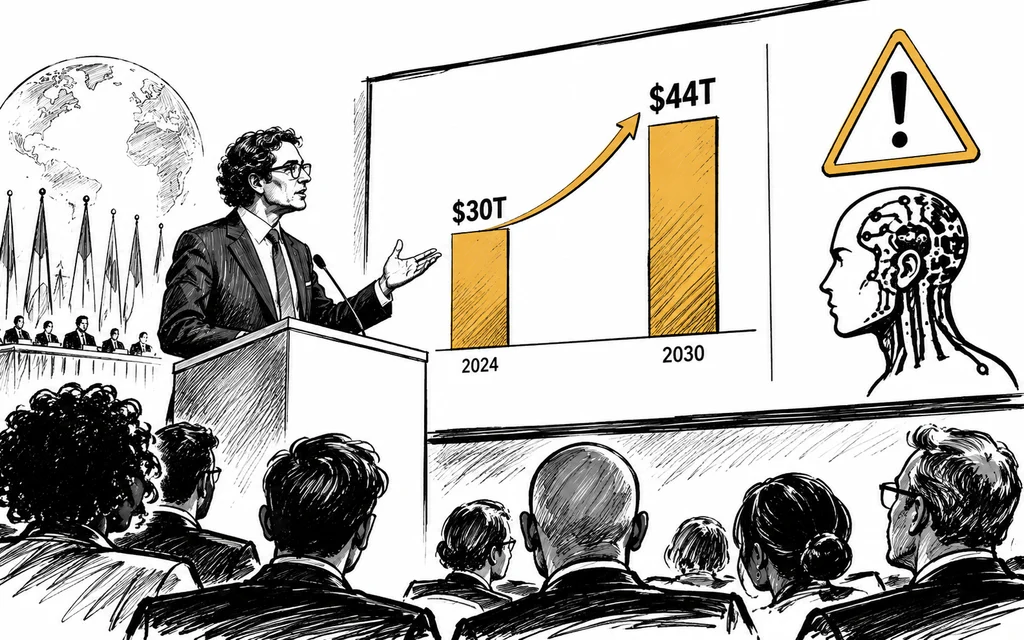
Jack Clark presented an extraordinary growth scenario to global policymakers while arguing that governments have only a few years to build meaningful safeguards.
Artificial intelligence could push U.S. economic output from just over $30 trillion to $44 trillion by 2030 under a set of aggressive assumptions modeled internally by Anthropic. Reuters reporter David Lawder reported Saturday that Anthropic co-founder Jack Clark presented the estimate at the IMF and World Bank annual meetings in Bangkok while also warning policymakers that their window to establish effective AI safeguards may be measured in years.
The pairing matters because the same capability that could produce extraordinary economic growth creates the risks Clark wants governments to address. Anthropic’s model assumes AI continues improving rapidly enough to accelerate scientific discovery, support new inventions and contribute to industries that do not yet exist. Clark acknowledged that the projection “sounds very outlandish,” while arguing that much faster scientific progress could make growth rates possible that conventional forecasts do not capture.
Economic output, however, does not determine who receives the income produced by that growth. AI can increase the amount an economy produces while simultaneously reducing demand for certain categories of labor. Clark acknowledged that displacement is already occurring in jobs with high AI exposure, including call centers and customer service, while scientific research may see employment increase as human researchers gain access to large numbers of AI assistants.
That creates a distribution problem before it creates a growth problem. If companies can produce more with fewer workers in some occupations, the productivity gain initially belongs to the company using the technology. Workers benefit only if those gains later return through higher wages, lower prices, new jobs or public policy. GDP can rise substantially without guaranteeing that the workers displaced during the transition receive a comparable share of the new wealth.
Anthropic also has a direct financial interest in the growth scenario it is describing. Reuters reported that the company is preparing for an initial public offering expected in November that could value it at as much as $2 trillion. That does not invalidate Clark’s argument, but it puts the projection inside a commercial reality: one of the companies building the technology is also asking governments and investors to believe that the market for it can become enormously larger.
The safety argument points in the opposite direction. Clark warned that AI capable of accelerating legitimate biological and cybersecurity research can also expand access to dangerous knowledge. He called for strict human oversight in biological research and told policymakers that the period in which humans can establish meaningful controls while retaining clear command over advanced systems is shrinking.
Governments therefore face two incentives that can collide. They want the investment, scientific capacity and economic growth AI companies promise, but aggressive development also increases the cost of waiting to establish rules. Countries that regulate slowly may attract more investment in the short term while inheriting larger labor, security and accountability problems later.
The next phase of AI policy will be shaped by whether governments treat growth and safeguards as separate debates. Anthropic’s own presentation suggests they cannot be separated. If AI approaches anything close to the economic scale Clark described, regulation will no longer be a constraint sitting outside the technology business. It will determine who captures the gains, which risks companies are permitted to create and how much of the cost is left for workers and governments to manage afterward.